

Before Hot Dogs Took Over, These Sandwiches Ruled Ballpark Concessions
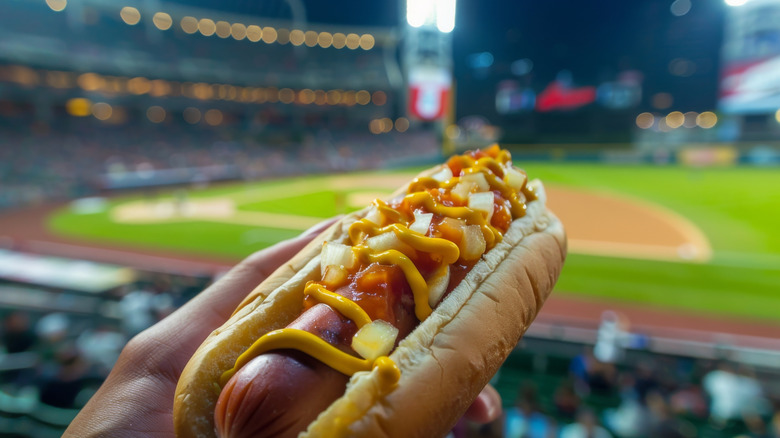
For many, it is impossible to separate watching a game of baseball in the stands from the hot dogs that accompany the experience, and with good reason — per the National Hot Dog and Sausage Council, the average baseball hot dog vendor will sell between 10,000 and 12,000 hot dogs per season. Yet this was not always the case — until the late 19th century, the predominant food sold at most baseball games was the ham and cheese sandwich.
In a 1924 New York Times article, Yankee Stadium vendor Harry Stevens explained that when he began serving baseball fans in 1894, ham and cheese sandwiches were the only food available (though other stadiums would also offer ice cream), and eating while watching the game was not particularly popular. Although German immigrants introduced hot dogs to the United States in the mid-19th century, this modern-day find at stadiums would not be introduced as ballpark fare until 1893, which some attribute to St. Louis bar owner Chris Von de Ahe (who also owned the St. Louis Browns baseball team).
It's possible the ham and cheese sandwich appealed to tastes or traditions already embedded in the cities where major baseball stadiums could be found, which had large and diverse immigrant populations. When the ham and cheese served as the chief baseball snack, France was also developing its love affair with the croque monsieur, the hot sandwich of ham and cheese sometimes slathered in béchamel sauce that would become a national emblem. The English had been enjoying ham and cheese sandwiches for a century before they became a mainstay in the U.S., while ham, cheese, and bread were all common parts of the German Abendbrot, the traditional cold supper dating back centuries.
Why the hot dog replaced the ham and cheese in ballparks
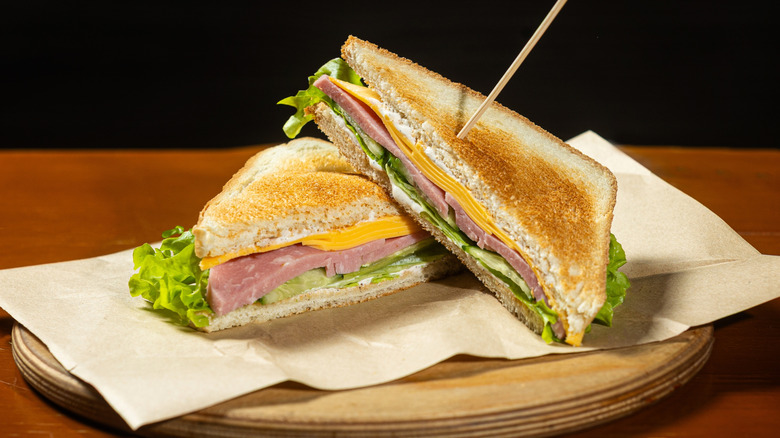
There were a number of reasons the hot dog would supplant the ham and cheese sandwich as baseball's go-to snack. From the vendor's perspective, the process of filling a split-top bun with a frankfurter was easier than assembling a sandwich. Hot dogs were also more convenient for customers, as they could be eaten while standing, sitting, or walking, plus they were hot, affordable, and filling. But it was Harry Stevens, the aforementioned Yankee Stadium vendor, who is credited with making the link between baseball and wieners inextricable. Recognizing their growing popularity, his self-founded company, Harry M. Stevens Inc., was soon supplying hot dogs to ballparks across America.
The popularity of hot dogs was not just restricted to fans. Babe Ruth — the Boston Red Sox, New York Yankees, and Boston Braves player legendary for both his incredible talent and his prodigious appetites – loved them so much that he once consumed 12 hot dogs between games during a doubleheader.
Today, there is a range of iconic hot dogs that can only be found at major league baseball stadiums, from Boston's famous Fenway Frank to Cincinnati's Skyline Chili Coney Dog, which comes generously topped with the unique (albeit notoriously divisive) clove and cinnamon-flavored Cincinnati chili. Although the popularity of hot dogs doesn't look like it will go away any time soon, baseball's culinary landscape is forever evolving. Case in point: In 2022, Kauffman Stadium, home of the Kansas City Royals, unveiled the BBQ Reese's Sandwich, an incongruous assemblage of pulled pork, Sweet Baby Ray's Barbecue Sauce, bacon bits, and crumbled Reese's Peanut Butter Cups. Despite becoming a viral sensation, this sandwich would prove too revolutionary for the ballpark and was eventually discontinued — sadly, there's no accounting for taste.