

Your Common, Everyday Strawberries Aren't As Simple As They Seem
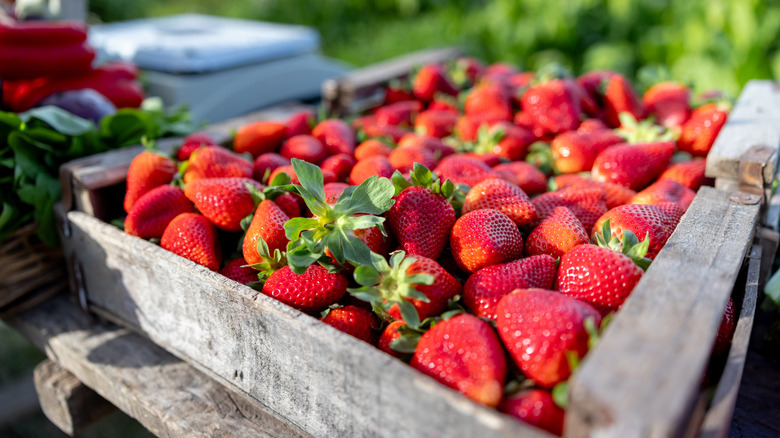
You may not realize it, but when you hold a strawberry you bought at the grocery store you are holding hundreds of years of scientific work in your hand. We like to think of fresh fruits and vegetables as something gifted to us by Mother Nature. Simple and pure food that we just plucked and replanted in neat little rows before the advent of GMOs with additives, and other evil modern food manipulated by big corporations. Yet basically everything we eat has been heavily altered from its original state, even before the rise of modern agribusiness. From the very beginning of agriculture crops were slowly crossbred and changed from their natural state to increase yields, and become more weather resilient. And the strawberries we eat today didn't really take shape until the late 18th century.
Wild strawberries had been observed and eaten since antiquity, but they were not particularly appealing as food. In Europe the original wild plants were called woodland strawberries, and while they were consumed during festivals or eaten for their supposed medicinal qualities, they were mostly grown as ornamental plants due to the fruit being tough and relatively flavorless. Instead it was wild strawberries found in the Americas that eventually became the basis for the fruit we eat today, but even that took time.
Modern commercial strawberries are a crossbreed of two previous varieties, Fragaria chiloensis from Chile, and Fragaria virginiana in Virginia. Each one had advantages over the European variety. The Chilean strawberry was much larger than the small wild European berries, but it also didn't taste great. The Virginia one however was much sweeter and tastier, and was better suited to growing in European climates.
Modern strawberries are carefully crossbread plants selected for their growing qualities
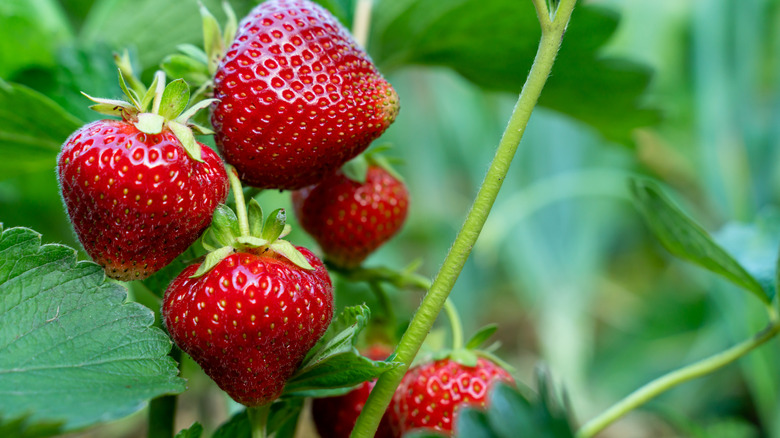
The beginnings of the modern strawberry came about in France in 1765, when a botanist combined plants the old-school way: by simply planting them together. The Chilean strawberry pollinated the Virginia one, giving birth to Fragaria ananassa, the species that is still used today. It was originally called the "pine strawberry," because its sweet flavor was more reminiscent of a pineapple than the strawberries of the time.
But that was just the beginning. The development of crops is continuous, and strawberry cultivars would be cross-bred with each other over and over to emphasize positive characteristics. This could mean for color, flavor, or hardiness against disease.
The first variety of strawberry bred in America was called "Hudson," and was developed in the 1780s. In 1851 another American variety named "Wilson," was born which did not need to be cross-pollinated to thrive, making strawberries easier to grow and turning them into a major commercial crop. The development of strawberries has gotten so complicated that modern versions have eight sets of chromosomes, compared to wild varieties with two, meaning four different species have eventually gone into the ones we eat. These day,
Of course all this cross-breeding and scientific work can have its downsides. As many people reading this may have noted, supermarket strawberries are often bland. Modern berries are usually selected for size, appearance, and durability at the expense of flavor. Large bright red strawberries are attractive to consumers, while toughness means they can be shipped more easily, which isn't exactly an incentive that aligns with our taste buds.