

$100 Worth Of Groceries In 1960 Would Cost 4 Figures In 2026
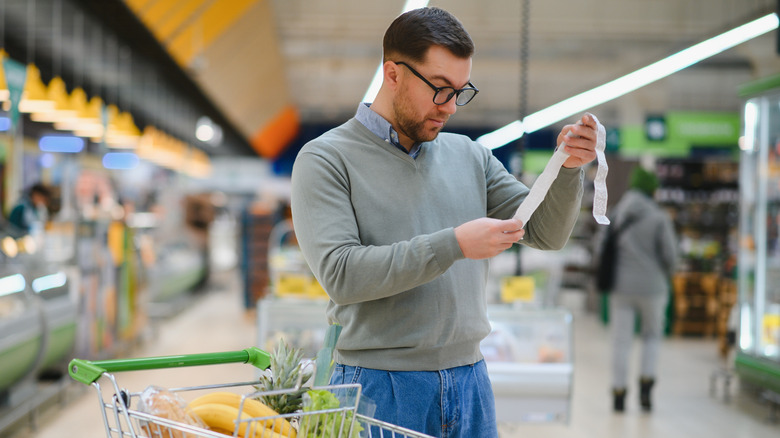
Even for people who understand that prices are always rising, seeing the cost of groceries in the 60s versus 2026 can be pretty shocking. We've all been exhausted by food inflation, with grocery prices increasing around 30% between early 2020 and 2025, and pantry staples are only getting pricier. While that shock was rough, it isn't an isolated phenomenon. Previous decades, like the 70s and 80s, also saw major spikes in food inflation, some even larger than the most recent increase. Even in more stable years, prices still tend to rise a little bit. Over time, you get some truly mind-blowing changes — $100 worth of groceries in 1960 would cost about $1,095 today.
This information comes from the American Institute for Economic Research cost of living calculator, which uses consumer price data gathered by the U.S. government's Bureau of Labor Statistics (BLS). That data is combined into a basket of commonly purchased goods to create an "Everyday Price Index" showing just how much the cost of goods like groceries has increased over the years.
That ten-fold increase in the cost of food may be alarming, but it's only part of the story. In 1960, the median family income was $5,620 per year, meaning half of Americans earned more and half earned less. In 2024, that same number was $105,800. That's nearly 19 times higher. So while food prices are far higher than in 1960, wages have actually outpaced them. And you can really see that when you look at how much American households spend on groceries.
Grocery prices have soared since 1960, but Americans spend less of their income on food
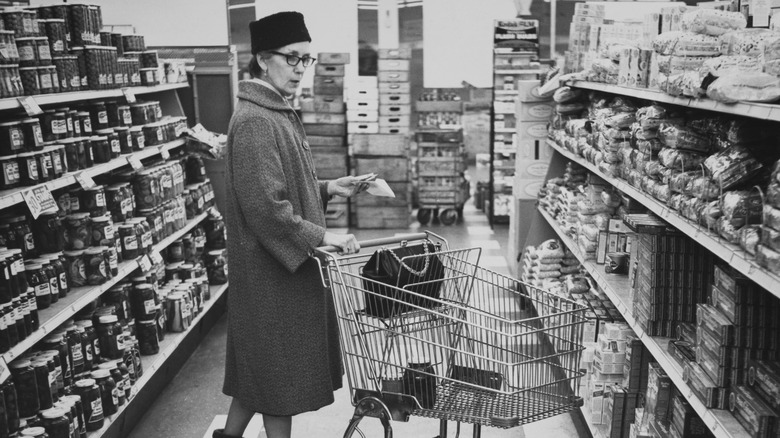
According to the U.S. Department of Agriculture (USDA), Americans spent an average of 11.3% of their disposable income on groceries in 2022, when recent food inflation was at its worst. While that's the most current data available, the fact that wages have outpaced inflation the past three years likely means that number is still relatively accurate. That's the highest it's been since the early '90s and is certainly painful for many Americans, but it was around 17% in 1960. Even in 1980, it was still above 13%.
The recent spike in food costs has actually been more driven by the increasing cost of going out to eat, not groceries. The USDA separates the overall spending number into food at home and away from home. In 2022, the number for food at home — aka groceries — was only 5.62% of income, compared to almost 14% in 1960.
It's easy to see the comparison in average prices, too. According to BLS data in 1960 (measured per pound), ground beef was 53 cents, whole chickens were 44 cents, white bread was 20 cents, and bananas were 16 cents. Today, the BLS data for those prices are $6.90 for ground beef, $2 for chicken, $1.87 for white bread, and 65 cents for bananas. Only beef, which has seen rising grocery store prices, has outpaced normal inflation, though compared to median wages, it's still cheaper than it was in 1960. If wages had increased at the same rate as they have since 1960, chicken would cost about $8 per pound, bread nearly $4, and bananas around $3.
Food inflation has been primarily driven by increasing wages
Over the short term, all kinds of things drive increases in food prices. The big spikes in egg prices in recent years were driven by bird flu, while global warming could be pushing up the cost of seafood through ecosystem disruption. But the big jumps we see in overall food prices over previous decades are mostly just normal inflation, which happens as incomes rise over time. Higher wages increase people's disposable income, which boosts demand for goods and, in turn, causes things like groceries to experience inflation. And as we've seen, most of those price increases since 1960 have actually not kept up with overall income.
It may be frustrating that higher wages don't go as far as we want, but this cycle has its upsides. Remember that your cost is someone else's income, whether it's grocery workers or the farmers growing what you eat. Grocery stores are very low-margin businesses, with profit margins of just 1–3%, so at least 97 cents of every dollar you spend goes toward costs like paying employees. And the government sees a small amount of inflation each year as a good thing, as it helps keep employment high, since falling prices can cause businesses to shed jobs and cut back on the spending that keeps the economy going. Social media posts showing grocery prices from past decades make for fun nostalgia and interesting time capsules, but they aren't easy one-to-one comparisons to today. And as tough as food inflation has made things in recent years, there were plenty of times in the past when it was worse.