

Barley Or Rice: What Budweiser Uses To Brew Beer
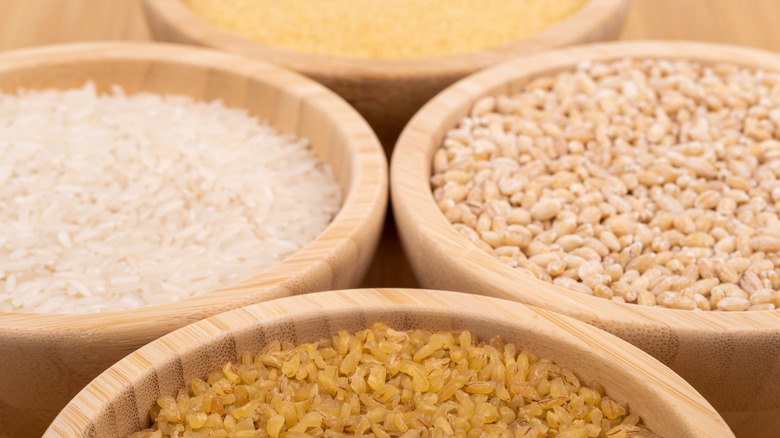
We've all heard of sake, Japan's rice wine (you can even make a 2-ingredient homemade rice wine yourself), but did you know that Budweiser also uses rice to brew its beers? As it turns out, there's an interesting reason behind that choice.
When Europeans brought beer to the New World in the 1600s, they were using barley-based beer-making techniques. They soon learned from Native Americans how to brew beer using corn instead, and it became their default because barley was scarce and expensive to import. The beers would be flavored with molasses, spruce, or sassafras. By the 19th century, German immigrants were making their mark on American beers using corn, which was abundant and cheap. It also didn't have the instability issues that beer made with American barley had. The American lager was born: A pale, crisp, easy-to-drink light beer.
Rice has always been a part of Anheuser-Busch's brewing process. Anheuser-Busch founder Adolphus Busch and his brewmaster Irwin Sprule developed their first Bohemian-style pilsner, St. Louis Lager, in the mid-1870s. A second, slightly more pale and more bubbly version followed, made for Busch's friend, Carl Conrad, a St. Louis restaurateur. The "Conrad Budweiser" was made with malt, a blend of European and American hops, and 23.5% rice, which they felt gave the beer a more refreshing taste. Budweiser grew to become one of the many beers owned by Anheuser-Busch.
Why does Budweiser use rice?
Founder Adolphus Busch was outspoken about his distaste for beers brewed with corn. Busch believed that corn, being a cheaper ingredient, made an inferior beer. Now, Anheuser-Busch claims to be the largest user of rice in the entire country.
To understand why Anheuser-Busch opted to use rice instead of another grain in its brewing process, it helps to know what grains are used for in beer-making. The grain you use changes the color, flavor, and aroma of the beer. Grains need to be malted (soaked in water), germinated, and then roasted to halt germination and dry out the grain. The drying temperature influences the grain's color (and therefore the beer). For instance, lower temps are used for pale-colored brews.
Next, the milled malt is combined with water and heated, causing the natural enzymes in the malt to dismantle starches and turn them to sugar, which later becomes alcohol in a process called mashing. While the barley used in European beer-making was the two-row variety, while the American version used six-row barley and had a higher percentage of protein. Anheuser-Busch determined rice to be an alternative that added fermentable sugars to the brew without giving it an unappealing amount of body from protein (which also made it more likely to spoil).
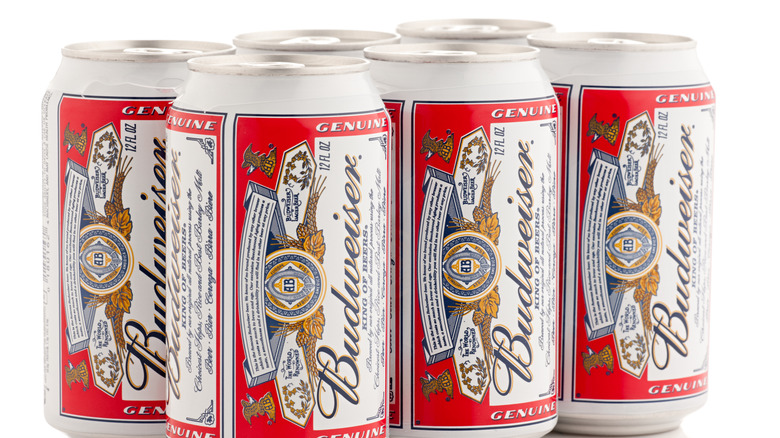
Strangely, the images on Budweiser's label don't reflect the rice used in the brewing process, but instead feature sheaths of barley and wheat: You'd never know that rice is one of Budweiser's main ingredients.