

California Vs Italian Olive Oil: What's The Difference?
We may receive a commission on purchases made from links.
The olive oil aisle has a way of making you feel like you're browsing a Mediterranean map. Spain, Turkey, and Italy supply most of the world's olive oil, which tracks — olive oil has always felt like an Old World staple, and Italian cuisine especially has built its identity around it. So when you run across California on those same shelves, it may be a bit startling. The Golden State handles most of the country's olive oil production, even if it rarely gets the same credit. What actually separates the two, and does the origin on the label change anything once the oil hits the pan?
First, let's talk geography. Where an olive tree grows — the soil under it, the altitude, the amount of sun it gets — all of it ends up in the oil. Italy is the easiest place to see this in action. In the north, in regions like Liguria, the oil is noticeably lighter, its flavor shaped in part by cooler, higher ground. Tuscan oils, meanwhile, tend toward the more intense end of the spectrum: bold, peppery, and herbal. Some Sicilian oils can run in a similar direction, but most are soft and buttery. The variety of olives used and how they're processed matters just as much as the sun and soil, so expect real variation within any region.
California's Mediterranean-like warmth and dryness mean that olives do quite well there. What sets California olive oil apart isn't so much the land as the process. Producers there move quickly, pressing olives within hours of harvest and getting oil to shelves in a fraction of the time Italian bottles typically take. The result tastes like it: fresh, bright, and a little peppery, with a fruitiness that hasn't had time to fade.
Where Italian and Californian olive oils really come from
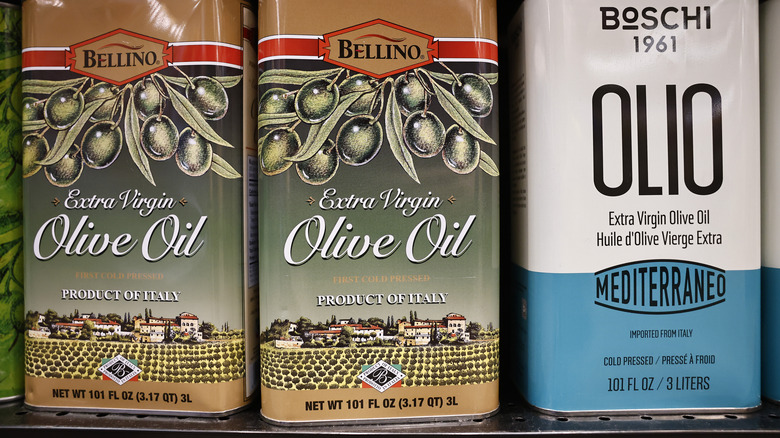
Walk the olive oil aisle and you'll find Italian bottles at almost every price. A 16.9-ounce Bertolli goes for under $9 at Walmart. A Sicilian Partanna Castelvetrano runs about $20. A Frescobaldi Laudemio from Tuscany can push $40. The country of origin is the same across all three, but what's inside is very often not. You see, "Italian" olive oil isn't always Italian. Blending oils from countries like Spain, Tunisia, or Greece and bottling them in Italy is common practice (see this Colavita EVOO as an example), and the label rarely makes that easy to spot.
That said, Italy does have a system in place to combat this. If you find a DOP (Denominazione di Origine Protetta) certification on an olive oil label, that means it has cleared regional standards set by the Italian government — the olives, the geography, and the process are all accounted for. You're still not guaranteed to love what's in the bottle, but it's a meaningful step above oils where the origin is anyone's guess, and these tend to sit at the higher end of the price range (for good reason).
On the California side, if the bottle features the California Olive Oil Council (COOC) seal, you're getting Californian olives. This trade association manages everything regarding Californian olive oil — and it actually requires producers to hit acidity benchmarks stricter than European Union standards. So most Californian olive oil is mid-range and up, and a solid everyday bottle of unfiltered extra virgin California Olive Oil from 365 by Whole Foods runs about $18. Not a bad place to start if you're still figuring out what you like.
When to cook with each kind of oil

Here's the thing: If you can, keep both olive oils in your kitchen. To be fair, there's no single flavor that defines all Italian oils or all California oils. Italy's olive oil industry dwarfs California's by almost every measure — scale, variety, history — which is part of why navigating it takes a little more effort. Still, both places produce oils with recognizable tendencies, and knowing what's what can nudge you toward better pairings depending on what you're cooking. A bolder Italian oil, like a Tuscan EVOO, belongs in dishes that can hold up to it. Stirred into a plate of spaghetti aglio e olio and Calabrian breadcrumbs, it brings an herbaceous depth that a lighter oil would flatten. Grilled meats and rich braises are another natural fit.
California oils, on the other hand, are often noted for their brightness and range. The fresh flavor and fruitiness make them a natural fit for salad dressings and vinaigrettes — raw applications where flavor has nowhere to hide and a dull oil shows immediately. They can handle everyday sautéing and roasting just as comfortably. And because the profile stays clean rather than assertive, they're one of the better picks for baking — add these olive oils to cheesecakes, savory quick breads, anywhere you want to have the richness of olive oil.
That said, no rule here is absolute. A touch of olive oil, no matter what kind, in soup or as the finishing touch to a roasted chicken, is better than none. So buy what tastes best to you, use it before it goes flat, and the origin debate will take care of itself.