

Here's What Happens When You Make Cold Brew In Milk
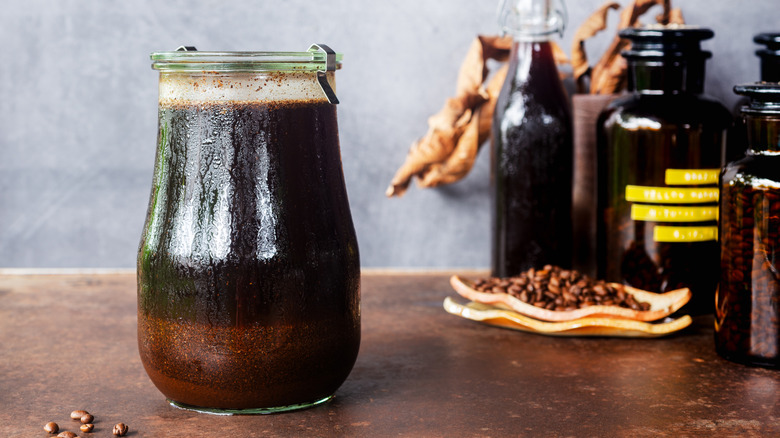
If you tend to order your cold brew "with room" for milk, this one's for you. Today, we're shining the spotlight on cold brew coffee made with milk instead of water — which is a real thing, and ideal for fans of cafe au laits and other milky, chilled sippers. To make cold brew, coarsely-ground coffee beans are soaked in cold or room-temperature water, steeped slowly for a prolonged period (roughly 12 hours or overnight), then strained. The result is a strong, highly-concentrated brew that is smooth without any bitterness. You can simply add milk to this drink, but let's see what happens if you replace water with milk in the first place.
Steeping those grounds in milk instead of water yields a fuller body and a smoother, silkier mouthfeel. The milk's subtle sweetness offsets the coffee's naturally bitter tones, softening and taming the brew for a more luscious profile. It's roughly the flavor and texture equivalent of ordering an iced latte versus an iced Americano. The former's addition of milk delivers a fuller body and toned-down coffee flavor, while the latter arrives thinner, stronger, and more coffee-forward. The same is true of cold brew made with water versus one made with milk.
Milk-steeped cold brew (colloquially known as "milk brew" in the coffee industry) has been popularized by Japanese cafes such as Koffee Mameya and Kurasu Kyoto, which have championed the drink since 2021. While it may be increasingly common in Asia, milk brew has yet to break into the fourth-wave coffee culture mainstream in the U.S. But, it's simple enough to make at home, especially with the help of a few pro tips.
Milk brew is sweeter and more rounded than cold brew

Cold brew follows a 1:8 ratio of coffee grounds to water by weight (e.g. 2 ounces of coffee per 16 ounces — or 2 cups — of water), and the same is true of milk brew. For the most precise measurements, break out the kitchen scale. The grounds can be steeped directly in the milk in a glass jar, and left in the fridge for roughly 12 to 16 hours. Then strain the soggy grounds through cheesecloth or a paper coffee filter, and enjoy. A Reddit thread dedicated to milk brew recommends tucking a paper towel under a wire mesh filter for maximum straining power. The longer you steep, the stronger your brew will be, but take care not to overdo it. Longer than 24 hours is likely overkill.
As when making regular cold brew, use a coarse or medium-coarse grind size. Fine coffee grounds are liable to pass through the cheesecloth. Worse, ultra-fine coffee grounds have more surface area, which leads to over-extraction in the long game of cold brewing, and the result could be a bitter, oversaturated brew.
Word to the wise: One crucial difference about making milk brew as opposed to cold brew is the constant need for refrigeration. If you're making a single Mason jar of milk brew, this factor may not be of consequence. But larger batches of cold brew — like the kind made by professional coffee shops — are often steeped in spacious buckets overnight, then portioned into smaller containers post-strain. Because milk is perishable, milk-brewed coffee must be refrigerated at every step of the way. This limits milk brew's production scale to multiple smaller containers rather than a single, larger, centralized batch.
Customize milk brew with roast levels and milk choices

The function of milk brewing is to create a new coffee profile — one with a full, heavy body and a built-in sweetness without the addition of sugar. For this reason, medium or light roast coffee beans are typically used to produce milk brew. The harsher, more bitter tasting notes of dark roast coffee clash with rather than complement the milk.
Light roast beans allow milk's subtle sweetness to shine, while using medium roast beans imparts a bolder, more pronounced coffee flavor. These milky offerings stand on the opposite end of the spectrum from bold, robust Vietnamese iced coffee, which marries strong-brewed coffee with sweetened condensed milk. Milk brew is subtler, intrinsically balanced, and does it all in one step — no mix-ins necessary.
Just as roast levels create varying flavors, using different types of milk impart unique notes of sweetness and body, as well. Steeping grounds in whole milk will create a rich, full texture, while full-fat vanilla oat milk yields a sweeter yet lighter-bodied brew — which would be a far cry from milk brew based in plain, thin almond milk. Feel free to get creative with your nuanced flavor combinations. We suggest steeping chocolatey, caramel-forward, medium-roast Brazilian beans in rice milk as a tasty jumping-off point (you can thank us later).