

Think Twice Before Putting Your Trust In This Restaurant Menu Information

In 2007, New York City was the first jurisdiction to require calorie counts at restaurants with more than 15 locations. By 2018, a similar federal law took effect nationwide. These laws mostly focused on fast food chains, but as customers have come to expect this information, many independent establishments followed suit. While some people have been calling for an end to calorie counts, they can be helpful. However you feel, this is information best taken with a grain of salt.
Tasting Table talked to Angel Luk, registered dietitian, about why you might not want to fully trust the caloric information you see written on a menu. "Depending on the restaurant and staff of the day, the consistency of how a meal is prepared can vary, despite standardized recipes," she told us. It's worth noting that all calorie count labels can be inaccurate, with a 20% margin of error allowed by the FDA.
Luk explained that "the food being analyzed for the nutrition information is likely done in a highly controlled environment following the restaurant recipes to absolute precision." But day-to-day, the preparation will change slightly in the kitchen. As Luk explained, "the human-error side of the actual cooking in a real restaurant is where a dish may be higher in calories than expected due to common practices like 'eyeballing.'"
Don't count on that calorie count
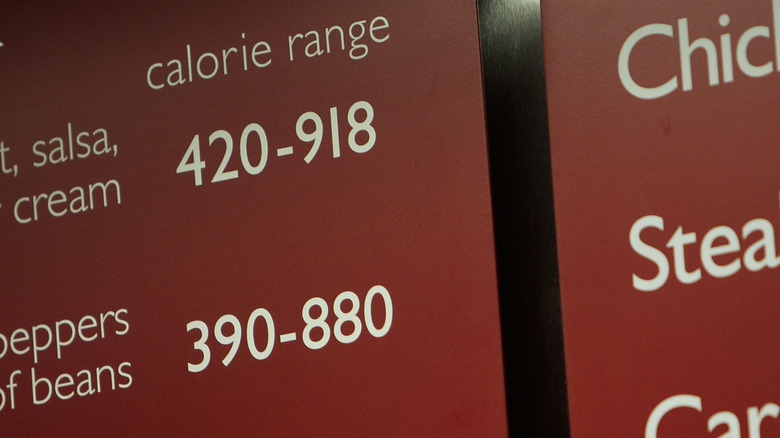
Most calorie counts aren't the result of a restaurant sending a dish to a lab for detailed physical analysis. Instead, the data is the result of calculations. Restaurants use a standardized set of factors that state how many calories are present per gram of fat, protein, carbohydrates, and alcohol. Calorie counts are then calculated based on standardized recipes that pull information from nutritional databases.
In other words, if you order a steak and mashed potatoes, the listed calories are based on database information for a typical cut of steak in a standardized portion. If the steak you are served is a little larger than the one used for the menu information, if it had more fat marbling, or if the chef used more butter when basting it, your specific steak will probably have a higher calorie count than listed on the menu.
Tasting Table asked Angel Luk if it was even possible for a restaurant to provide exact calorie counts, and she confirmed that the numbers on menus are more of a general guide than set in stone facts. "Unless a restaurant is a fast food style operation where food is more so reheated and served, it's near impossible to have exact calorie counts," she told us. "This would be true of any establishment where the food is truly prepared from scratch."