

This Nostalgic Cartoon Was The First Ever To Inspire Its Own Morning Cereal
Today, the idea of movie tie-in Happy Meals and superhero-branded snacks is just par for the course. We're used to being constantly marketed to by a well-known spokesperson, even if the pairing doesn't exactly make sense. Like, say, Elon Musk's Tesla Mezcal tequila, which is one of the worst celebrity-owned liquor brands. But when the cereal Fruity Pebbles debuted nationally in 1971, it became one of the first massively successful cereals built directly around a licensed television property, "The Flintstones." This was a huge shift in how food companies thought about food marketing and commercializing childhood culture.
We can thank Post Cereals for this late-capitalist venture, as the company was searching for ways to compete aggressively in the ever-growing children's cereal market. While breakfast cereals were already heavily advertised during those Saturday morning cartoons in the 1960s, the anthropomorphic animal mascots were specifically invented for the cereal. We'd like to give an honorable mention to Toucan Sam and the Trix Rabbit for hocking some of the best-ranking fruity-flavored cereals.
What made the Flintstones so different is that the beloved characters were already their own form of celebrity. Wilma, Fred, and their kid Pebbles had already wiggled their way into America's hearts as the first primetime animated sitcom. Thanks to its dual draw of both adults and children, it was one of the most recognizable shows in America. Considering that Fred Flintstone and Barney Rubble were already hocking Winston cigarettes on TV in the early '60s, a children's cereal wasn't that much of a stretch.
The cereal began the trend of combining marketing with entertainment
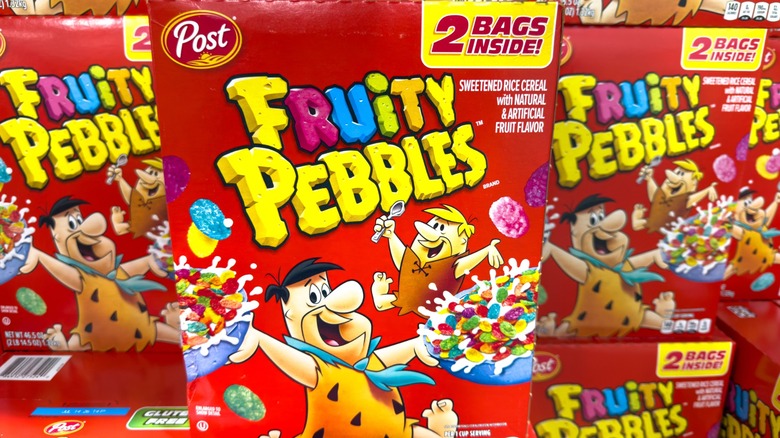
Post Cereals realized it could harness this already existing emotional attachment to the popular cartoon without having to dream up a whole new mascot from scratch. Enter Fruity Pebbles. Named after the daughter in "The Flintstones," the tiny rice-based cereal pieces actually looked like colorful pebbles from the so-called Stone Age cartoon world. Funnily enough, the pebbles' rainbow of colors don't correspond to a rainbow of actual fruit flavors. The cereal pieces are all the same flavor, but the colorful illusion makes us think we're tasting notes of orange, lime, and cherry.
Similarly, the second branded Flintstones cereal, Cocoa Pebbles, doesn't contain any real cocoa. A 2019 class-action lawsuit revealed the brand uses alkalized cocoa, not natural cocoa powder. To be sure, it's not that much of a surprise considering how processed and sugary most popular breakfast cereals are. Nevertheless, both cereals remain a hit because of the way they transform leftover milk into something sweet and colorful or chocolate-y.
Interestingly, the Flintstones show only lasted from 1960 to 1966, but the cereals have maintained incredible longevity. The Pebbles cereals have endured because the characters are standalone cultural icons, rather than a passing novelty gimmick. It's quite possible many young fans today only know the Flintstones from the cereals, rather than the 1960s primetime show. The branding is arguably one of the most recognizable cereal partnerships ever created, and Post is still releasing limited-edition Pebbles. Its latest version is Cinnamon Pebbles, which has been brought back multiple times.