

8 Beloved Mexican Restaurant Chains That Are Slowly Disappearing
Let's be real: The U.S. isn't short on Mexican restaurants. In fact, per Datassential, there are a whopping 80,000 Mexican eateries across the country, which accounts for around 10% of America's entire restaurant industry. Of course, there are many independent restaurants, but the sector is arguably dominated by chains like Taco Bell, Chipotle, Del Taco, and Moe's Southwest Grill (which, fun fact, one of our writers dubbed the best restaurant chain of them all in 2024). But next time you're chowing down on a Crunchwrap Supreme (Taco Bell's best-selling menu item), remember to spare a thought for the Mexican restaurant chains that aren't doing so well.
Many Mexican and Tex-Mex restaurant chains that were once incredibly popular are now beginning to decline, and some are close to disappearing completely. Here, we take a closer look at the beloved Mexican restaurant chains that are getting closer to the history books, from Abuelo's to Acapulco. If your favorite is on this list, we recommend heading to your local spot and ordering a burrito, stat.
Abuelo's
Texan chain Abuelo's, founded in the 1980s by Taiwanese restaurateur James Young together with entrepreneurs Chuck Anderson and Dirk Rambo, enjoyed success throughout the 1990s and 2000s. At its peak, it boasted 40 locations in Florida, South Carolina, Kansas, and beyond. But in 2007, things got rocky; it looked like Abuelo's, which prides itself on offering authentic Mexican food rather than just Tex-Mex, was down and out. But it came back in the late 2010s after the recession and started growing once again.
Unfortunately, though, that growth didn't last. The pandemic threw Abuelo's into a state of turmoil, but customers also felt that the chain just wasn't as good as it used to be. "Last time we went it was [awful] and no one was there," wrote one Redditor in response to the news that one of its restaurants in Chattanooga, Tennessee, was closing. "A year or so before that, it was delicious and packed. I wonder what happened." In the same r/Chattanooga thread, some compared the food to frozen Mexican dinners, but others were bereft. "Damn that's my spot," wrote another Redditor. "Best enchiladas anywhere in town."
Sadly for Abuelo's, it didn't just lose its Chattanooga spot in 2025. In September of that year, it filed for bankruptcy and closed multiple restaurants. At the time of writing, the chain is down to 13 locations.
On The Border
Also in Texas in the 1980s, another popular Mexican chain restaurant was born: On The Border. Led by David Franklin of El Chico, On The Border quickly carved out its own niche, specializing in fajitas, fresh guacamole, and margaritas. To this day, it still offers some of the best margaritas in the game. That's according to one of our taste testers, anyway, who ranked several chain restaurant margaritas and declared On The Border's as one of the best they'd ever sipped.
But it seems great cocktails can only do so much for a chain. On The Border, which had around 120 locations in 2023, has been struggling of late. In 2025, just like Abuelo's, it filed for bankruptcy and was forced to close multiple locations, leaving it with 80 restaurants. Customers were disappointed by the news, but many weren't surprised and felt that On The Border hadn't kept up with the times. "Back maybe 20 years ago, both locations in my town were packed every weekend on a wait," wrote a Redditor in the r/restaurants thread. They added: "It's really sad [because] I used to crave their food, but last time, it was so depressing to eat in there I told myself I'd never go back."
Maybe there is hope on the horizon, though. In May 2026, restaurant group Pappas Restaurants announced it was acquiring On The Border's remaining locations.
Baja Fresh
It might be hard to picture now, but there was a time when Baja Fresh was the biggest burrito chain in the country. The chain, founded in the 1990s in California by Jim and Linda Magglos, was an instant hit. People loved its high-quality, fresh food, and the self-serve salsa bar was the main attraction for many customers. By the end of the decade, there were nearly 60 Baja Fresh locations in the U.S., and by 2003, that number had grown to more than 200.
But this rapid growth turned out to be a curse. After being acquired by Wendy's, Baja Fresh couldn't deliver on sales. In the early 2000s, it was outperforming even Chipotle, but it simply couldn't keep up. Baja Fresh ended up being squashed by the competition, and while it has limped along over the years, it is now down to just over 70 locations, less than half of its peak. Customers still mourn the glory days of Baja Fresh, especially as the salsa counter that made it special is now gone, seemingly for good.
Rubio's Coastal Grill
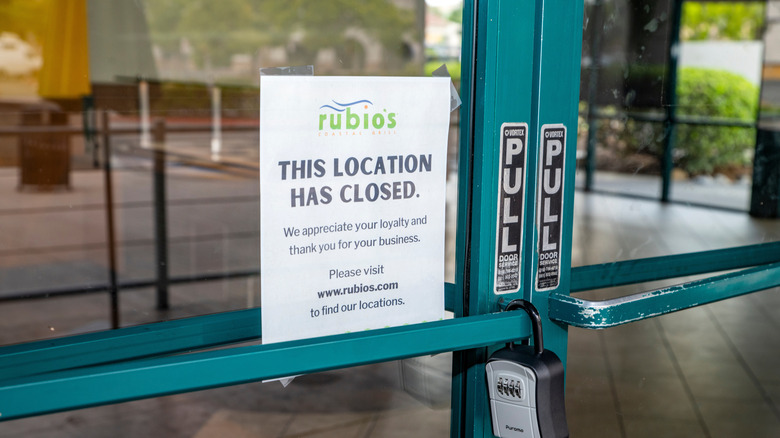
The very first Rubio's Coastal Grill opened in San Diego in the 1980s. If you're spotting a pattern here, it's no coincidence. Tex-Mex cuisine boomed in popularity during this decade. People loved finding their favorite dishes, and for Ralph Rubio, a California surfer, it was all about the fish tacos. He didn't have much experience when he opened his first restaurant, but he did have a great recipe that people loved. By 1992, Rubio had opened 16 restaurants (then called Rubio's Baja Grill), and by 2000, the chain was opening its 100th location.
For a while, it seemed like Rubio's (which changed names a few times, settling on Rubio's Coastal Grill in 2015) was on a rocketship to success. But the trajectory didn't last, and by 2017, sales were slowing down. Three years after that, the pandemic hit, and Rubio's had to file for bankruptcy. By June 2024, the chain had been through multiple closures and was down to 86 locations. In that same month, things went from bad to worse when it filed for bankruptcy a second time.
Fans were disappointed by the closures but felt the chain has become too expensive to continue buying from. Redditor BSY_Reborn wrote in the thread r/fastfood, "It's just not worth the price." They added: "At my location it's $12 for a basic fish burrito, that I can eat in about 30 seconds, and I'll still be hungry after."
Taco Cabana
In the 1970s, Felix Stehling was ahead of many Tex-Mex entrepreneurs when he opened the first Taco Cabana in San Antonio, Texas, in the parking lot of a shuttered Dairy Queen. Together with his family, he served up simple, affordable Mexican-inspired cuisine to local people 24 hours a day, and they loved it. Taco Cabana, which pioneered the patio cafe concept, evolved from a neighborhood spot into a chain, and by the early 1990s, it had 17 locations. The growth kept going over the decades; in 2021, it was purchased by YTC Enterprises, and by 2024, there were around 144 Taco Cabanas in Texas.
In October 2025, though, news came of multiple sudden closures in San Antonio. According to the chain, this was a strategic decision ahead of the launch of its first nationwide franchising program, but there has been more bad news since. In March 2026, it was revealed that the chain was facing at least seven lawsuits over unpaid rent, for example.
Many customers are also of the opinion that Taco Cabana has been going downhill for a while. "I don't know if it was because I was a kid and my taste has evolved but I feel like it [used] to be a pretty good fast food Mexican joint. Now you'd never catch me there," said Redditor exceptionally_humble in the r/sanantonio thread.
Tijuana Flats
Floridian entrepreneur Brian Wheeler was a little later to the Tex-Mex game than others on the list, founding Tijuana Flats in the mid-1990s. After realizing he was a dab hand at making hot sauces, he started experimenting with different recipes in his garage before getting an investment from his father and opening his first restaurant in Winter Park.
Tijuana Flats grew steadily over the decades; customers flocked to its restaurants for its signature hot sauces, but also for its strong lineup of burritos, flautas, and other Tex-Mex classics. By 2023, there were 120 Tijuana Flats locations across Florida and neighboring Southeastern states. But in 2024, things took a turn. The chain, which Wheeler sold to AUA Private Equity in 2015, was forced to file for bankruptcy and close 11 locations due to poor sales and difficult market conditions. At the same time, Tijuana Flats was also sold to a new owner: Flatheads, LLC.
Things went from bad to worse, and when Tijuana Flats emerged from bankruptcy, it had closed roughly 40 restaurants. In February 2026, there were around 87 locations left. Flatheads, LLC, is hoping to keep the restaurants afloat through franchising deals. But new franchisees will have their work cut out for them to convince some customers to come back. To put it mildly, many weren't all that surprised by the bankruptcy filing. "Long time coming," wrote Redditor T1redBo1 in the thread r/orlando. "The quality went super down hill. Like just straight up bad food."
Chevys Fresh Mex
Also in the 1980s, Chevys Fresh Mex opened in Alameda, California, for the first time. Thanks to a machine (or El Machino, as it was called) that could make fresh flour tortillas once a minute, the spot, founded by Warren Simmons, was a hit. People loved how truly fresh the food was, and in the 1990s, one Los Angeles Times reviewer even declared he liked Chevys Fresh Mex's fresh fajitas more than any food he'd eaten in Mexico. At its peak, the chain had expanded had more than 60 restaurants.
But all good things come to an end — even El Machino's incredibly fresh tortillas couldn't save Chevys Fresh Mex from bankruptcy in 2003. This was, in part, due to a difficult hospitality market in early-2000s California, with rising energy bills and increasing insurance rates. But it was also because the chain's parent company Chevys Inc. was bogged down by other poor-performing chains, like Rio Bravo. Chevys Fresh Mex, then under the ownership of Real Mex Restaurants, survived bankruptcy, but the years that followed brought more financial issues (Real Mex Restaurants also filed for bankruptcy in 2012), which weren't helped by its own failure to modernize.
Today, Chevys Fresh Mex is still in business, but it has just a fraction of the locations it once did. At the time of writing, there were 16 restaurants left. Around seven of those are in California, but the chain also has locations in Missouri, Maryland, New Jersey, Minnesota, Virginia, and South Dakota.
Acapulco
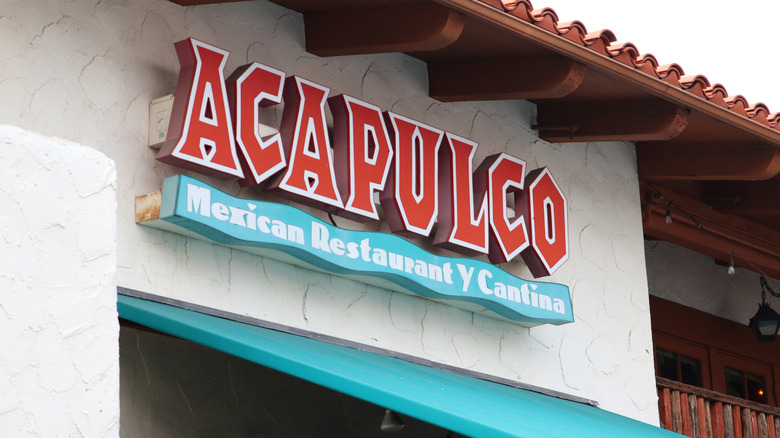
Before any of the chains on this list, there was Acapulco. In fact, the chain got its start in 1960. Founder Raymond G. Marshall tasted Mexican food while working as a hotel chef, and he was hooked. He decided to open the first Acapulco Restaurant and Cantina (then called Acapulco y Los Arcos) in Pasadena, and people agreed with him: Mexican food was really worth getting excited over. By the Tex-Mex boom of the 1980s, Acapulco already had more than 30 locations and was generating around $37 million in sales.
Acapulco stayed on top until the late 2000s, when the financial crisis hit and rocked hospitality to its core, leading to widespread closures across the industry. Things didn't get much better after that. In fact, like Chevys Fresh Mex, the chain was also owned by Real Mex Restaurants when it filed for bankruptcy in the early 2010s.
By 2016, Acapulco had shrunk to fewer than 10 restaurants. In May 2026, the chain dwindled to just two locations, and by the end of the summer, there will be just one spot left. Its Glendale restaurant is set to become a car wash, leaving its Long Beach restaurant as the last Acapulco standing. Many customers are devastated by the loss of the chain, and at the time of writing, more than 2,400 people had signed a petition to keep the Glendale spot open.