

How US Military Rules Led To McDonald's First Drive-Thru
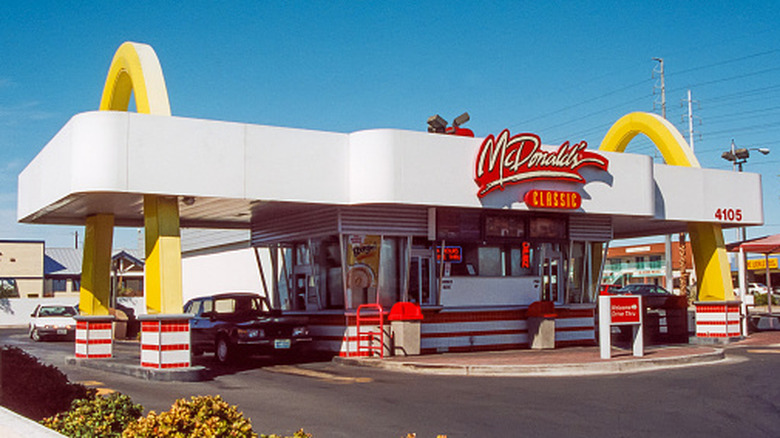
With over 25,000 McDonald's drive-thrus operating worldwide and 95% of its American locations having one, it would be fair to say that the chain's embrace of the drive-thru model has been one of its most rewarding and enduring business gambits. Yet this success might not have come to pass were it not for the role played by United States military rules in bringing about McDonald's first ever drive-thru.
Although catering to motorists had been central to McDonald's business since its beginnings in the 1940s, with one of its earliest restaurants adopting the drive-in model popular at the time, the chain's first drive-thru didn't exist until the '70s. As noted on the McDonald's website, by that time fast food rivals had long before pioneered the invention of the modern drive-thru, and in 1974 the Dallas regional manager of McDonald's proposed to then-company vice president Brent Cameron that the chain should get in on this emerging trend.
Originally, a site in Oklahoma City was planned for the first McDonald's drive-thru, but the project was delayed. In the meantime, McDonald's became aware of slackening sales at a location in Sierra Vista, Arizona — near Fort Huachuca Army Base — in part because U.S. soldiers were forbidden by regulations from leaving their vehicles when off-base while wearing their uniforms. Obviously, this rule impeded them from entering McDonald's. Local McDonald's licensee David Rich realized that the problem could be solved by installing a sliding window in the restaurant's wall, allowing food orders to be passed directly to passing drivers, and so the first McDonald's drive-thru came to pass.
The drive-thru isn't the only feature of McDonald's inspired by the military
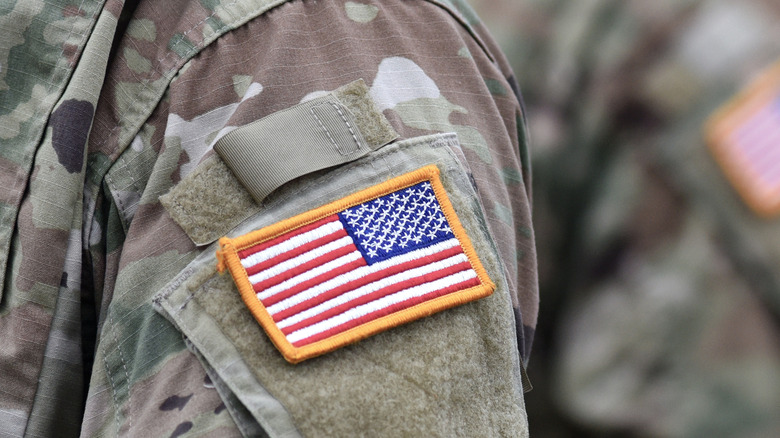
The relationship between McDonald's and the U.S. military would prove to be a lasting one. Today, McDonald's restaurants can be found in military bases across America, exclusively catering to service members and other authorized personnel. Meanwhile, the Golden Arches are represented among the fast food chains with locations in the Pentagon catering to federal employees. Other fast food companies have also made accommodations with the military, even in wartime — following the 2003 invasion of Iraq, for example, some U.S. bases set up post-occupation branches of Burger King, Subway, Pizza Hut, and Cinnabon.
The drive-thru isn't the only prominent element of McDonald's that owes its success to military influence, either. Several McDonald's menu classics are made from restructured meat, the process of which was created by the U.S. Army during the 1960s to lower its food expenses. Per Vice, a military food research lab was tasked with designing a way for meat rations to be cheaper, more convenient to store, and easier to transport. The method the scientists came up with — in which meat trimmings were ground, salted, tumbled, enriched with fat and sodium phosphate, and then reshaped — was quickly embraced by McDonald's, and this is the technique behind how McDonald's McRib patties are made.
So, the next time you enjoy a McRib, remember that you have military food science to thank for it. Just try not to make this McDonald's drive-thru mistake when you order it, or you'll leave empty-handed.