

Are Trader Joe's Olive Oils Actually Italian?
Fans of Trader Joe's know that you can go around the world with a stroll down any aisle of the grocery chain, and international flavors are an important draw for customers. By some accounts, it's a greater challenge to find American-made products in Trader Joe's than it is to find internationally produced or packaged foods. Knowing the origin of an item can tell customers a lot, from elaborating on the quality of a product to giving insight into the volatile world of economic policy and price changes. Olive oil will always generate curiosity related to origin, which is why you might want to know that only some of Trader Joe's olive oils are Italian.
Trader Joe's carries a range of olive oils from a diversity of places. That said, there are only some purely Italian olive oils at Trader Joe's: its Sicilian Selezione extra virgin olive oil is one, pressed and bottled in Sicily from a picking of Biancolilla, Ogghiredda, and Cerasoula variety olives which have grown on the island. Alternatively, you may find your TJ's carrying the 100% Italian President's Reserve extra virgin olive oil, which is purely Italian. While no one can blame you for favoring Italian olive oil, Trader Joe's best olive oil, for example, is from California.
Trader Joe's olive oils are a mixed bag
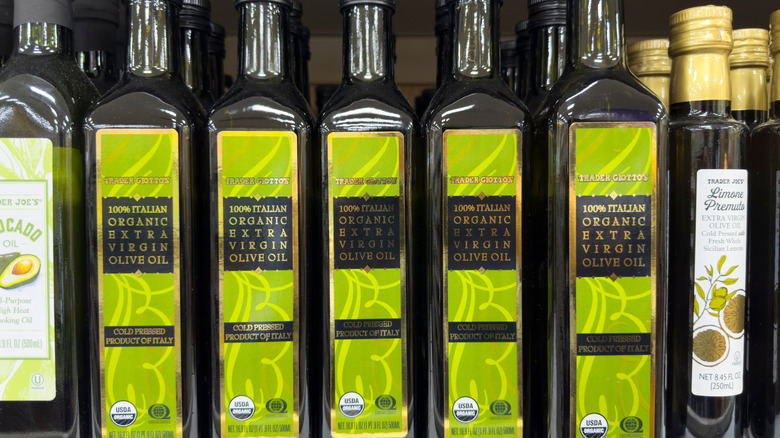
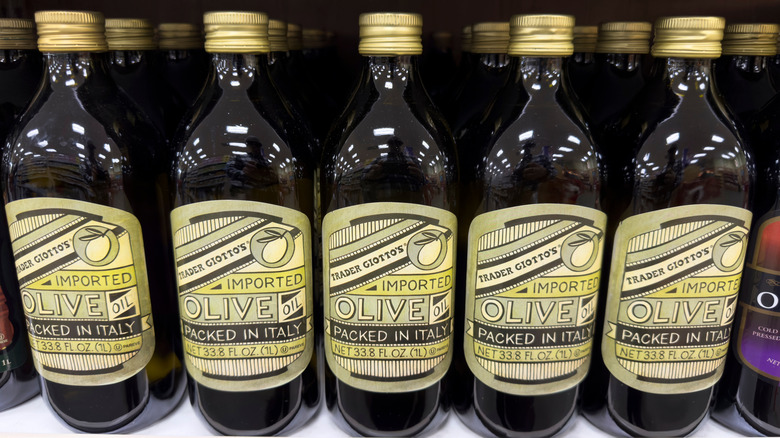
In Tasting Table's taste test of TJ's olive oils, one of our top five proved to be the Trader Giotti's extra virgin olive oil, which is cold-pressed. That olive oil isn't purely Italian, but a Mediterranean mix, which could include oil from "Italy, Greece, Spain and/or Tunisia," per the grocery chain. The premium extra virgin olive oil (also cold-pressed) comes from orchards the globe over, but which TJ's says is packed in Italy. Another oil that's brought over after packaging in Italy, but which features international olives, is the Trader Giotti's imported olive oil, which isn't an extra-virgin variety.
The Italian designation is particularly important because few countries take the production of olive oil as seriously. Recently, Italy announced tighter regulations and enforcement on identifying and punishing olive oil fraud, a move that aims to crack down on mislabeling and obscure sourcing, origin, or contaminants within olive oils. At the same time, European Union regulators have noted Italy as being a strong influence towards maintaining quality in Europe's oil business by ensuring that each step of the supply chain regulations is met.