

Here's How Cruise Ships Handle The Immense Amounts Of Leftover Food
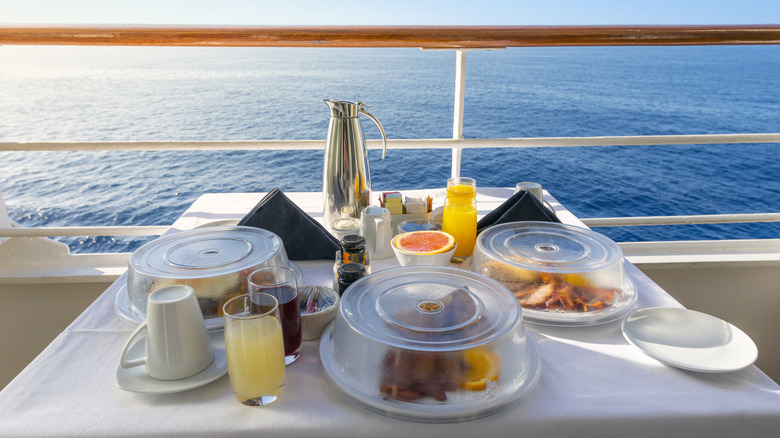
The largest cruise ship in the world, Icon of the Seas, can hold 7,600 passengers. Every one of those people, plus the thousands of crew, needs to eat three meals a day and enjoy some snacks. For a seven-day journey, Icon of the Seas leaves port with 130,000 pounds of food on board. Imagine how much food waste is produced by the end of that one week period. In order to be as efficient as possible, cruise ships have developed some clever procedures to reduce waste. There are even some ways you can help while avoiding all the common cruise ship buffet line mistakes.
Every cruise ship, even the one with the worst buffets, has to manage food waste. On Icon of the Seas, food waste gets repurposed. Waste is converted into pellets. Along with old cardboard and biowaste, those pellets are burned as fuel to run the steam engines that partially power the ship's water park. Other food scraps are sent to the incinerator. But this system is specific to Icon-class Royal Caribbean ships.
In the U.S. and elsewhere, maritime law allows food waste to be discharged at sea if it has been ground small enough to pass through a screen with openings no larger than 25 millimeters. The ship must be at least three nautical miles from shore to do this. If food waste is too large, it can still be dumped at sea, but the ship needs to be 12 nautical miles from land. Waste can also be incinerated or brought back to port to be disposed of.
Other solutions to reduce pollution
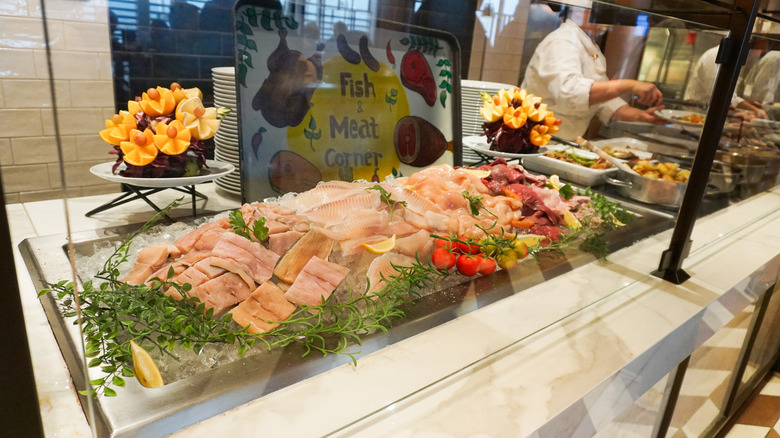
Viking Line's food waste is converted to biogas after the ships reach shore. Other ships, like Sun Princess, use biodigesters. Bacteria in biodigesters break waste down into greywater that can be pumped overboard or stored. Some biodigesters can reduce the volume of waste by up to 90%, according to Green Lodging News. This would reduce not just food waste but fuel consumption, since less energy would be needed to transport the smaller volume of waste. Dehydrators are used on some cruise ships, sometimes alongside biodigesters. Like home dehydrators, just on a larger scale, these machines are used to dry out food waste. The dried waste can be disposed of once the ship reaches port.
In a 2018 report from the journal Environment, Development and Sustainability, more than half of the 11 cruise ship operators surveyed said food waste was discharged at sea. Many of these more high-tech developments have been implemented since then, so waste management has become a higher priority for some cruise lines.
Cruise lines are also looking to head off food waste before it happens. Royal Caribbean uses AI software to more accurately determine how much food will be needed on a given cruise based on factors like weather and demographics. Along with efforts to better control portion sizes and predict passenger demand, less food is brought onboard to begin with, resulting in less waste overall. As a passenger, you can help reduce food waste in the same way as you would at a buffet on land. Take smaller portions and, if you want, go back for more after. Multiple trips if you're still hungry are better than overfilling a plate with food you won't finish.