

McDonald's French Fries Are Made With Technology That Feels Like A Sci-Fi Movie
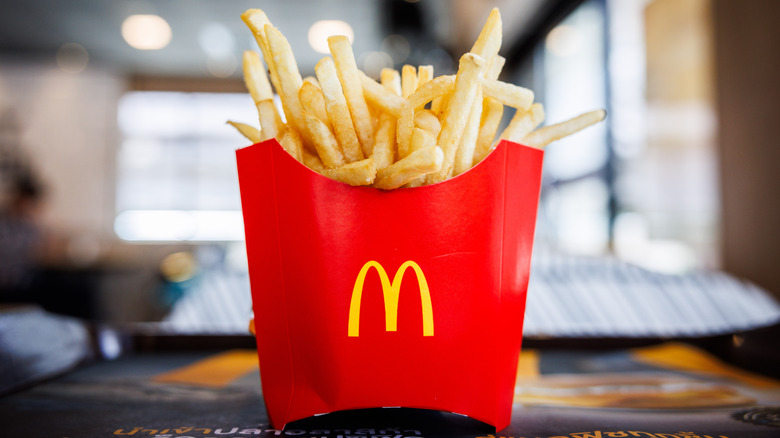
McDonald's has long been considered to have some of the best fries in the business. They're consistently crispy outside, soft inside, and flavorful. They may not be as beloved as when they were made with beef tallow, but fries are still the top-selling item on the McDonald's menu. A lot of effort goes into making sure that these golden, crispy potato sticks come out the same every time, and that includes using some pretty advanced technology.
All McDonald's fries are first processed in a factory. They start as raw potatoes and are peeled, cut, seasoned, partially fried, frozen, and packaged. Along the way, they undergo quality control checks. The french fries run down conveyor belts in the factory where optical scanning machines inspect each one. Any fries with visible blemishes are removed from the line so that you don't end up with a bad potato alongside your burger. This is all happening at a remarkable rate of speed, and thousands of fries are scanned every minute.
McDonald's fries are supplied by J.R. Simplot, Lamb Weston, and McCain, with McCain detailing its almost entirely autonomous fry-making process. Aside from an initial inspection in which workers cut away obvious blemishes, no other human hands touch the potatoes from the time they arrive at the factory until they are shipped out. Machines wash, peel, cut, and inspect them to achieve consistency at a much higher speed than human workers could ever match.
Sci-fi french fry
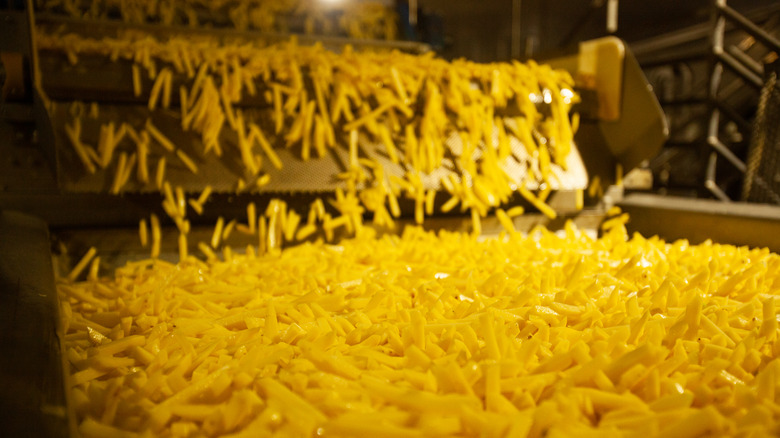
Optical scanning technology is not the only cool feature of the McDonald's french fry factory. To achieve precision cuts, whole potatoes are fired with a pressurized water cannon at up to 75 miles per hour into a grid of cutting blades that slice them into shoestring fries. The waste water moves at such a high speed that a factory employee who did an AMA on Reddit said a coworker once got sucked under by it and had to be rescued.
The fries go through a process called the ingredient dip followed by partial frying. For the ingredient dip, the fries are treated with a sugar called dextrose that helps ensure consistent golden color. They are also treated with sodium acid pyrophosphate, which stops the potatoes from turning grey when they freeze. After that, they are fried in 400-degree Fahrenheit oil and sent into a 50-yard-long freezer tunnel, where they are cooled to 10 degrees Fahrenheit in a matter of minutes.
Companies like McCain are now making use of AI and what it calls predictive crop intelligence technologies, including satellite imagery and other data, to improve potato crop conditions and yield. Lamb Weston is also using AI to help increase yield by optimizing how potatoes are cut and sorted. For factories that process billions of pounds of potatoes per year, even a small advantage from this new technology is considered worthwhile. That means your McDonald's fries are going to be the product of not just efficient factory systems, but robotics and AI in the future, if they aren't already. That's a long way from how McDonald's fries were originally prepared by being left out in the sun to dry.