

Keep Onions Crunchy While They Cook With This Easy Slicing Method
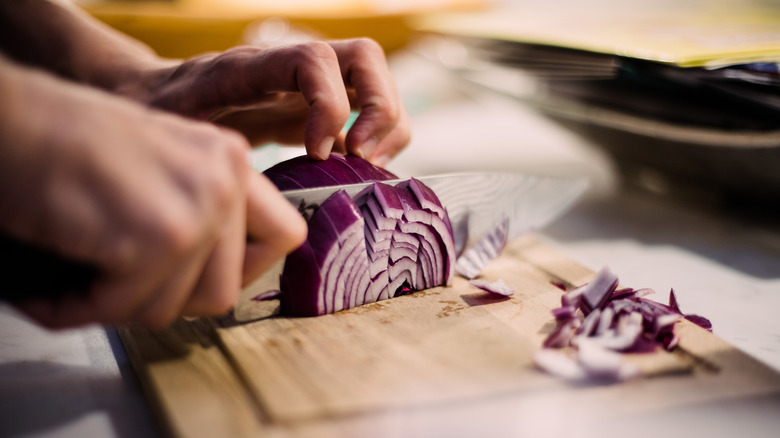
Onions are one of the most ubiquitous vegetables in the kitchen. They're the foundation of countless recipes across culture and history, but somehow, they never cease to feel tricky to prepare. There are endless "hacks" for dealing with them, but the best strategy is to stop trying to outsmart the onion, and start paying attention to how it's built. In this case, observing the direction you slice in determines how crunchy or soft the onion ends up biting.
The onion is a tunicate bulb, a squat stem wrapped in a dense bundle of modified leaves that hold onto water and nutrients beneath the soil. When you slice across the equator of the onion, the cell walls break open and leak the liquid they contain, along with the sulfur compounds that make us cry. If you cut it from root to stem, following the layers pole to pole, the cells rupture to a lesser degree, so less water spills out, and the onion form maintains more structural integrity. Onions are about 90% water, so that difference adds up. The more intact structure leads to less water, which means less steaming in the hot pan, slower breakdown, and a firmer texture as the onion cooks. When you bite into an onion cut like this, your teeth will do the rupturing of the cell wall, which is what the juicy burst of "crunch" is.
Technique for texture
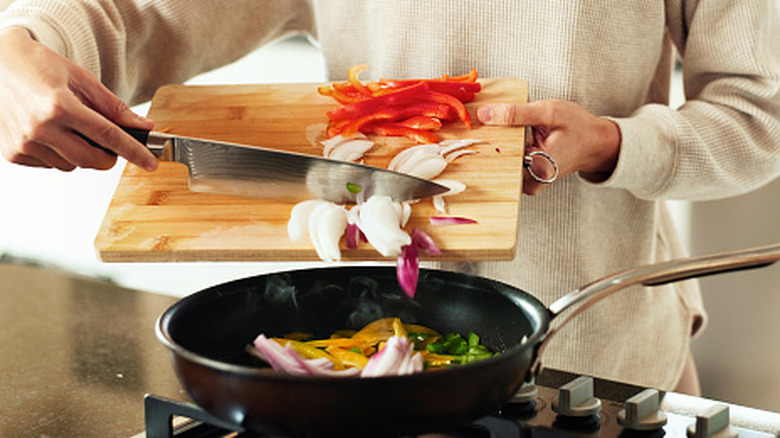
A firmer texture is desirable when you want the onions to retain some bite. Textures is less of a concern when you cook down or caramelize the onions until they're basically melted, like in a French onion soup recipe or even a basic mirepoix or soffrito. But for something like a stir fry or a sizzling skillet of fajitas, a hydrated, turgid onion serves as a textural contrast against the recipe's softer components. The same goes for quicker sautees, or as a topping for burgers and sandwiches, where a crunchy onion will provide resistance and intrigue when layered with soft meat, bread, and cheese.
There are a few ways to reinforce the crunch. A brief soak in very cold water can firm the onion, because a slight rehydration firms up the plant tissue. It will also dull the sharpness, because lower temperatures slow down the chemical reactions that drive flavor, and some of the onion's flavor compounds will dissolve out in the water. It will taste clean, but less intense, which can be great when used raw on a burger, as a taco garnish, or in a potato salad.
The country that eats the most onions per capita might be Tajikistan, but in 2018, The National Onion Association reported that the average American eats an incredible 20 pounds of onions per year, so it's a plant worthy of our consideration. If you observe how it's built, notice the grain, the botany and the chemistry, you'll develop techniques that will lead to the best bites.