

Aldi Refuses To Use This Controversial Seasoning In Any Of Its Products
Aldi is more than just an inexpensive place to do your grocery shopping; it is also its own unique little food universe. You may have noticed that very few of the products are recognizable names. That's because more than 90% of the items sold in the grocery chain are from its private label. Many of these Aldi dupes are better than the name brands, but when a company is selling almost entirely its own products, a small decision (like skipping a certain seasoning) suddenly has an impact on nearly everything in the store. Such is the case with monosodium glutamate (MSG), which Aldi has chosen to exclude from all its in-house products.
For those unfamiliar with MSG, it is a flavor-enhancing salt that provides foods with a savory, or umami, flavor. It is simply the sodium salt of glutamic acid, one of the most common amino acids found in all sorts of everyday foods like meats, dairy, tomatoes, and nuts. One of the biggest misconceptions about MSG is that it is a purely artificial ingredient cooked up in a lab — it's not.
In the early 1900s, a Japanese chemist named Kikunae Ikeda discovered MSG as the result of his wife's cooking. As the story goes, when he asked her what gave her tofu soup its distinctly meaty flavor, she suggested that it came from the kombu, an umami-rich seaweed common in Japanese cuisine — also known as kelp. From the kombu, he isolated and extracted the MSG, patenting the salt and naming the flavor as well. That's right, the man who discovered MSG also named the fifth taste: umami.
MSG is a product of fermentation
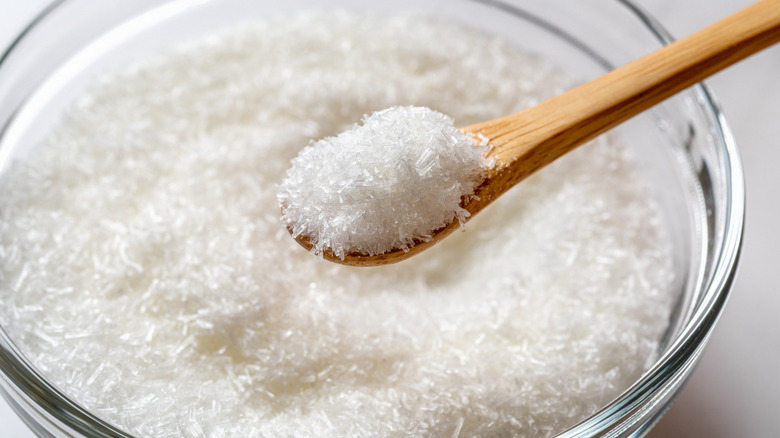
These days, MSG is no longer derived from kombu, but it is still a product made from plants. Since the 1960s, MSG has been produced primarily through the fermentation of starchy products like sugarcane and corn. As these are fermented, they produce glutamic acid. To turn this acid into a salt, it is neutralized with the highly alkaline sodium hydroxide, also known as lye. What is left is a shelf-stable and perfectly safe salt that adds a significant savory, salty, umami boost to anything you choose to use it with.
But if MSG is just a fermentation-derived amino acid salt, why would Aldi choose to exclude it from all its private-label products? Well, MSG has long been a controversial subject in the food world despite its charming origin story. While Aldi does freely admit that MSG is considered safe by the U.S. Food and Drug Administration (FDA) — as well as that it is naturally occurring in various foodstuffs — the chain cites customer preferences as the reason for excluding this seasoning. One can only assume that the brand has done its market research and knows what it is doing.
MSG is a powerful flavor enhancer, so cutting it across the board puts their products at a significant disadvantage when stacked against certain competitors. But such is the anti-MSG sentiment that a chain as large as Aldi feels that including it could have a negative effect on sales. So, what is the root of this MSG hate from consumers? Well, it's complicated.
Xenophobia may be to blame for this MSG hate

There was a time when it was common for some to blame MSG on certain adverse reactions, such as tingling skin, headache, heart palpitations, and nausea. While conversation about these MSG-induced episodes circulated widely, to this day science has not been able to show a link between MSG and these issues. In fact, it may all stem from a 1968 letter published in the New England Journal of Medicine, in which a doctor described a set of strange symptoms that overtook him after eating at a Chinese restaurant, pinning the reaction on ingredients like soy sauce, cooking wine, and, yes, MSG.
It was later admitted that this was a hoax, but that did not stop "Chinese Restaurant Syndrome" from spreading in the collective mind. As a result, Asian eateries often feel the need to tout MSG-free menus, while it is secretly slipped into all sorts of other foods. Processed foods like chips, fast food, frozen meals, soups, and condiments all commonly use MSG. And while those may not be the healthiest choices, there are lots of great ways to use MSG in your home cooking to add extra umami while also reducing sodium content — MSG only has about one-third as much sodium as table salt.
None of this is to say that Aldi's choice not to use MSG in its products is related to anything other than consumer opinions, as the brand itself indicates. It is only to say that MSG is one of the most heavily researched food additives thanks to all the misinformation over the years. In reality, although customer preference may be to avoid it, there really is no evidence that MSG is bad for you.