

How To Drink Scotch The Scottish Way (Just Add One Ingredient)
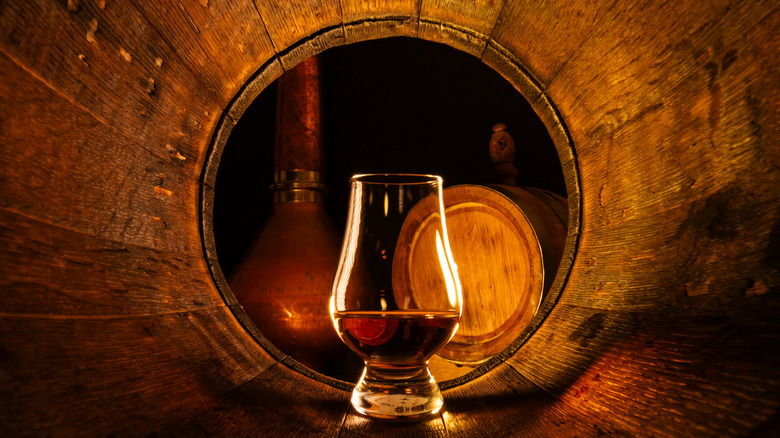
Being born and raised in Scotland, I know that one thing my country loves almost as much as drinking Scotch is telling other people they are drinking it wrong. This can be intimidating for whisky novices, particularly when it comes to the vexed question of whether Scotch is improved by adding water. As a former bartender and a current enjoyer of our national spirit, I can tell you why a few drops of water in your whisky is considered by many Scots to be de rigueur.
First things first — is water in your whisky just an affectation, or is there science behind it? In 2017, a study from Linnæus University in Sweden found that adding water to whisky will bring to the surface more guaiacol — the flavor compound derived from the charred oak barrels in which Scotch is aged — meaning dilution will actually enhance the whisky's taste.
Adding water will also help you appreciate aspects of a Scotch that might otherwise be hidden by its strength. If you've ever tried a whisky described as having notes of banana and cinnamon, only to find yourself unable to detect this through the Scotch's sheer burn, a little water will unlock these subtleties. However, phenolic compounds — which carry those prized flavors of smoke and peat — are prone to diminishment when diluted, so if you like peated whiskies, you may wish to sample your Scotch neat before deciding whether to add water.
Water can be especially necessary when dealing with cask-strength Scotch. Case in point: A friend of mine once offered me an undiluted dram of single malt, but neglected to mention it was almost 60% ABV, a potency most moonshines would envy. As a result, my first sip of this rocket fuel almost blew my head off.
Here's how to add water to Scotch
How much water you should add to Scotch is a matter of personal taste. As a bartender at both an old-fashioned Scottish Borders pub and at a high-end cocktail bar, I saw drinkers take their Scotch neat, with a little water, with more water than the Scotch itself, and even — quelle horreur — with ice (a much maligned order, but one which works well with stronger, more assertive whiskies). In my experience, bartenders feel customers can order their drinks however they like, so don't fear being castigated for your preference.
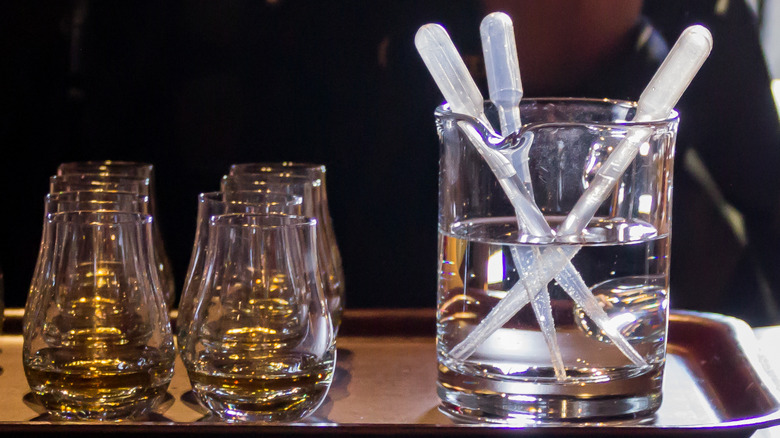
Those who wish to maximize precision over every drop of water may employ a whisky pipette or water-dropper. Full disclosure: I have never in my life encountered a Scottish bar that provides a pipette when serving whisky, so other than at tastings held by organizations like the Scotch Malt Whisky Society, these specialist accoutrements are mainly for those drinking at home. Instead, if ordering water with your Scotch in a Scottish pub, you will likely be presented with a small jug of tap-water. Don't be put off — Scotland is enormously proud of the quality of our tap-water, which is widely regarded as some of the purest in the world, as Scottish spring water is very low in taste-adulterating minerals. If you are drinking Scotch outside of Scotland, however, opt for distilled or deionized water.
Bear in mind that while adding water may enhance the pleasure of a good Scotch, it will not magically transform a bad one. Indeed, certain cheap whiskies (such as the Jacobite, a Scotch so astonishingly terrible I have only ever seen it sold in gas stations) can never be rendered palatable, no matter how much H₂O you drench them with.