

The One Rule Designers Follow When Mixing Patterns In Kitchens
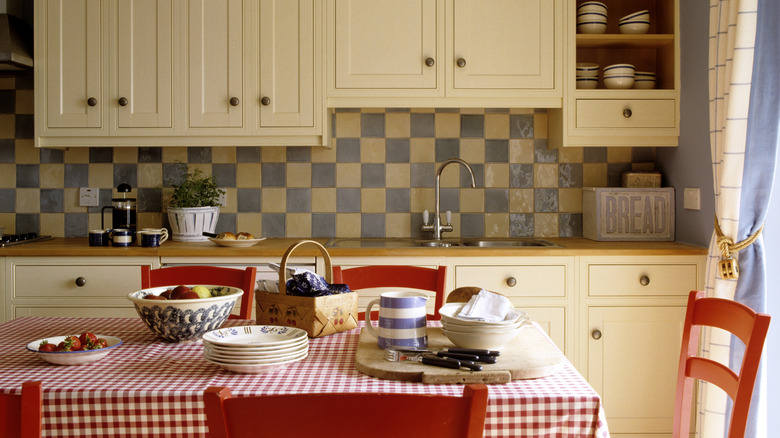
Playing with patterns is an easy way to give your kitchen a visual facelift. Whether you're spending the weekend on a quick upgrade or engaging in a full kitchen project to boost the value of your home, you're going to want to think about how the textures and patterns you've picked affect your space. Do they bring calm or busyness? If you're planning on combining different patterns, our design expert has a key tip to do with the size of the pattern.
We spoke to Marlyn Gonzales, kitchen designer at Rumor Designs, who emphasizes the importance of scale when selecting and layering patterns. "Using patterns that are too similar in size will result in competition rather than harmony," she says. When designing, look for opportunities to pair heavyweight patterns, like large geometric designs, with smaller and plainer designs for contrast. If you were to choose only heavy patterns, you would create visual disruption.
Also consider scale in the sense of kitchen size. If your patterns are too busy, they could make your space look smaller. "If the kitchen is very small, choosing softer patterns or having more 'restful' areas may be easier on the eyes," says Gonzales. On the other hand, if you're designing an open-concept kitchen, considering how the patterns you use blend into the other spaces within eyeshot is also vital, as you want to create cohesion rather than calamity.
How to mix up different patterned elements in your kitchen
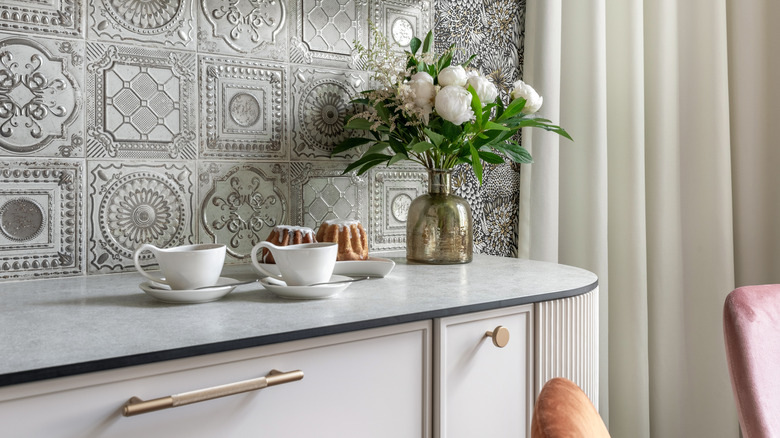
Marlyn Gonzales offers some helpful examples of layered patterns — and ways to integrate them into a kitchen. She says, "An example could be selecting a patterned backsplash tile, and pairing it with a softer patterned countertop (think soft marble or quartzite looks), then adding in a third pattern in the bar stools' fabric will add an extra layer of interest." You can also integrate texture with decor items rather than permanent fixtures. Think about kitchen towels, drapes, candles, and pillows, which can easily be swapped out with others once your kitchen starts to look a bit uninspired.
That being said, Gonzales also underscores the importance of integrating neutral space as well as patterned elements. "Keeping everything balanced in a kitchen is key to avoiding a messy or busy look. For example, you can have patterns in the countertops or backsplash, but allowing the eye to rest on a solid surface, such as the cabinetry, will allow for more harmony," she says. The key here is for your space to look intentional and methodically designed, and considering both scale and blank space when deciding where and how to layer patterns will help you achieve that.