

Abraham Lincoln Hardly Ever Drank Alcohol. Here's Why
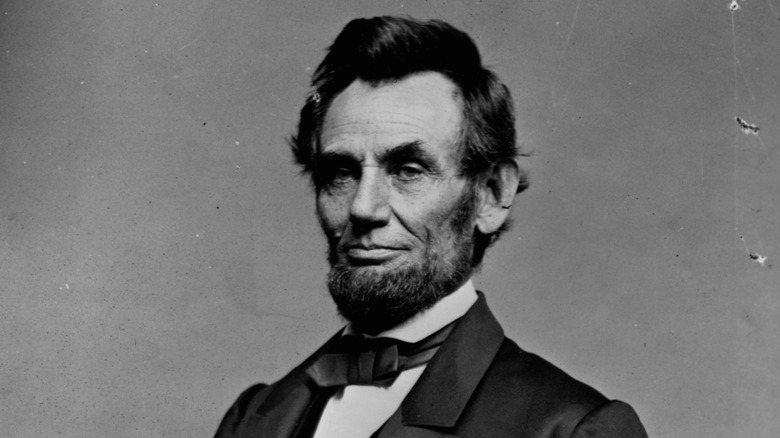
While some presidents (like Ulysses S. Grant) were famed fans, several U.S. presidents allegedly never drank alcohol. One such abstainer was Honest Abe. Although, Lincoln's personal relationship with alcohol wasn't so much about moral superiority as a lack of appetite. According to "The Presidents' Cookbook" by Poppy Cannon and Patricia Brooks (1968), Lincoln is reported to have once said, "I am entitled to little credit for not drinking because I hate the stuff. It is unpleasant and always leaves me flabby, undone." As the book notes, there are records of wine being served at celebratory White House functions, at which Lincoln — not a staunch teetotaler, but not a fan of imbibing — reportedly sipped wine or Champagne to be polite. On a regular day, however, he stuck to water or milk at private dinners.
This account is corroborated by Mark Will-Weber, author of "Mint Juleps With Teddy Roosevelt: The Complete History of Presidential Drinking." In an interview with Bloomberg, Will-Weber maintains that Lincoln would often pretend to drink wine at social dinners, pressing the glass to his mouth without swallowing for the sake of politeness.
Instead of sipping cocktails, the former president delighted in other treats. Lincoln was a fan of chicken fricassee and simple Southern corn cakes — although his appetite was famously pretty small. According to John Hay, private secretary to Lincoln, the president "was one of the most abstemious of men; the pleasures of the table had few attractions for him," as reported by History. He also disliked hunting and fishing.
Lincoln didn't like the way liquor made him feel, but had no qualms about it for others
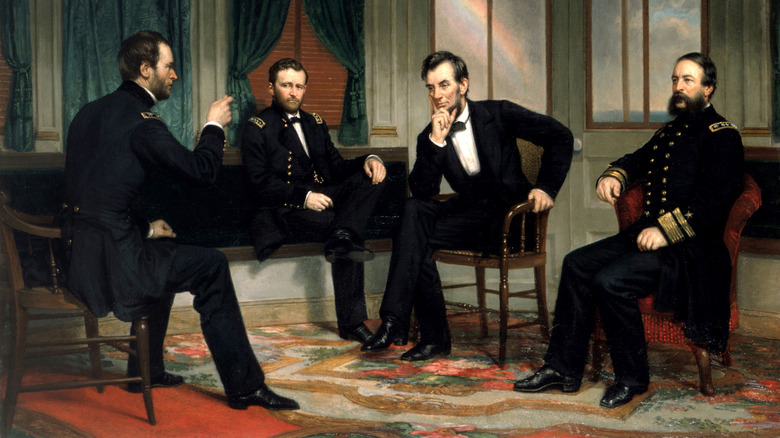
It's worth noting that Lincoln was born into the liquor business, as his father worked in Kentucky whiskey distilleries. For a time, the former president himself even worked in a grocery store that sold whiskey — a fact which Stephen Douglas often used against him during the debates preceding the 1860 election. Meanwhile, also worth noting is the fact that Lincoln grew up following the teachings of the Baptist church, a discipline against over-indulging in alcohol. His tepid liquor stance was perhaps influenced by his religious beliefs — or perhaps even inflated as an advantageous appeal to potential constituencies. The U.S. Temperance Movement (which advocated alcohol-abstinence more famously than moderation) began in 1810s and retained a strong following through at least the 1880s. This cultural trend would have coincided with Lincoln's assumption of the presidency (1861-1865), and comprised an ostensible voting bloc at the time of his candidacy.
Albert J. Beveridge's book "Abraham Lincoln: 1809-1858" recounts a story in which Lincoln was offered a sampling of homemade wine while visiting Reason Hooten's Danville home, and Lincoln reportedly had a taste. But, per the book, "'He was a remarkably temperate man,' testified [Joesph] Gillespie, 'eschewing every indulgence not so much, as it seemed to me, from principle as from want of appetites. I never heard him declaim against the use of tobacco or other stimulants although he never indulged in them.'"