

Why The Traditional 'R' Rule For Eating Oysters Doesn't Really Apply Anymore
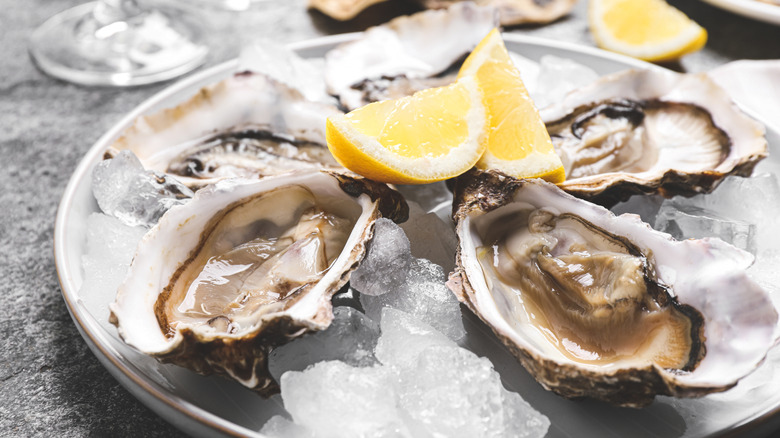
Anthony Bourdain famously waxed poetic about the romance and forbidden-attraction of slurping down a raw oyster. But, would this salacious sensory experience be safe during the summer months? Not according to the traditional "R" rule, which advised people to eat oysters only in months that feature the letter "r" in their names (i.e. September, October, November, December, January, February, March, and April). That means May through August would be oyster-less, but this wasn't because of elevated summertime holding temperatures in restaurants. The old oyster rule refers to the toxic red tides common in ocean waters during warmer months — which also happens to be oyster spawning season.
At one time, when oyster fishermen were only serving wild-caught oysters, it was customary to avoid summer harvesting in order to allow the oyster supply to repopulate. Plus, the return was hollow: Spawning oysters taste "off" and watery. Also during those summer months, red tide algae and other bacteria that's toxic to humans becomes more plentiful in the warmer waters, and are likely to be absorbed by the wild oysters. A study published by the Public Library of Science found that humans have been following some version of the "R" rule for at least 4,000 years, with a seasonal oyster-harvesting record found dating back to the Late Archaic period. However, the rule only applies to wild oysters. Nowadays, most are farm-raised or kept in highly controlled environments, making the "R" rule a thing of the past.
The R rule applies to wild-caught oysters, but most oysters nowadays are farmed
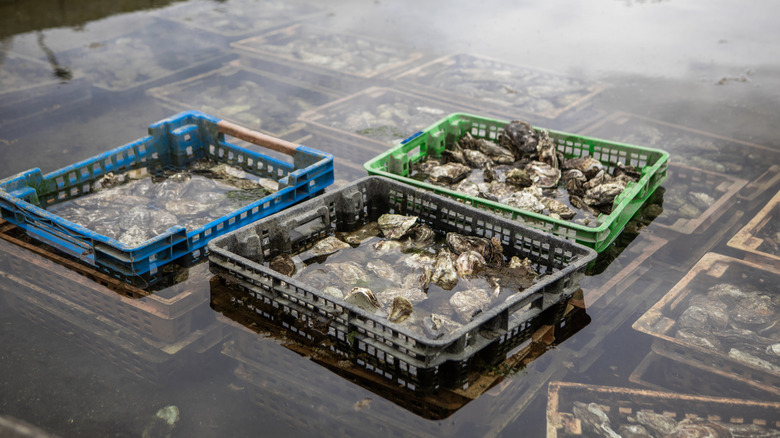
Advances in food safety (namely, reliable refrigeration) now allow oysters to be transported even in piping-hot weather. For extra safety, U.S. law requires every oyster catch to be labelled with its time and place of harvest. Even more than temperature-controlled transit, strides in sustainable farming practices mean that bacteria-free oysters are available for purchase around the world all year long. Controlled oyster farms minimize variables such as bacterial contamination, as farmers monitor the environment to ensure consistent water temperatures and quality. Farms even exist for types of oysters that thrive in both warm and cold waters, showcasing various tasty terroirs.
As printed by In a Half Shell, acclaimed oyster writer Rowan Jacobsen explains, "Almost all oysters are farmed these days, and that's a good thing [...] shellfish aquaculture is actually the greenest form of protein production on the planet, because shellfish get all their food by filtering algae out of the water. You just put baby oysters in the water and take out market-size oysters two years later, leaving the water cleaner than you found it." Jacobsen adds, "A farmed oyster [also] gets much better (i.e., roomier) living conditions than its wild kin. Choose the farmed ones. Support the farmer." Happily, there are fewer guidelines for gourmands navigating the contemporary oyster world than there were in the past. Thanks to innovative aquaculture, the old "R" rule is outdated logic. Anytime can be oyster time.