

These Are The Worst Kind Of Ribs To Try Cooking If You're Short On Time
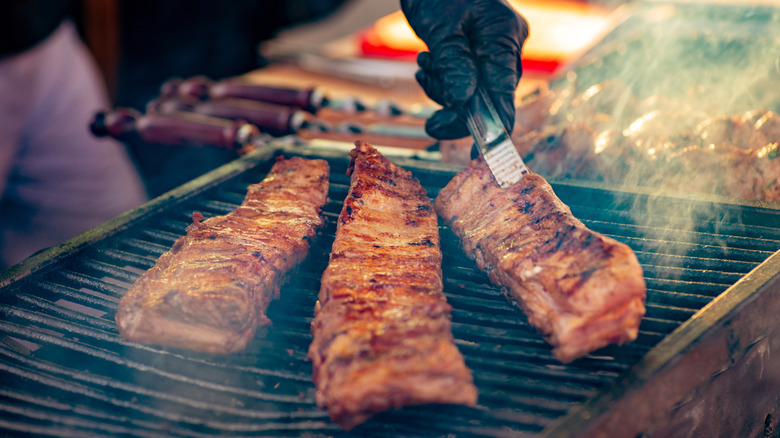
Most Americans love a hearty slab of ribs, but with those long cooking times how often do you actually get to eat them? Even for more relaxed weekend cooking schedules, the hours that it takes to produce good ribs can take them off the table as an option a lot of the time. But not all ribs are created equal in this regard either. There are some kinds that, believe it or not, you can pull together in a few hours, yet others will take up most of your day if you want them perfectly tender. When talking to Verde Farms founder Dana Ehrlich about tips for cooking beef ribs, he admitted they are the worst option for people under a time crunch.
Ehrlich tells us, "unlike other cuts of meat, beef ribs have a lot of cartilage and fat, so everything needs to be cooked low and slow — especially as a full rack." This is because more so than the ribs of pigs, the exterior of the rib area on the cow gets a decent amount of work, and any area of any animal that does a lot of work ends up tougher. In the case of beef ribs they have quite a bit of sinew and connective tissue in the meat, which necessitates a longer cooking time to fully break them down. This is not a matter of personal taste on the texture either. With that connective tissue, and other things like a membrane on the side of beef ribs, if you don't cook beef ribs low and slow for quite a long time, they will be inedibly chewy.
Beef ribs have more connective tissue than pork ribs, making them a bad choice for quicker meals
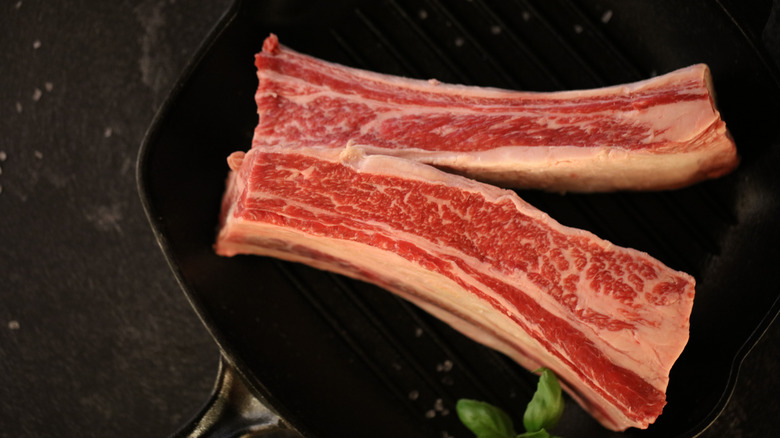
There is one other problem beef ribs have as well: They are quite a bit bigger than pork ribs. They can be up to twice the size of your average pork ribs, especially when they are the large beef plate ribs, also known as dino ribs. Even without all the extra sinew in beef ribs, the sheer size of them will mean they take longer to cook through until tender. With both their size and toughness beef ribs can take eight hours or more to barbecue, and even if you crank up the temperature a bit from the standard 225-250 degrees Fahrenheit closer to 300, they can still take five hours or more.
Instead if you want to squeeze in some weeknight ribs, or only have a limited time on the weekend, stick with pork baby back ribs. As noted before, pork ribs have less connective tissue than beef, and of the pork options baby backs are the smallest and have the more naturally tender meat.
While of course its ideal to cook them low and slow too, baby back ribs will still be tasty cooked faster at higher temperatures, even if they won't be quite fall-off-the-bone tender. Cooked in the mid to upper 200s they can be done in about two hours, and if you cook them on a hot grill or in the oven at 400 degrees they can be done in an hour. They will be more firm than slow cooked ribs, but still plenty chewable, and sometimes that and your favorite barbecue sauce are all ribs need.