

Bananas Seem Pricier These Days, But They're Cheaper Than They Were In The 1970s
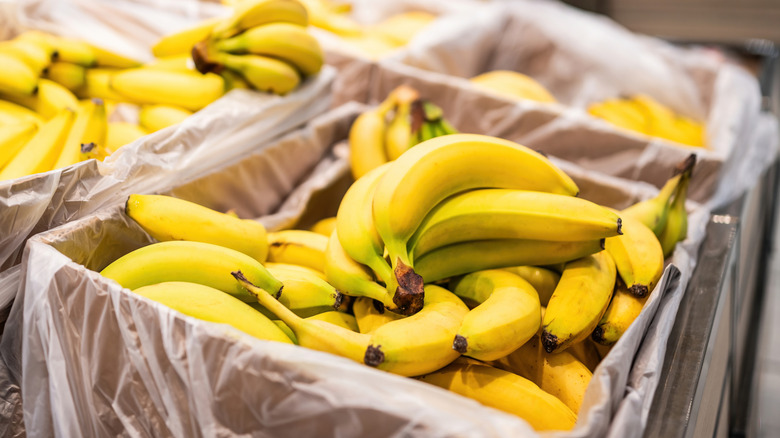
It can seem like every time you step into a grocery store, there's a new price hike on staple items. Inflation has become as unpredictable as the geopolitical circumstances driving it, and it can be easy to feel like food has never been more expensive than it is now. Plus, you're not imagining it — groceries indeed cost way more in some places. However, historically speaking, not every item costs more. One example of that is the price of bananas. Although banana prices did recently see a jump, they are still significantly cheaper than the 1970s, when accounting for inflation.
According to the Bureau of Labor Statistics, bananas cost 23.2 cents per pound in 1975. Adjusted for inflation, that would be $1.46 in 2026 money. However, as of March 2026, the average price of bananas, per pound, was about 66 cents (via FRED), significantly lower than 50 years ago. So, why were bananas were so expensive back then? Between 1965 and 1982, the United States experienced "The Great Inflation" — a period caused by a rapidly expanding economy, lenient economic policies, and an energy crisis that drove up the price of oil. During this period, food prices experienced sharp inflation of over 20%, drastically affecting staple goods like bananas. However, while the price of bananas is much lower today, the same can't be said for all food items: The average price of butter has increased more than sixfold since 1970.
The price of bananas is climbing again

Bananas may be cheaper now than they were in the 1970s, but prices did jump in 2025. According to FRED data, a pound of bananas was roughly 62 cents in January 2025, increasing to 67 cents by September 2025. This price jump was initially triggered by the Trump administration's tariffs on imported goods — which were announced in April of that year — since most of the bananas sold in the United States are imported from Central America. However, in November 2025, Trump issued a tariff exemption for hundreds of agricultural products, including bananas. Despite this, the price of bananas remains higher than it was before the implementation of tariffs.
However, it's not all politics. Another factor driving the price of fresh produce is climate change. The banana variety we're familiar with could become extinct due to increasingly extreme weather conditions. As these bananas become harder to grow, and harvests are less plentiful, prices will inevitably rise. For example, Trader Joe's kept the price of its bananas fixed for two decades — charging just 19 cents per banana — until 2024 when it had to raise the price to 23 cents per banana due to increased costs.