

Roast Isn't The Most Important Factor When Making Drip Coffee (This Is)
We may receive a commission on purchases made from links.
Whether it's the utilitarian pep in your step that launches the day's events or the plaintive evening sipper that helps get you through an American winter, drip coffee matters. It may not be as glamorous as a hand-crafted latte, but it should still taste awesome. Take it from this veteran barista and former cafe manager — if your drip coffee game is "blah," it's probably not the coffee's fault. Your grind size might be to blame. Even more than choosing dark roast versus light roast, the most important step in making consistently knockout drip is matching your grind size to your preferred brewing method.
Imagine a cup filled with gravel and a cup filled with sand. If you poured a pitcher of water over each glass, the water would pass much more quickly through the gravel than through the sand. The same principle applies to coffee grind size, which controls the speed at which water passes through the coffee. In this way, grind size (aka the exposed surface area of the coffee) directly determines flavor extraction.
Whether you rock a state-of-the-art Technivorm Moccamaster or a humble Mr. Coffee machine, nearly all mechanical drip appliances require the same-sized grounds. But, if manual brewing methods are more your speed, accessing your grind size can be a quick and effective way to troubleshoot an off-tasting cup. If the coffee tastes bitter and burnt, there's a good chance the grounds were over-extracted and the grind size is too small. Conversely, if your brew tastes weak and over-diluted, your grind size might be too coarse.
Make sure your grind size suits your choice of brewer
If you brew your drip coffee using an electric coffee maker, the ideal grind size is medium, the texture of granulated sugar. This is the standard grind size of store-bought classics like Folgers and Maxwell House. While such automatic drip coffee machines deliver on the convenience front, unlike manual brewers, they do not allow users to control the brewing time — which is why that grind size matters. Putting fine espresso-style grounds into the appliance's basket will yield undrinkably bitter, overextracted coffee (and probably clog your appliance, alongside).
When brewing drip coffee with manual a pour-over, however, (like this iconic cork-wrapped model by Chemex), opt for medium-coarse grounds — a tad finer than what you might use for a French press and coarser than grounds for machine drip coffee, with a texture like rough sand. This middle-of-the-road grind size helps hold the coffee's extraction time at a balanced rate: not too fast but not too slow.
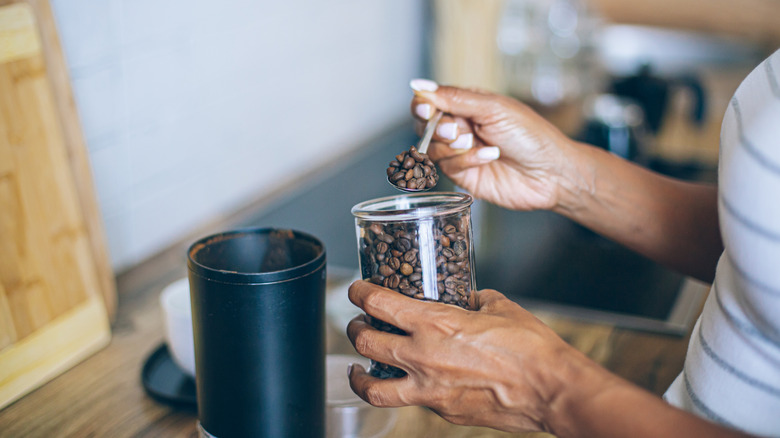
For maximum control over the quality of your daily brew, buy whole roasted coffee beans from the store and grind them at home yourself. Splurging on artisanal whole bean coffee from your local coffee shop or roastery also delivers a lot more dimensionality than the store-bought standard (especially if you use the more delicate pour-over brewing method, which helps preserve the beans' fragile flavor compound structures). For the freshest, best-tasting coffee, don't grind your beans until just before you're ready to brew 'em. If fresh-ground coffee is part of your daily routine, it might be worth investing in a high-quality electrical coffee grinder, such as the OXO brew conical burr coffee grinder ($109.95 on Amazon) or the Hamilton Beach custom grind electric coffee grinder ($37.95).