

The Simple Mistake Everyone Makes With Homemade Caramel
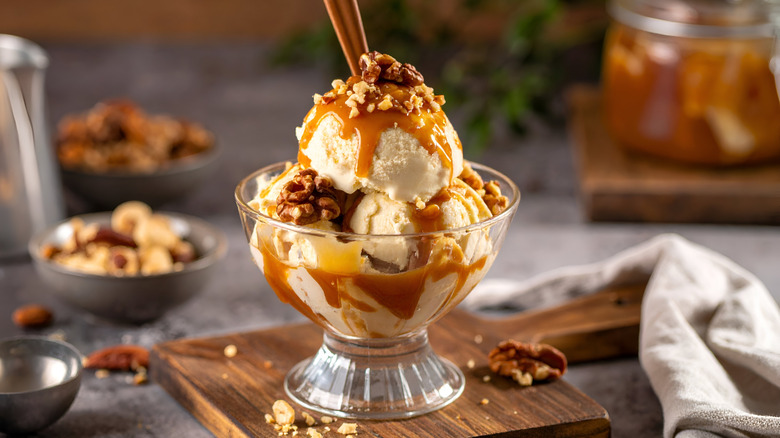
As far as ingredient lists go, the ones for caramel recipes are shorter than most. Sugar and water are the only two things you really need to make homemade caramel, with cream and butter usually adding a softness to the sauce. But the fact that the recipe only needs a few ingredients does not mean it's easy to make. Not only is there a long list of mistakes you need to avoid when making homemade caramel, many of these errors are of the kind that can't really be fixed.
The best (and easiest) way to make caramel is to slowly melt sugar in water to create a thick, smooth, bitter-sweet liquid that forms the base of many decadent indulgences, from candies and drizzles to puddings and ice creams. While the process is simple enough, the chances of your caramel ending up too sweet, too bitter, or too brittle are high unless you're 100% focused on the task at hand.
When we asked Arman Liew, culinary trained creator of The Big Man's World, what the most common caramel-making error was, his answer was that many people don't go far enough with caramelization. "The biggest mistake I see, and one I made myself, is pulling the caramel off the heat too soon," Liew told Tasting Table. The best versions of caramel have a bitter edge to them — just short of burnt is ideal. Taking the sugar off the heat too early means you've basically made a sugar syrup, instead.
Tips to take your caramel game to the next level
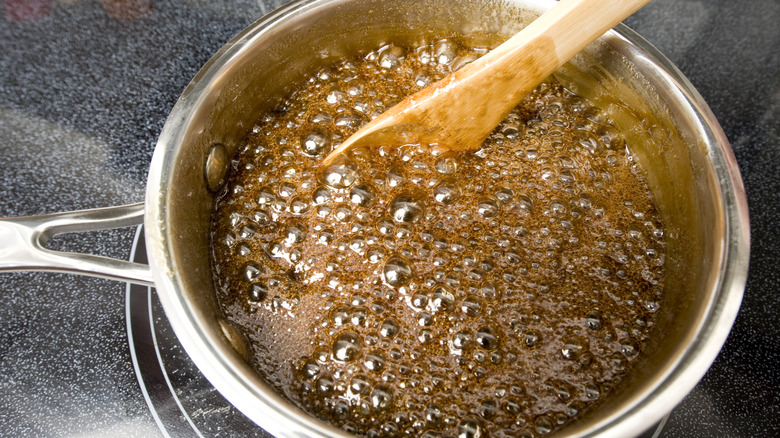
Liew said that he completed an entire module in culinary school on heat-specific desserts, but his most important tip for making caramel isn't rocket science. "The biggest thing? Patience. Caramel cannot be rushed. Not the melting, not the cooling, not the process," he explained. "The moment you try to speed it up, something goes wrong." Beyond patience, he also noted that prep was just as important. From the point the sugar starts melting, things move pretty fast; so if you're adding cream or butter, he suggests having these ingredients measured out in advance instead of scrambling during the cooking process.
When it comes to adding the cream, Liew shared that one trick to stop your caramel from hardening or even separating is to use warm cream. "If you pour cold cream into hot caramel, it will bubble up and seize. I suggest warming it first and adding it very slowly," he explained. He also recommends using a heavy-bottomed pan for better control and even distribution of the heat. "Thin pans create hot spots, and caramel can burn in seconds," he noted. Liew's final tip supports what other experts have said about the best way to make caramel at home, and that's to avoid stirring the mixture once the sugar has started melting. "Stirring actually encourages crystallization, which can make the sauce grainy. I recommend swirling the pan gently instead to even things out."
Don't try making chewy caramel without a thermometer
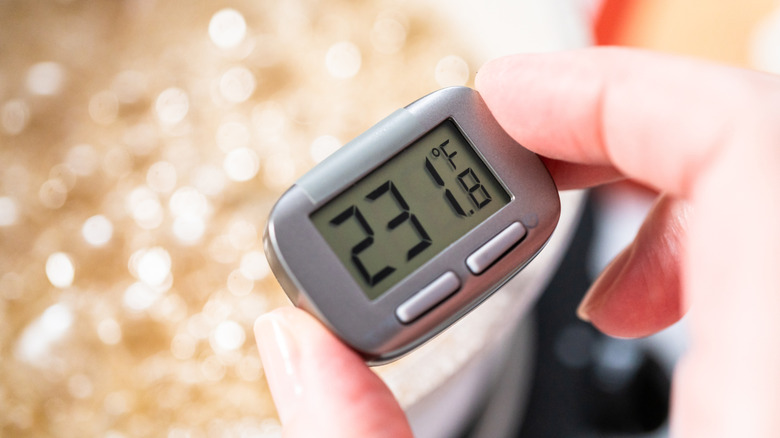
While it's possible to make a creamy, buttery caramel sauce by eyeballing measurements and following your instincts, it takes more than that when it comes to making chewy or hard caramel. If that's what you're going for, using a candy thermometer is non-negotiable, according to Liew. "Chewy caramels set around 240 degrees Fahrenheit, hard caramel around 300 degrees Fahrenheit. Even a small overshoot changes the texture completely. Don't rely on visual cues alone," he stated.
Quick note: Candy thermometers are different from meat thermometers. For one, they're designed with longer ends so you can measure the temperature from a safe distance. Second, they're built to withstand much higher temperatures. Where meat thermometers are good up to 200 to 220 degrees Fahrenheit, candy thermometers can withstand temperatures over 400 degrees Fahrenheit.
When it comes to hard caramels specifically, Liew says there's one additional step to be followed. "Don't rush the cooling," he underlines. "Pull it too early, and it stays sticky; disturb it while cooling, and I find it can crack unevenly."