

This Iconic St Louis Breakfast Combines Everything — And We Mean Everything — On One Plate
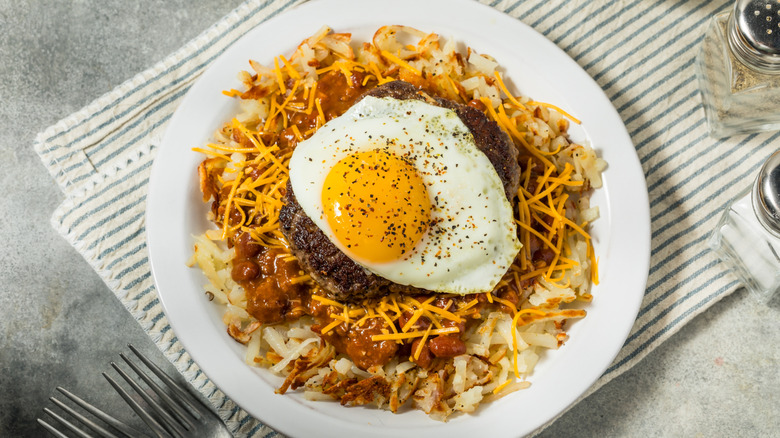
St. Louis has long been known as the Gateway to the West, seated as it is on the western bank of the Mississippi River along the trail that settlers would've used on their journey to the frontier lands. But despite the massive Gateway Arch towering above the city, and its attendant national park below, there is another thing for which St. Louis deserves to be known: the slinger, the most iconic breakfast dish from the state of Missouri.
In order to better understand not just what the slinger is (and can be), but also its significance to the culinary scene of St. Louis, we talked to not one, but two experts on the topic. Wendy Schweikert, owner of Chili Mac's Diner, and Catherine Neville, VP of communications for Explore St. Louis, both sat down with us to explain this unique dish.
"A slinger is not subtle," Neville says. "It's a full plate of 'yes' when you probably should be saying no." This towering breakfast plate typically starts with a layer of hash browns on the bottom, topped with Midwest-style chili and a thick layer of melted cheese. Then it gets a hamburger patty — or breakfast sausage in some cases — which is, in turn, topped with runny eggs. Already a formidable meal, Neville explains that with that stack, the creativity has only just begun. "After that, it's whatever the place feels like throwing in," she says. "Onions, peppers, hot sauce, maybe toast on the side to help you keep up. It's messy, it's rich, and it's delicious."
The origins and cultural significance of the St. Louis slinger
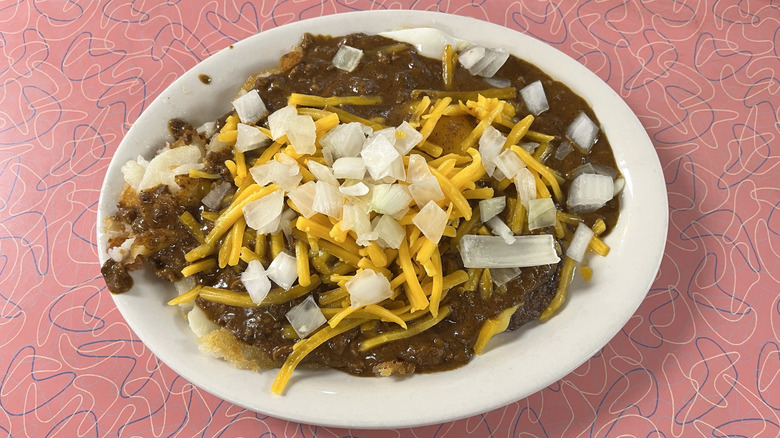
As you might expect given that ingredient list, the slinger is often considered to be the ideal food to end a long night out on the town, or to try to nurse the hangover that follows the next morning. According to Schweikert, however, that is not how this dish first came about. While she does admit that it admirably serves in the role of sopping up one too many drinks, according to her, it started in the early 1960s at O.T. Hodges Chili Parlor — now called Chili Mac's Diner due to family disputes over the name — simply as a way for customers to get everything they wanted on one plate.
There is, naturally, some debate as to the very first slinger, as there often is with such iconic foods. As Neville explains it, "The slinger traces back to St. Louis diner culture, most often credited to late-night spots like the old Eat-Rite Diner, where cooks were putting together hearty, no-nonsense plates for overnight workers and bar crowds."
As much as we love to find and credit the folks who invent these iconic dishes, in truth it doesn't really matter. The dish was a product of a time and a culture, spreading throughout the city and finding such a foothold in the tastes of the people that would cement it as a symbol of the city for decades to come. "It wasn't something that came from a single chef or a formal recipe," Neville says. "It evolved naturally out of what diners already had on the line ... Like a lot of the best St. Louis food traditions, it stuck because it worked."
There is no one recipe for a slinger
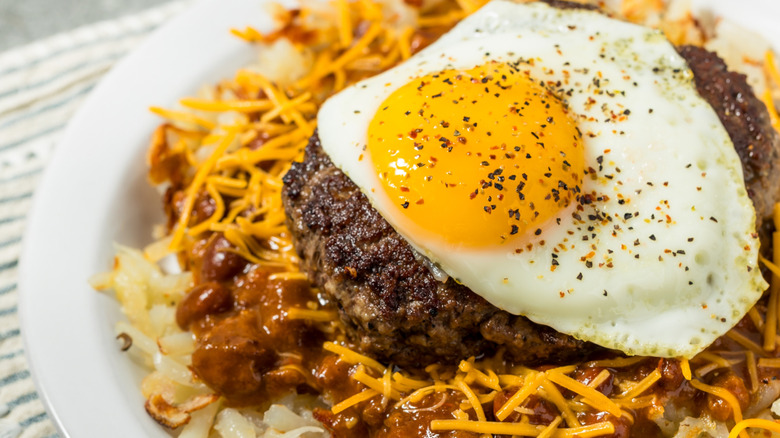
When we let go of finding exact origins, it's easy to see how this dish compares with other similar plates from across the country, such as Rochester's "garbage plates" and the unique five-way Cincinnati chili. It also allows us to appreciate the diversity of slinger recipes that exist in St. Louis without getting bogged down by what might technically qualify as "original." Food is an ever-evolving art, and the slinger is a strange and beautiful canvas of excess on which it is portrayed.
In fact, when you start to get into the alterations that customers make to their slingers, the gap between this dish and other diner favorites starts to close. For example, Schweikert mentions that some customers substitute the burger in their slinger for hot dogs, a classic component in a garbage plate. She also notes that some customers have asked for the potatoes to be replaced with spaghetti, as Cincinnati chili is often served. The slinger is not so much a recipe to be followed as an invitation to create. Other common alterations to the dish include swapping the chili for white gravy, topping it with mounds of jalapeños, or drowning it in hot sauce. Another unusual ingredient that finds its way into this mash-up is a tamale on top. It is certainly strange, but so is the rest of the dish, allowing the tamale to fit right in.
"You have to try it," Neville says. "It gives you a better sense of the city than anything curated ever will. You eat a slinger, you get it." While you're at it, though, she does also suggest sampling St. Louis-style pizza and the city's signature gooey butter cake, as well.