

Why Gin And Tonics Glow
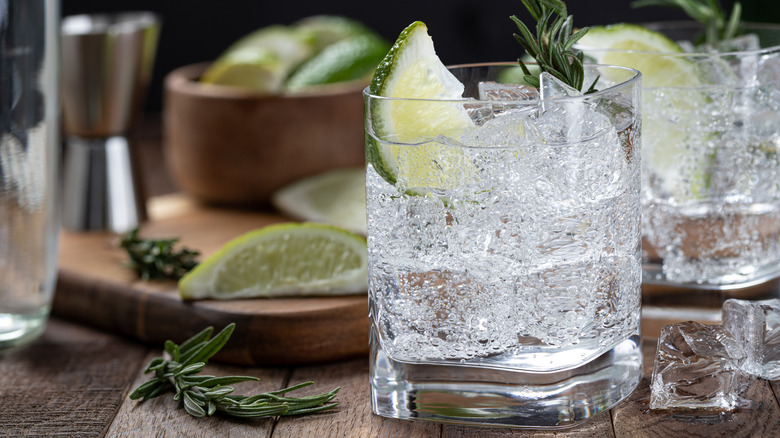
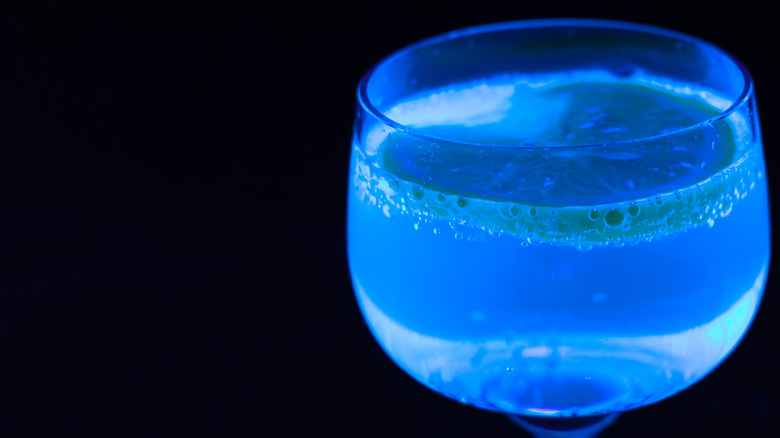
Gin and tonic is a fairly common cocktail with a long history. No matter what bar you step up to, you can rest assured that the barkeep has the ingredients on hand to whip you up one of these simple drinks. But despite its ubiquity, the bitterness of the gin and tonic means that it is far from the most popular drink out there — unless, that is, you happen to be under black lights. In a setting such as that, this drink is all but guaranteed to make an outsized appearance. You see, when you put a gin and tonic under a black light, it responds in a most peculiar way: by glowing bright blue.
The plain spirit doesn't respond to these lights at all, so you can't expect other gin cocktails like rickeys, gimlets, and martinis to put on a similar show. What is actually responding to the light in this instance is one particular ingredient in the tonic water, quinine. Here's how it works: So-called black lights actually emit ultraviolet light, which exists at a wavelength that is not visible to the human eye. When this light comes into contact with the quinine molecules, however, they take it in and then reemit that light in a slightly longer wavelength, which is now visible to us. The result is that cocktails made with tonic water take on an enchanting ethereal glow when placed under black light. But what exactly is quinine, and how did this unusual molecule find its way into our cocktails?
What is quinine and why is it in tonic water?
The history of tonic water actually goes back centuries, to well before it was a chic mixer for a London dry gin. The mystical fluorescent ingredient quinine is actually derived from the bark of the cinchona tree, which is found in the Andes mountains in South America. Indigenous healers of the area had discovered that this bark could be used as a medicine. As it turns out, the quinine in the bark serves to stop the reproduction of the blood-borne parasite that causes the disease, thus giving an infected individual relief from the fever, chills, nausea, and other brutal effects of the disease. Malaria is not common in temperate climates, but runs rampant in tropical areas.
Pitt's Aerated Tonic Water was the first product of its kind to hit the market, a fizzy quinine-containing drink intended as a general digestive tonic to help travelers acclimatize to the tropics. The credit likely goes to British soldiers in tropical climes for first adding gin to the mix, thus creating the classic cocktail and giving it the tropical roots that would allow it to take hold of summertime imaginations around the world. Imaginations being a key word, as it is said that for the tonic water we use as a mixer to actually provide any significant anti-malarial properties to the drinker, they would need to down close to 70 liters of the stuff.
The weak formula we mix into cocktails still has enough quinine that, when paired with a black light, every bottle of tonic hides an impressive party trick. But what would it look like if these drinks actually contained a therapeutic dose of the medicine? That would likely be a drink capable of turning a few heads, to say the least.