

What Is A Casserole? The Key Components That Define The Dish
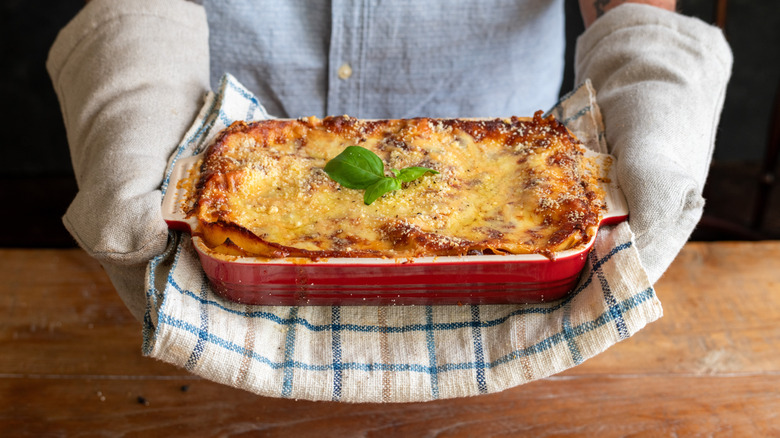
What do tuna casserole, Frito pie, and lasagna all have in common? Aside from being classic comfort foods, they're all casseroles. The fact that they are so different is part of what makes casseroles hard to define for many people. You rarely hear clear rules about what constitutes a casserole the way you do with soups or cakes. That doesn't mean no rules exist.
The word casserole comes from the French word for a type of sauce pan or stew pan ... essentially you make a casserole in a "casserole." You can trace the root back through Latin and Ancient Greek origins, where it refers to a pan or vessel. That's why we still call it a casserole dish or pan today. It's less about what you cook and more about the vessel it is cooked in. The definition, that a casserole is a baked one-dish meal served from the same container in which it was cooked, is a common refrain from most sources. With such limited conditions, you might think defining a casserole would be easy, but because it leaves the door open to any baked one-dish meal, it becomes harder to clearly identify what counts as one. The difference between a green bean casserole and a lasagna is significant, but they both qualify as casseroles. But is a pastry-topped pie like a chicken pot pie a casserole? Some would say it is, while others would say it's a pie and not a casserole.
Even with such loosely defined criteria, there are some things casseroles generally have in common. Most casseroles have a binder that prevents them from being just a loose pile of ingredients. That could be anything from eggs and gravy to cheese or another sauce. Ingredients can vary, but the binder brings cohesion to the dish.
On a roll with casserole
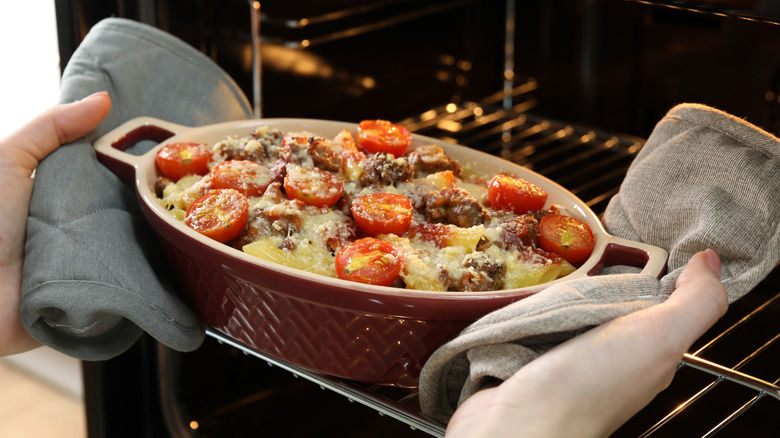
Casseroles are baked with all of the ingredients together, so the texture can be a little one-note. Most ingredients become soft and the flavors can be uniform or muddled. That's why a topping is often added for textural contrast. Think of bread crumbs on top of a macaroni and cheese casserole, or crispy onions on a green bean casserole. The cooking method of a casserole is important, too. Oven baking is a requirement because putting similar ingredients in a pot on a stovetop would produce something closer to a stew.
The ingredients can be mixed together, like in a broccoli and cheese casserole, or layered, like in a lasagna. Even though cheese is common in many casseroles, along with starchy elements like potatoes and rice, there's no universal ingredient that has to be included. Vegetarian bakes are as acceptable as ones cooked with meat. Casseroles aren't strictly dinner meals, and breakfast versions are very common.
There are casseroles in many different cultures. A Greek moussaka, English Lancashire hotpot, and a Brazilian escondidinho all qualify as casseroles. That said, America seems to have the most diverse number of casseroles, and they are especially prolific in both Southern and Midwestern cooking. Seasoning is often simple, relying on staples like salt, pepper, onion, or garlic powder, alongside cheese or canned soup. There are plenty of vintage casserole recipes around to try if you're looking for some nostalgia and to gain a deeper understanding of the dish's history.