

Yes, Moldy Country Ham Is Safe To Eat — And This Is The Way It's Actually Expected
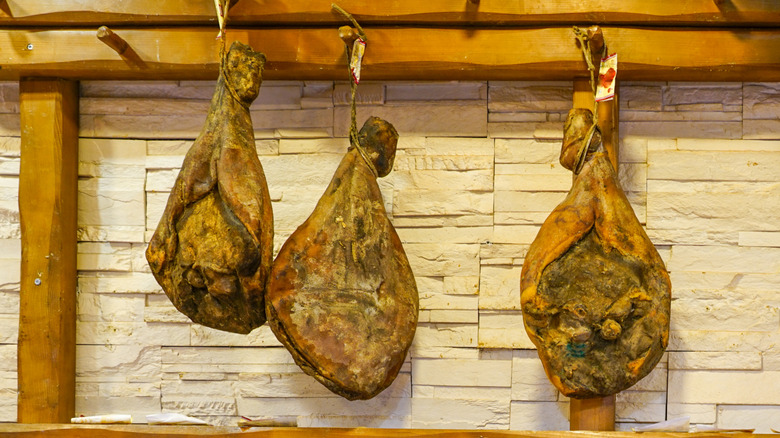
Mold on food is something we almost always want to avoid, but the word almost does a lot of heavy lifting in that sentence. Think about blue cheese, for instance, or soy sauce, which is fermented with mold. In certain cases, mold does have its place. One such case is country ham, which you may be surprised to learn is still perfectly edible even if mold has grown on it. That's not to say you want to take a big bite out of a moldy spot, but you should still safely be able to eat the ham.
According to the USDA, mold on a cured country ham is common and usually harmless. There is the potential for more dangerous molds, but it recommends washing the ham with water and scrubbing the moldy area with a stiff vegetable brush.
Country ham is similar to Italian prosciutto and Spanish serrano ham because it is dry-cured. This is an ancient method of meat preservation that predates refrigeration and has stood the test of time. A pork leg is rubbed with salt, sugar, and seasonings, then hung to cure, as opposed to being brined in liquid like a wet cured ham. This process takes months, even up to a year. The curing takes place using an environment at around 85 degrees Fahrenheit, and some mold growth is common as the meat loses moisture, despite air circulation and humidity control usually being applied to mitigate it.
Traditionally, the process of country ham begins in late fall. After being rubbed with the salt and seasoning mixture, the pork legs hang during the winter. In spring, the cure is washed off, then the meat can be smoked and hung again.
Be bold and remove the mold
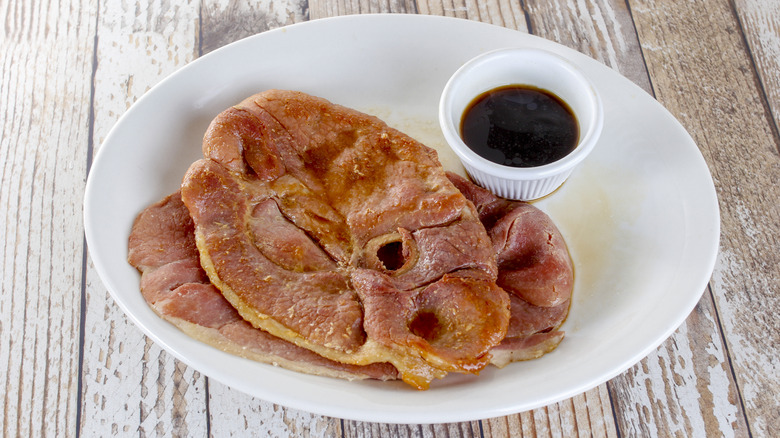
Even though country ham with mold on it is safe to eat, the mold itself should not be consumed. It should be removed because it could potentially be dangerous. A greenish-blue colored mold is to be expected. However, if it's a black mold, you need to scrub it thoroughly to make sure not even a trace remains, because that's more dangerous than the green strains. It's worth brushing up on which molds on cured meat are safe and which aren't.
Despite salt helping to preserve the ham and prevent the formation of bacteria, some bacteria will still take hold. However, as the ham loses moisture and the salt increases, this prevents mold from taking root inside the meat. That's why it's still safe to eat once you clean or cut it off.
Some people recommend cooking country ham after cleaning it. You can do this either by slicing it and frying, or baking it. It's also possible to soak a country ham before cooking depending on the type. While there's nothing wrong with cooking it, there's also no reason to. Just like a good Italian prosciutto, country ham has been thoroughly preserved and can be eaten as is. It's best enjoyed in very thin slices because of the intense saltiness and flavor, which can become overpowering if it's sliced too thickly. However, this should only be done with a fully preserved dry-cured ham. While some kinds of ham are fully cooked and safe to eat, others require cooking first, so it is best to check the label.