

The Regional BBQ Chain That Made Up Its Origin Story Entirely
Cookout connoisseurs typically know what to look for in a great barbecue restaurant, and what should be considered a red flag. Authenticity is typically a good sign that you're in for some tasty grub, which is why so many chain barbecue restaurants lean into a homestyle aesthetic, often highlighting passed-down recipes and historic ties to the American South. But while some businesses may embellish a few details within their biography, others have invented characters out of thin air.
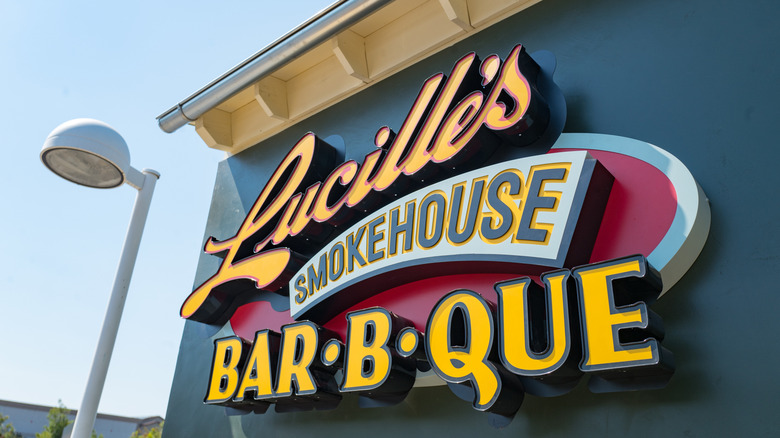
Lucille's Smokehouse Bar-B-Que was founded in Long Beach, California, in 1999 by Hofman Hospitality Group, and has received much acclaim over the years while opening new locations in and out of state. For years, diners could spot references to the chain's namesake, including old-timey photographs of Lucille herself – a Black woman from South Carolina. According to the restaurant's website, Lucille Buchanan "grew up eating in her grandma's lunch shack, a tiny little nothing of a place on a back road, outside of a small town," (per Culinary Worker's Union). Eventually, Lucille left home to eat her way across the South before realizing that nothing beat her grandmother's cooking. Shortly after World War II ended, she eventually settled in Southern California to open a restaurant and share her culinary inheritance. Except, Lucille never existed.
While some may argue this was a case of "creative marketing," it has problematic implications. For many, the idea of a white-owned business creating a stereotyped Black character from the Jim Crow era to promote their plantation-themed restaurant was yet another example of appropriation and erasure. In 2020, the chain amended their website, removing all mention of Lucille, and has since refused to comment on their offensive brand strategy.
Lucille's isn't the only brand to have invented a fictional backstory
Lucille's Smokehouse Bar-B-Que may be one of the more recent businesses to have been called out for inventing a fictional founder or backstory, but it certainly wasn't the first to employ the underhanded marketing tactic. Perhaps the most high-profile case is that of Aunt Jemima, the now-discontinued pancake mix and syrup brand.
Named after a character in a minstrel song, Aunt Jemima found fame in the late 19th century after a formerly enslaved person, Nancy Green, was hired to promote the product at Chicago's World Fair. The brand's owners decided to lean into Green's success. In the 1950s, Disneyland opened a plantation-themed restaurant called Aunt Jemima's Kitchen. The chain began to expand until Civil Rights activists protested the Aunt Jemima caricature and the restaurants closed or rebranded. However, it wasn't until 2020 that PepsiCo — the brand's most recent owners — finally acknowledged Aunt Jemima was based on racist stereotypes and rebranded.
London-based Italian restaurant chain Frankie & Benny's is guilty of similarly misleading marketing. It's long promoted the tale of its "founders" — two childhood friends from New York who took over a family restaurant in 1953. But the men are entirely fictitious. And it's not just the food world that's relied on a bogus biography. Abercrombie and Fitch's spin-off fashion brand, Hollister, has also spun a tall tale over the years. The company invented an adventurous sailor named John M. Hollister who traveled the world before settling in LA to open a store selling trinkets from the South Pacific. Hollister's equally fake son, John Jr., took over the business, apparently intent on selling surf apparel to preppy millennial teens.