

The Theory On How Hell's Kitchen Contestants Remember Orders
For people who enjoy cooking, watching food-based reality shows isn't quite the passive experience. Apart from getting involved in the characters and their story arcs, there's the added layer of constantly stepping into the contestants' shoes, imagining how they would tackle a particular challenge, or what dreamy dish they'd make using that week's mystery box ingredients. Then there are times when you want nothing to do with the competitive kitchen. Because, while Gordon Ramsay has occasionally been nice to Hell's Kitchen contestants, the show's highlight reel invariably involves the celebrity chef screaming orders in a contestant's face as they're reduced to tears.
Seriously, how do these Hell's Kitchen contestants remember any of those orders that are flying in? Especially since even at the best times, Ramsay only seems to yell them out once, and none of the contestants seem to be taking any notes. This is a question that has popped up online more than once, and there are a host of well-informed points of view on how the system works. The short answer: a combination of training, clear communication, a systematic workflow, and specific kitchen vocabulary designed to keep everyone on the same page while saying very little.
That's not to say it's easy. "It might be hard if one has never worked on the line, or is unfamiliar with this system," one Redditor wrote. "However, I believe prior to the show, contestants are taught how to prepare the mise en place and all the menu items, and the standards they need to uphold. They are also given recipe books to memorize and practice."
Here's how the system usually works

He's got a reputation as an angry chef, but according to guest judges on Hell's Kitchen, there's more to Gordon Ramsay than you see on TV. Which makes sense, because while his TV persona is of someone sparking chaos, his role leading a service requires great organizational skills. "It's not just calling and firing everything as it comes up but managing the flow of production of the team to maximize efficiency and food quality," one Redditor explained. For example, if all the fryers are in use, they will wait to call out the next order for wings. Or they'll only call out for 10 to 20 orders at a time, and follow up with status checks and reminders.
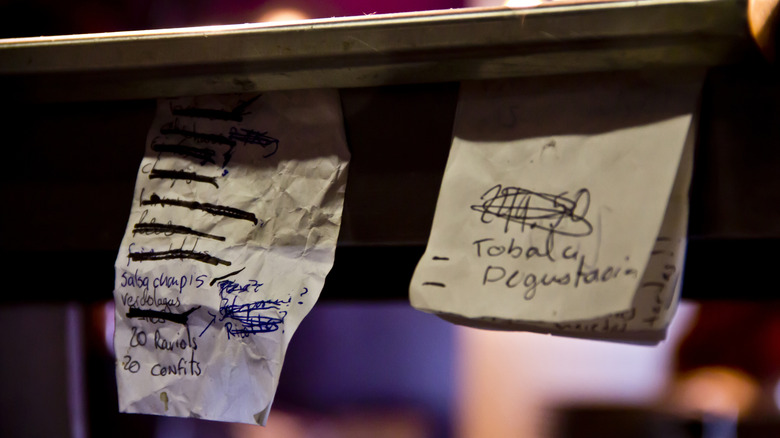
Even so, contestants still need to be able to multitask, keeping their eyes on the stove top and ears tuned for instructions from Ramsay. "As a line cook somewhere like Hell's Kitchen, you have a small menu," one Redditor shared. "He might call six items for a table, but I'm only responsible for two steaks and one pork chop, and I'd add two and one onto my running tally."
Another Redditor put it down to developing what can be described as selective hearing. According to them, the different chefs in the kitchen are only waiting to hear what their section has to cook. So, when the expediter asks for "2 wellington, 2 spaghetti, 1 lamb, 1 risotto", the chef at the meat station will only pay attention to 2 wellington, 1 lamb. "They can ignore everything else GR (Gordon Ramsay) says," the Redditor wrote. Line cooks are also trained to use simple tricks, like setting out a few components of the dish as they're being called out. This way, they know exactly what they need to get on to next.
The art of over-communication

While processes are important in this high-pressure scenario, good communication keeps the engine running smoothly. In fact, even with television shows, you'll notice a correlation between the point at which flustered line cooks stop responding to the head chef and all hell breaking loose. To avoid this, kitchen teams have developed a shorthand that allows them to communicate while using as few words as possible. And you'll notice contestants on Hell's Kitchen using a lot of these words and phrases.
For example, when Ramsay is reading out a set of orders, each cook on the line that has a dish in there will respond with a loud "Yes, Chef!" or a "Heard!" Some kitchens also use "call backs" to ensure the message has been received. This means the line cooks have to repeat the entire order to confirm they have understood exactly what's required of them in the next few minutes. Viewers of the award-winning restaurant drama "The Bear," a show that embraced chaos even in its fictional fine-dining menu, will be familiar with the phrase "all day," which is basically the head chef giving a total tally of a specific dish they're expecting. So if they've already asked for two steaks and are adding one more, they'll follow that up with a "three steaks all day." That essentially means, in all, the line cook should have three steaks going.
To the untrained ear, people yelling out random words with no context — "item," "adding on," "heads up," and (especially) "fire," can sound like chaos — especially if it's Gordon Ramsay doing the yelling. But in reality, it's exactly the kind of over-communication that's keeping the wheels turning in the kitchen.