

Never Plug These Kitchen Appliances Into Power Strips
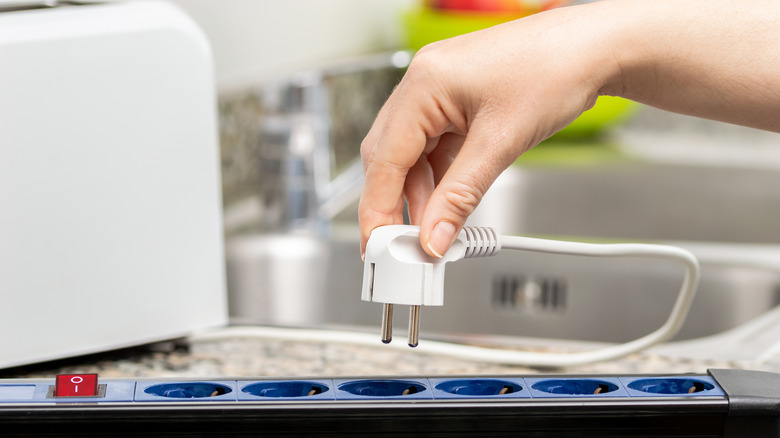
If you have an older home, your kitchen may not have as many electrical outlets as you need. Even in modern homes, some outlets may be in awkward places that are hard to reach. It may be tempting to use a power strip to increase the number of kitchen appliances you can use, but doing so could end up being dangerous. Most power strips are designed to handle a low load from small appliances like cell phone chargers, computers, and televisions. Plugging in a high-wattage appliance – or multiple — may cause the power strip to overheat. This is a major fire hazard, but could also cause electrocution.
High-powered appliances like refrigerators, freezers, dishwashers, garbage disposals, microwaves, toaster ovens, and electric ovens should be plugged directly into the wall. Anything that requires a lot of power to operate or has a motor or heating element should have its own dedicated wall outlet, including blenders, electric kettles, and coffee makers. In addition to the risk of fire or electrocution, using a power strip for these appliances can overload your electrical system, leading to tripped breakers and power outages. If you aren't home when this happens, you may come back to spoiled food or damaged appliances.
If you're not sure if you can use a power strip for your kitchen appliances, the best thing to do is read the manual. Each appliance's manual will give you guidance on how to safely set up, plug in, use, and maintain it. Following these instructions is a crucial element of home kitchen safety and fire prevention, and is a tip that will make your kitchen appliances last way longer.
Other safety tips to consider for kitchen appliances
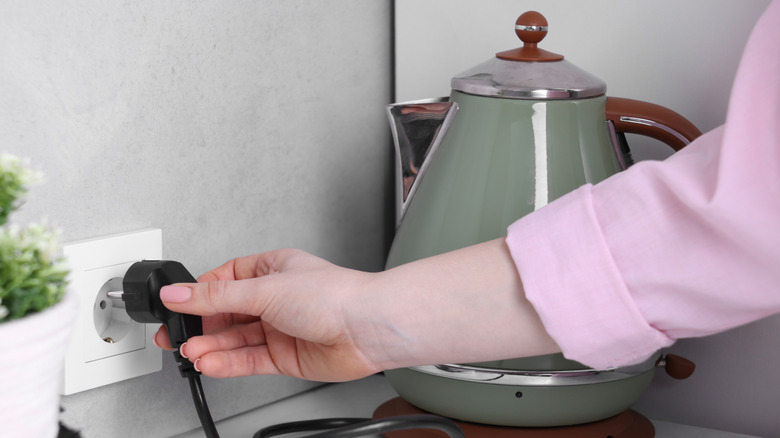
The outlet you choose isn't the only safety precaution to take with your kitchen appliances. For instance, small appliances should be unplugged if a storm is on the way in order to prevent dangerous power surges and damage to the appliances. Before using an extension cord for kitchen appliances, read your manuals for instructions on what type is safe to use – or if you should avoid using one altogether. You should also regularly inspect extension cords to make sure they aren't cracked, frayed, or otherwise damaged. And never run an extension cord underneath furniture or appliances, as this could cause overheating or fire.
If your appliance has a three-prong plug, it needs the corresponding electrical outlet. Using an adapter that converts a three-prong plug to a two-prong one so that you can plug it into a kitchen outlet can be a fire hazard. The third prong on the plug of certain appliances and electronics is a grounding plug. Converting it to a two-prong plug overrides that crucial safety device, as plug adapters don't properly ground the appliance. It may work fine for short-term, temporary use, but should not be used as a long-term or permanent solution. Doing so can cause the cord to overheat, start a fire, produce an electric shock, or overload and damage your home's electrical system.
If you are using an adapter, unplug these appliances when leaving the house or when they are not in use. Ultimately, the best solution if you don't have enough outlets in your kitchen or if there are no three-prong and GFCI outlets is to hire an electrician. They can install updated outlets and additional outlets safely.