

Grind Matters For Pour-Over Coffee — Here's How To Get It Just Right
We may receive a commission on purchases made from links.
Even with coffee house culture in full swing, you can become your own barista with the right technique. And while throwing some grounds in a coffee maker is convenient, the pour-over method makes a superior cup of joe — but grind matters for pour-over coffee. We spoke with Matt Woodburn-Simmonds, former barista and founder of Home Coffee Expert, who notes why the grind matters. "The grind texture is critical to getting the correct speed of water flow through the coffee grounds and the best flavor extraction from pour-over," he says.
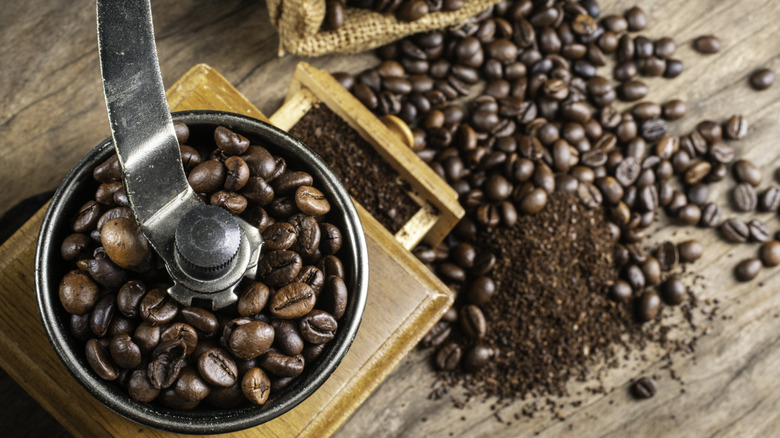
According to Woodburn-Simmonds, "A medium-fine grind, between 400 and 600 microns, or roughly the consistency of table salt, is a good place to start." The simple hack to grinding coffee beans more evenly is to move your grinding machine around. No coffee grinder? Try this low-tech way to grind coffee beans by using a sealable bag and a heavy pan. But it isn't just the grind size that matters, but also the timing of when you grind the beans.
Our expert thinks you should stop pre-grinding coffee beans. "You should always grind your beans within 20 minutes of brewing your pour-over, if possible," he explains. "This will ensure the most flavor is retained from the beans into the grounds to end up in your final cup." Of course, a fresh grind means nothing if the beans themselves aren't fresh. As Woodburn-Simmonds recommends, "To have beans around 2 weeks after the roasting date for peak flavor too, if you can."
More tips for pour-over coffee from our expert and beyond
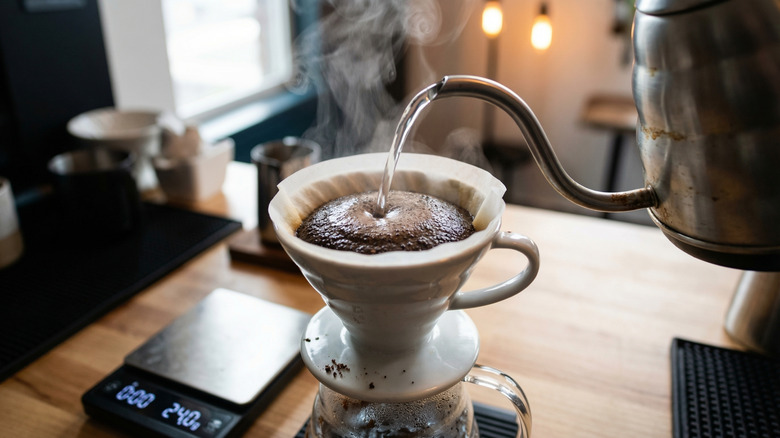
Grind size is a big factor in how successful you impart flavor into pour-over coffee. Either extreme on the grind size scale would certainly be a mistake with pour-over coffee. "If you use very coarse ground coffee, your pour-over will be thin and acidic," says Woodburn-Simmonds, "and if you grind too fine, you'll get bitter coffee that takes forever to drip through." Since a pour-over already takes more time than other methods like the coffee machine, moka pot, and French press, waiting 10 minutes for coffee to seep through is not the best way to wake up. It may take a few tries to get the medium grind down pat, our expert tells, "but once you find that perfect grind, make sure to make a note of it so you don't forget."
In addition to grinding coffee beans fresh and the right size, the pour-over itself is a method that requires some finesse. And as far as water pouring goes, a gooseneck kettle is your secret weapon to the perfect pour-over. Containing a very thin spout, a gooseneck kettle allows for a more controlled, even, and slower pour-over, giving the beans more time to bloom and impart their flavor evenly into the water as it trickles through them. Furthermore, many KLEAH Gooseneck Electric Kettle have temperature mechanisms to prevent the water from boiling as boiling water will scorch the beans, resulting in a burnt taste.