

The Country With The Highest Milk Prices In The World
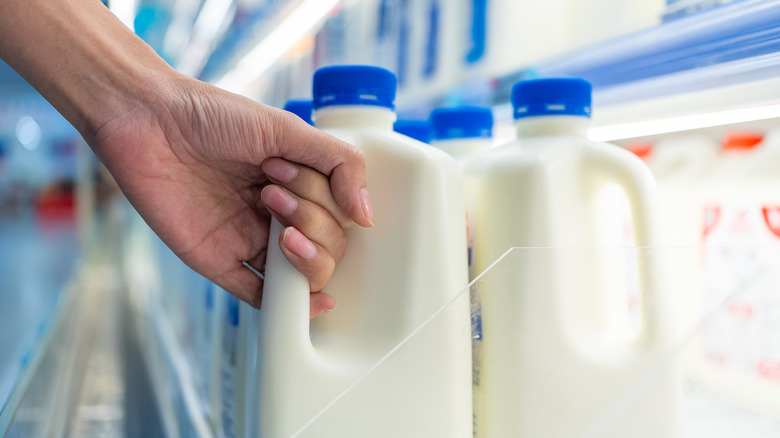
There are only six countries in the world where the average cost of milk is over $3 a liter: America, Ghana, South Korea, Singapore, Hong Kong, and Israel. Of these, there's only one country where milk costs over $4 a liter — and it's probably not the one you think. The country with the highest milk prices in the world isn't America, Hong Kong, or Israel, but Ghana, the West African country where buying a liter of milk can set you back by $4.15, according to Global Prices. Global Prices manually collects data from 78 countries, and the average price per liter is for milk with 1.5-2.5% fat content.
Ghana comfortably tops the price-of-milk list, with South Korea ($3.42) and America ($3.31) making up the top 3. At the other end of the list are Tunisia, where a liter of milk costs less than half a dollar and India, where dairy is less an ingredient and more a way of life.
Ghana, in contrast, has no real dairy culture to speak of (the absence of dairy products is telling on this list of 12 traditional West African dishes you should try at least once). According to research published on Discover Food, around 85% of the 35 million Ghanaians are lactose intolerant. It also has no organized dairy industry. It imports dairy worth $400 million, but domestic fresh milk production accounts for less than one percent of the total dairy market value (per USDA). There are a wide variety of reasons for this, ranging from a lack of trust in the quality of fresh milk to supply and distribution problems due to the hot weather.
Why Ghana has no dairy industry

While cattle rearing is common in Ghana, it's largely focused on supplying meat rather than milk. Neighboring countries like Nigeria and Kenya have invested in breeds that can produce between 15 to 30 liters of milk per day. But, according to the president of the Ghana National Association of Cattle Farmers, only "eight out of every 100 milk-cows in Ghana are able to give 3 liters of fresh milk per day".
The next problem is processing the raw milk. With temperatures regularly hitting 30 degrees Celsius (86 degrees Fahrenheit), raw milk needs to be refrigerated within 2-3 hours (raw, or unpasteurized milk, can spoil very easily, which is why it is banned in several countries). But most local producers don't have access to electricity or refrigeration, and end up throwing away what they don't sell. There are problems at a commercial level as well. A Dairy Global report gives the example of Nature Farms Ghana Limited, the leading supplier of domestically sourced milk in Ghana. The enterprise ends up utilizing less than half its processing capacity of 7000 liters a day because of limited supply.
An AgEcon paper titled "Analysis of Ghana's Local Milk Value Chain: barriers to competitiveness" (published in 2021) summarizes the problems succinctly in its conclusion: "The supply of fresh milk is seasonal and highly perishable with much milk collected going bad due to the lack of storage facilities. Sanitation is a major problem in the fresh milk value chain, beginning with milking down to marketing." The landscape seems to be changing. There are more malls and supermarkets, improving supply chain logistics, a growing expat community and a booming tourism industry, all of which is driving up demand for dairy. How this impacts the price of milk in the long run remains to be seen.