

Yes, You Can Consume Too Much Potassium: Here's What Happens When You Do

Is it possible to get too much of a good thing? Regarding the delicate balance of chemistry inside our bodies, yes. Potassium is an electrolyte, one of the charged minerals that helps control the electrical activity inside the body's cells. Under normal, healthy conditions, potassium levels are naturally and tightly regulated within the body, automatically, but if they rise too high in the bloodstream, it can result in uncomfortable, and potentially dangerous conditions in your body.
"Hyperkalemia, the medical term for the condition of having too much potassium in the blood, is not very common, and can have no noticeable symptoms," explains Destini Moody, a registered dietician-nutritionist and certified specialist in sports dietetics. "However," she continued, "signs of high potassium usually include muscle fatigue and weakness, as well as some tingling in the nerves."
The reason potassium has such wide-ranging effects comes down to basic physiology. Moody says, "This is because potassium is the main electrolyte responsible for regulating the electrical impulses in the nervous system and muscular system." Cells maintain different potassium concentrations inside and outside their membranes, creating an electrical gradient that allows nerves to transmit signals and muscles to contract. When potassium levels in the blood climb too high, the electrical system is thrown out of balance. Nerve signals may misfire and muscles can weaken. In severe cases, "When levels are very high, symptoms could appear in the heart muscle, which requires medical attention," Moody warns.
It's got electrolytes
Despite the risks of hyperkalemia, most healthy people are unlikely to develop it from eating everyday foods in a normal amount. The body has a built-in system for managing electrolyte balance, and potassium is constantly filtered and excreted through the kidneys. Problems tend to arise when that system is either impaired, due to illness, or if potassium intake becomes unusually concentrated.
"It would be highly, highly unlikely for a healthy individual to consume too much potassium through diet alone. Our kidneys are very efficient at clearing excess minerals like potassium from the system, but it may have a harder time with more concentrated sources like supplements," says Moody. This is why it's a good idea to keep an eye on daily totals of vitamins and minerals that add up if you're regularly consuming sports drinks and electrolyte powders along with vitamins, particularly multiple or combination formulas, which may be doubling up on certain ingredients. "Furthermore," Moody says, "if you have kidney disease, heart failure, consume a lot of potassium-based salt substitutes, or take certain medications, you could be at risk of harmful potassium buildup."
Potassium chloride is widely used in low sodium or sodium reduced salt substitutes, which are often marketed to people trying to lower their sodium intake for blood pressure management. These products taste similar to table salt but replace the sodium with potassium. For most people they're harmless, but for someone on certain medications or who has kidney issues, regularly seasoning with potassium-based flavorings can push their potassium intake into danger zones. This is also why it's crucial to share with your doctor what supplements (including electrolyte powders if that's a regular part of your intake) you take when they prescribe medications.
A little bit of everything
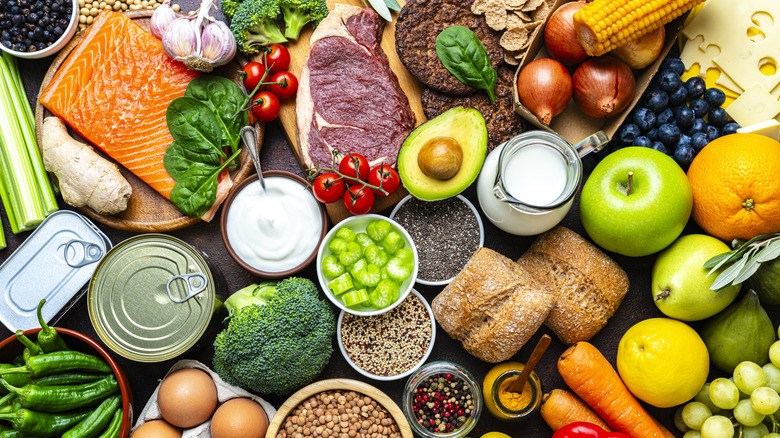
For those without complications or supplement regimens, potassium is an essential part of a balanced diet. According to Moody, "The National Institutes of Health recommends 3,400 milligrams of potassium a day for men and 2,600 milligrams for women. Adults eating at least 5-7 servings of fruits and vegetables per day can usually achieve this amount." The ceiling is 4,700 milligrams of potassium per day. Past 5-6,000 milligrams is where things start to get dangerous, but it would be pointedly hard to get there.
Bananas are famous for their potassium content, and Moody agrees that they're one of the "richest sources," but we know that there are a lot of other foods that have more potassium than a banana. For example, Moody also recommends "avocado, potato, spinach and melons." A typical day of ordinary meals that reaches the recommended intake without much effort could look like, a banana at breakfast, providing around 400 milligrams of potassium, a baked potato at lunch adding more than 900, then a handful of spinach, maybe as a way to upgrade the banana in a smoothie or with a salad at dinner, and some melon as a snack, adds several hundred more.
Many other foods are also potassium banks; a cup of yogurt contains 500 milligrams. A cup of lentils or white beans can rival or exceed many fruits. And because dried fruit is concentrated fruit, it contains more potassium by volume than fresh: A cup of dried apricots can contain 1,100 milligrams of potassium. Crucially, all of these foods supply potassium within whole foods, which come with fiber, water and other minerals that support normal metabolism and elimination. For most people, potassium isn't something that needs to be prioritized, avoided, or even scrutinized, it's just part of what makes a varied diet of whole foods healthy.