

Does Sam's Club Price Match? What To Know Before You Shop

In a world of constantly shifting prices for consumer goods and products, few tools can feel as useful as price matching. The practice of comparing one retailer's cost to another in order to achieve a similar price at your preferred venue can help shoppers exercise choice over where they want to spend money, without creating undue burden as to how much money they want to spend. Unsurprisingly, price matching is on the decline. Big box retailers that once built empires on the promise of matching or even undercutting competitors, like Walmart, no longer find much benefit in price-matching competitors. Perhaps not so coincidentally, Walmart-owned Sam's Club (which some think has a better shopping experience) has a significantly more limited price-matching policy than what you might expect.
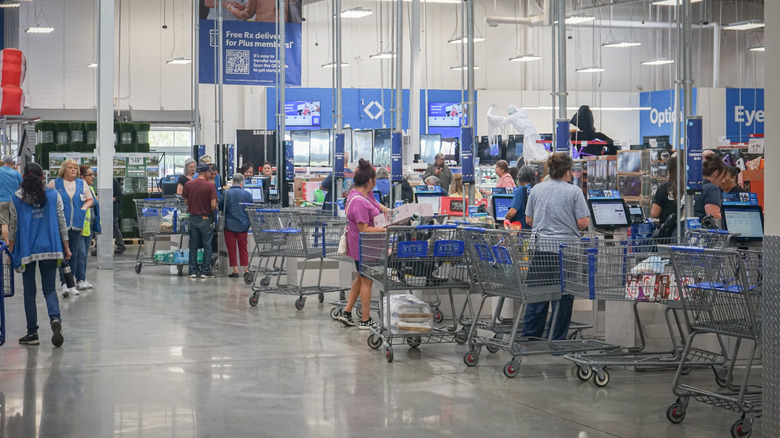
Sam's Club policy explicitly states that the retailer does not match the pricing of rival businesses. (If your pack of nuts is cheaper at Costco, which does price match, for example, you're going to have to go there.) One exception Sam's Club has to this policy is that, depending on location, individual Sam's Clubs may price match with other Sam's Clubs (just don't ask to share your membership). The exception to this exception is that an item on clearance or markdown at one store will not be price-matched at another. This is similar to the price-matching policy at Walmart, which states that items from Walmart.com can be price-matched to in-store inventory (with restrictions), but competitor products won't be considered. To request a price match, Sam's Club advises customers to speak with in-store managers on the why and how.
Price matching may be on its way out
Price matching seems like the sort of policy that's customer-first. To the surprise of no one, however, its beginning and end are both rooted in the fight for corporate dominance over retail spaces. At some point, Walmart, Amazon, Target, and even Toys-R-Us had price-matching policies that were intended as a way to save customers money, but primarily chop the knees out from underneath rival businesses. However, its secondary effect was always a race to the bottom for consumer prices, which doesn't actually benefit a corporation that's trying to mind its bottom line. This, among other reasons, is why Target recently ended its competitor price-matching policy as reported by the New York Times.
By some accounts, the reduction in price-matching policies has been an outcome of changes in the way business is done. Dynamic pricing offers a constantly changing landscape when it comes to cost, offering savvy customers benefits so long as they can keep an eye out for the changes. Alternatively, changing retail channels means that consumers have more choices where to shop these days — allegedly.
If you happen to be shopping at Sam's Club for something like kitchen tools and appliances, but would prefer to shop at a retailer that offers price matching, you should know that options exist. Best Buy, Home Depot, and Lowe's all offer a price-matching policy (with various terms and conditions) that still includes third-party retailers.