

Anthony Bourdain Said This Is The Worst Thing To Do When Cooking Steak

There are endless mistakes to avoid when cooking steak, from choosing the wrong cut to overcooking it. While they can be frustrating, these mistakes allow us to learn, grow, and become more knowledgeable home chefs — but there's one simple mistake you must avoid at all costs, according to the late Anthony Bourdain: Once your steak is done cooking, you should avoid touching it for five-to-seven minutes. Otherwise, all your hard work will have gone to waste.
In an interview with Insider Tech, Bourdain explains why you should avoid touching, poking, or cutting into your finished steak. "What's going on inside is, it is continuing to cook. But even more importantly, the juices are distributing themselves in a truly wonderful alignment," he says. If you cut into your steak without letting it rest, all those flavorful juices Bourdain speaks so highly of don't get a chance to redistribute throughout the steak; rather, they'll just leak out onto the cutting board.
It might be tempting to slice into your beautiful flat iron steak right after you've taken it off the grill, but by doing so, you're eliminating the possibility for an even better-tasting steak. "All the difference in the world between a good steak and a totally messed up steak is going on in that period of time that you're just doing nothing," Bourdain says, so be sure to keep your hands occupied elsewhere to resist any temptation.
Signs your steak didn't rest long enough
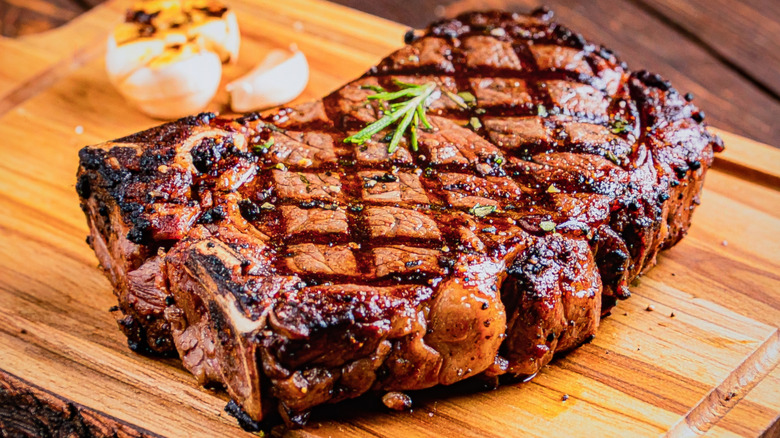
There are a few telltale signs that you didn't let your steak rest long enough. One sign has to do with how it looks on the inside. Bourdain says that cutting into a steak too soon can produce a bullseye pattern in the center. Rather than being a beautiful, red and pink gradient, you'll notice a big red spot, which indicates that it's not fully cooked, and that the juices haven't been able to properly distribute.
If you cook a steak properly, you should be taking it off the heat around 10 degrees before your ideal temperature. Those five-to-seven minutes are part of the carryover cooking process, and they allow your steak to reach that temperature, so cutting into it too soon will only do more harm than good.
Beyond the less-than-ideal bullseye look in the center of your steak, you'll know that you didn't let your steak rest long enough if its juices seep onto your cutting board when you cut into it. You want your steak to be juicy — not your kitchen tools. Too much juice on the cutting board means that your steak definitely needs more resting time, and that it is probably going to be both dry and lacking in flavor. A good, restaurant-quality steak has neither of these qualities, so for the best-possible dinner, don't forget to practice patience.