

The Trick For Converting Fahrenheit And Celsius When Cooking
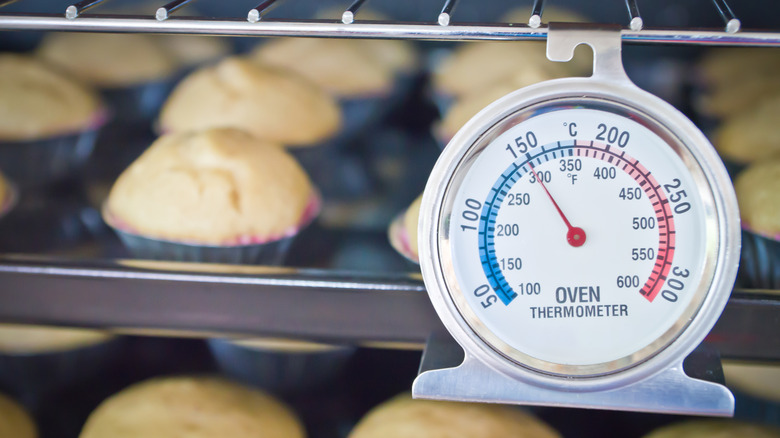
In general, the kitchen is not a place where one expects to need to do too much math. Aside from the simple multiplication required when, say, doubling a recipe, cooking and baking are often a matter of either carefully following the steps and measures laid out in a recipe, or just winging it and letting the chocolate chips fall as they may. But there is one situation where this may not be the case, and a little arithmetic might sneak its way into your culinary routine. Should you find yourself following a recipe from another country, odds are good that the temperatures are going to be given in Celsius, as the U.S. is one of a very short list of countries that uses the Fahrenheit scale. Fortunately, for those who don't mind a little mental math, it is actually pretty easy to convert temperatures between the two systems.
If you want to take a temperature given in Celsius and convert it to Fahrenheit, all you have to do is multiply the number by 1.8 and then add 32. The formula looks like this: (degrees Celsius x 1.8) + 32 = degrees Fahrenheit.
If mathematical formulas aren't exactly your cup of tea, it might be simpler to understand if we put it into a narrative. Maybe you stumble upon an article purporting to have discovered, at the end of years of intensive study, that the ideal oven temperature for cookies is 200 degrees Celsius. To convert that number to Fahrenheit — and absolutely nail your bake — just multiply the 200 degrees Celsius by 1.8, which gives 360, then add 32, for a total of 392 degrees Fahrenheit. For the record, that number is not purely hypothetical, with research indicating it may be the perfect temperature for baking cookies.
Converting between temperature scales just requires a little arithmetic
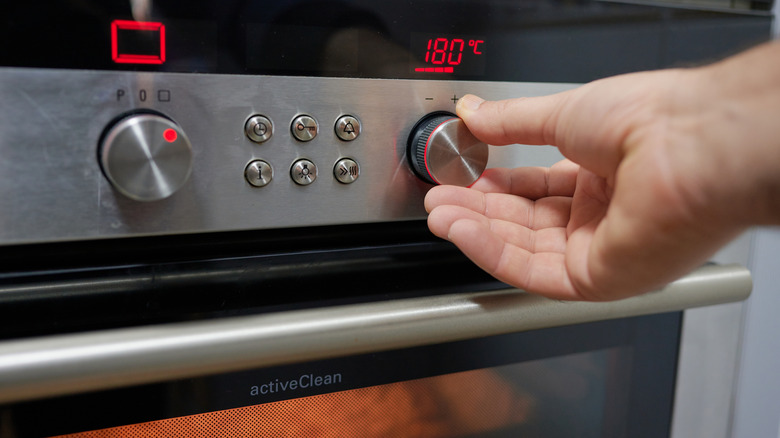
If you are cooking in the U.S., that simple conversion should cover you and open the door to converting those traditional European cookie recipes to work with your home oven. Of course, if you find yourself on the other side, and you want to share one of your grandma's secret baking recipes with folks elsewhere in the world, you just need to reverse that formula.
Converting Fahrenheit to Celsius is just as simple, though mental division does tend to feel a bit harder than mental multiplication. All you have to do to take a temperature from Fahrenheit to Celsius is subtract 32 and then divide by 1.8. The formula looks like this: (degrees Fahrenheit – 32) ÷ 1.8 = degrees Celsius. We can probably skip the bulk of the narrative this time, and instead just use that same cookie temperature as before. If you want to tell a friend in Spain that Nana's gooey lemon butter cookie recipe is best at 392 degrees Fahrenheit, start the conversion by subtracting 32, which leaves 360, then divide that by 1.8, which gives you a final temperature of 200 degrees Celsius.
If mental math isn't your strong suit and you are dealing with a finicky recipe where exact temperatures are paramount, you might be best using a calculator. You can either find yourself a dedicated temperature conversion calculator online or punch the question into google — format it like: "392 degrees Fahrenheit to Celsius" — and it will convert it for you right there. For those who wish to dig a little deeper, however, some understanding of how the scales came to be might make it easier to wrap your head around the conversions.
How these two temperature scales relate to food
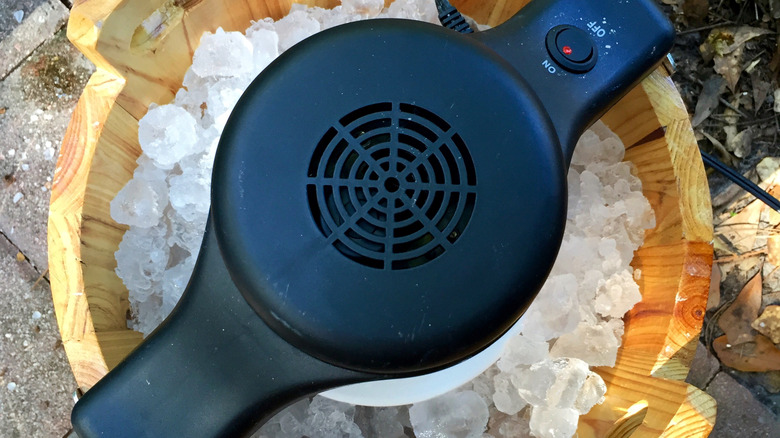
The Fahrenheit scale was developed in the 1720s by Daniel Gabriel Fahrenheit, a couple of decades before Anders Celsius put out his own scale. The lowest point on the Fahrenheit scale was not the freezing point of water, but rather the coldest temperature he could achieve with ice, water, and salt. Salt has a super-cooling effect on ice, which is incidentally the same method that was used for making ice cream before modern technology took over. For the high end of his scale, Fahrenheit chose the human body. The average body temperature did not end up at exactly 100 degrees, however, as the scale was adjusted to have a 180 degree gap between the freezing and boiling points of water.
The Celsius scale has a fairly obvious connection to the kitchen. 0 degrees Celsius is the temperature at which water freezes, and 100 degrees Celsius is the temperature at which it boils. Interestingly, however, when first released, the Celsius scale was inverted, with zero degrees being the boiling point of water and 100 degrees the freezing point. Thankfully, later in the 18th century other scientists decided to invert the scale.
If you are grumpy about the math that goes into converting temperatures, you can at least be glad for the adjustments made to these scales, and how they simplify the calculations. If the Fahrenheit scale hadn't been adjusted for that 180-degree difference, or the Celsius scale hadn't been inverted, the mental math would be a lot more confusing. Plus, we're all carrying a calculator in our pocket these days, so things could be a lot worse.