

This Iconic Midwest Beer Keeps Getting Harder To Find
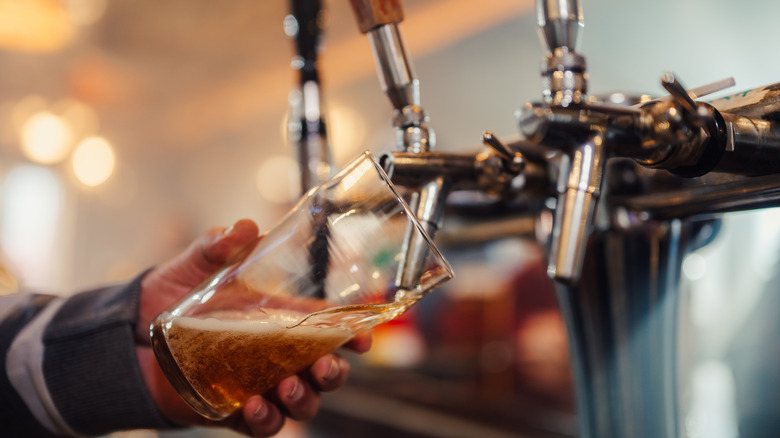
Some legends never die. They may disappear for a time, but if a brand truly resonates with a population and represents local history, it might just live on. Stag Golden Lager is one such living legend, surviving Prohibition and numerous changes of ownership since it was first brewed in Illinois over 100 years ago. Despite the brand's prestige, Stag seems to be getting harder to find year after year.
After changing hands many times over its lifespan, Stag Golden Lager is now owned by Pabst, a company that owns more brands than just their perfect beer to use in fish fry batter, Blue Ribbon. Rather than brewing Stag in proprietary brewing facilities, Pabst pays other production breweries to make the beer. This process is called contract brewing. Pabst had the beer contract-brewed by MillerCoors (later Molson Coors) for a long time, but is now under agreement with both Anheuser-Busch InBev and City Brewing to brew many of its brands, including Stag.
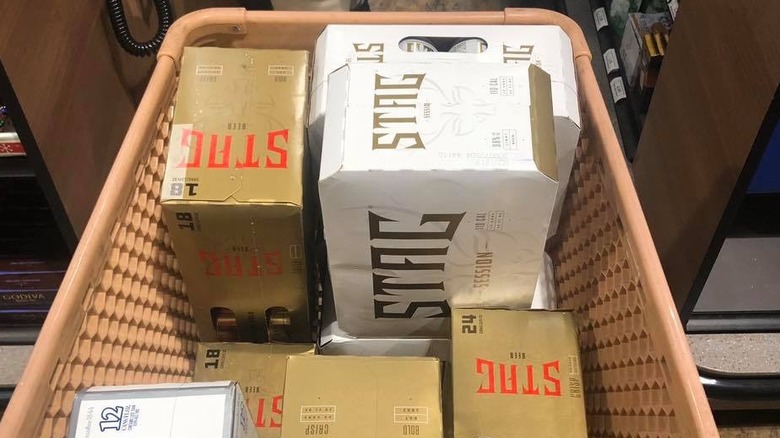
Sadly, to the dismay of Stag fans across the Midwest, the beer seems to be getting even harder to find, with one February 2026 Reddit post suggesting that kegs are being discontinued. The beer appears to still be available in pack form, however, and can be purchased from online retailers and in select Midwestern markets. Although there are states in the Midwest that drink more beer than Illinois, the pride the state has for Stag has kept the brand alive for over a century.
A history of Stag's ownership
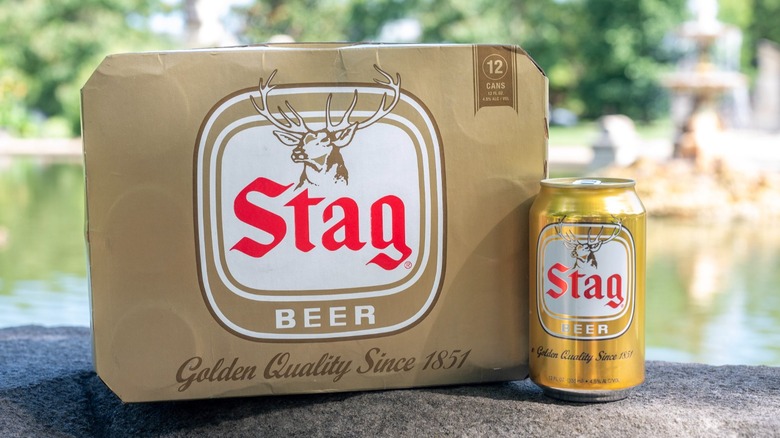
Before Stag, there was the Neu and Gintz Brewery, which started up in 1851 in newly-developing Belleville, Illinois. This brewery was later renamed Western Brewery, having changed ownership several times before eventually landing in the hands of Henry Louis Griesedieck in 1912. Belleville was settled by many German families, who brought with them a wealth of brewing tradition. Griesedieck was from a famous brewing family and used a traditional German lager recipe to introduce Stag, bridging the gap between American and German beer for over a century to come.
Around 1920, Prohibition brought Western Brewery to a standstill, until 13 years later when it once again opened its doors and Stag returned to Illinois. Another change of ownership came in the 1950s when Carling Brewing Company purchased the brewery, and again in 1979 when Wisconsin's G. Heileman Brewing Company bought Carling, and yet again when Heileman merged with large Australian brewing conglomerate Bond Corporation Holdings Limited.
Why Stag's original brewery closed
The Heileman/Bond brewery operated for a few years in the '80s until it was eventually shut down for good in 1988. It was closed for a few reasons, including the building's age, the brewery's capacity and location, and infringement on the area's water — it allegedly couldn't meet IEPA (Illinois Environmental Protection Agency) clean-water compliance standards.
According to the Digital Research Library of Illinois, Heileman was sued by the U.S. Environmental Protection Agency the year after the brewery closed for pollution of Belleville's sewage system over the past near-decade. The bizarre circumstances around the brewery's closure are allegedly described firsthand by one commenter claiming to be a former employee: "Management never wanted Stag to be successful. It was very unusual in the days leading up to the closing they made us clean all the coolers and areas with caustic and TSP all going down the drains. In the six years I worked there it wasnt done like that, it was a scam!!" TSP presumably refers to trisodium phosphate, a potent chemical cleaning agent.
Despite its original brewery closing its doors long ago, Stag beer lives on — not through a brick-and-mortar facility, but as a beloved, contract-brewed legacy label. The brand has not been without its changes over the past few years, with a controversial update to the logo's design in 2019. In 2022, Pabst brought back the old-school label, which still proudly reminds us of the beer's history with its slogan: "Golden quality since 1851."