

This Often-Overlooked Crème Brûlée Addition Adds Unique And Sweet Floral Notes
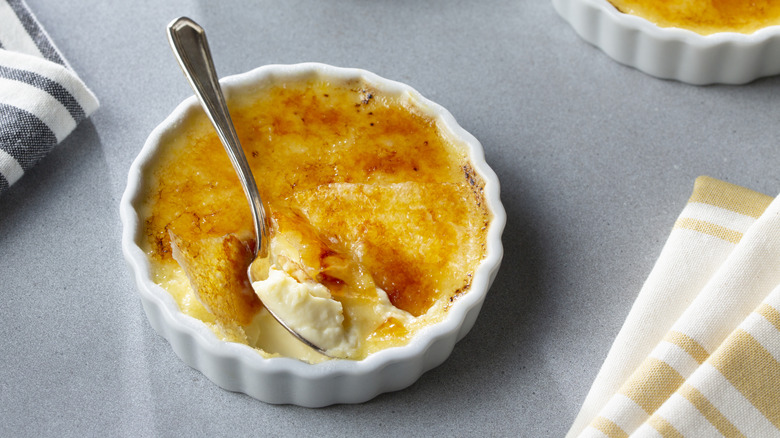
Few things end a fine meal with quite so much elegance as a ramekin of crème brûlée. Between the joy of gently cracking the burnt sugar top with the back of a spoon and the silky, delicately sweet custard hiding underneath, crème brûlée is a dessert rich in flavor, texture, and experience. But even dishes that are near perfect in their traditional form can benefit from a touch of creative flair. Chef Trew Sterling, executive pastry chef of Pastis Miami, told us that crème brûlée is ripe for just such a novel touch, and his simple suggestion is to turn up the complexity with a dash of honey.
"Adding honey to a crème brûlée base is a beautiful way to introduce nuance and depth," Sterling says. "Because crème brûlée has a naturally delicate flavor profile with cream, egg yolks, and vanilla, the honey doesn't just add sweetness; it becomes a defining flavor component." As such, it is important that the type of honey used in the custard base be chosen carefully to work in tandem with the other flavors.
"Much like wine," Sterling says, "honey reflects its origin and depending on the varietal, it can bring floral, fruity, earthy, herbaceous, or caramel notes to the dessert." Given the subtlety of the flavors in the dessert, he suggests opting for a floral honey, such as orange blossom, clover, or lavender, which can play its part without becoming the star of the show. However, Sterling does acknowledge that stronger-flavored honeys, like buckwheat, chestnut, or manuka honey, can work too, so long as they are used judiciously. "Ultimately, there are no wrong answers if you understand the fundamentals of a proper brûlée base," he says.
Incorporating honey in crème brûlée

Crème brûlée can be a bit finicky, between setting the custard and torching the top before serving, but if you know what you're doing, a touch of honey can be just the thing to elevate your crème brûlée without much effort. The key pieces to the puzzle are how much honey to use and when to add it. Fortunately, Chef Trew Sterling has these details for us.
"The best method is to dissolve the honey into the cream as you gently heat the base," Sterling says. While your favorite classic crème brûlée recipe likely has you mixing the sugar with the egg yolks before beginning to heat the custard base, the best results here come from dispersing the honey into the warming base. This gentle incorporation ensures balanced sweetness and honey flavor in each spoonful.
The question of balance is also important to the overall measurement of honey added to the recipe. "Honey is approximately 1.5 times sweeter than granulated sugar," Sterling says, "so you'll want to reduce the sugar in your recipe by about 25 to 50%." This reduction also defines how pronounced the honey flavor is in the custard, keeping it from becoming overwhelming.
Even with those pointers, there are a few more considerations to make. Because honey contains both sugar and moisture, reducing the overall sweetener by about 10% helps ensure a properly set custard. Be warned, though, the custard may also require a slightly longer bake, thanks to honey's hygroscopic qualities. And, finally, Sterling has one more warning: Honey on top won't melt and recrystallize into a crackly shell, so you'll want to stick to plain old granulated sugar for that part at least.