

Give Your Favorite Chili Mexican Flair With Just A Few Additions
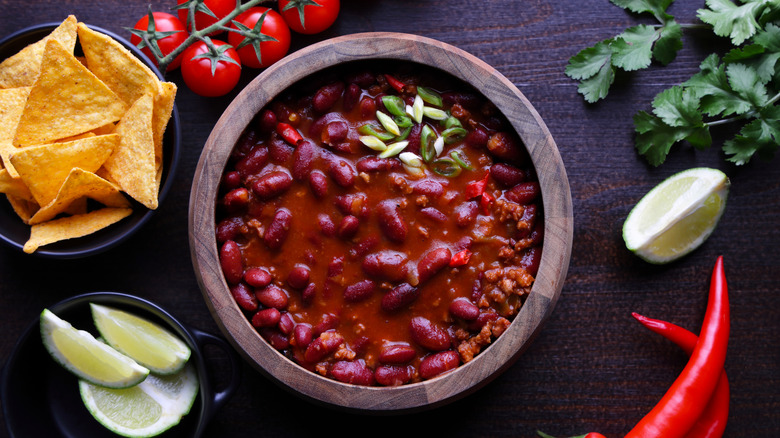
The exact origins of chili are a matter of wide speculation, with stories of the first pot of spicy bean, chile, and meat stew being attributed to cooks of all stripes. Some speculate that the first chili was a dish for cowboys on the cattle trail, made with easy-to-carry bricks of lard, meat, and chiles, while others suggest Canary Islanders brought their spices and culinary techniques to the New World, prompting prompted the creation of the dish. The wildest origin story even suggests that a Spanish nun metaphysically traveled to Texas in a trance — never physically leaving her convent in Spain — where Native Americans gave her a recipe for a venison stew with chiles in exchange for her spiritual guidance.
All we can really be sure of with regard to the first pots of chili is that the modern dish comes from the region that is now the border between Texas and Mexico, and it was likely born of a combination of indigenous and Mexican ingredients and techniques along with the culinary influence of European colonists. As such, chili is a dish that both welcomes regional variation and may be best when made with a significant nod to Mexican cuisine. But what we're suggesting here is not your run-of-the-mill Mexican influence, using chipotle or ancho chiles or topping the chili with crushed tortilla chips. No, for a truly unique bowl of chili that really sings an intriguing tale of Mexican cuisine, try topping it with elote or esquites ingredients.
How to bring the best parts of elote to your bowl of chili
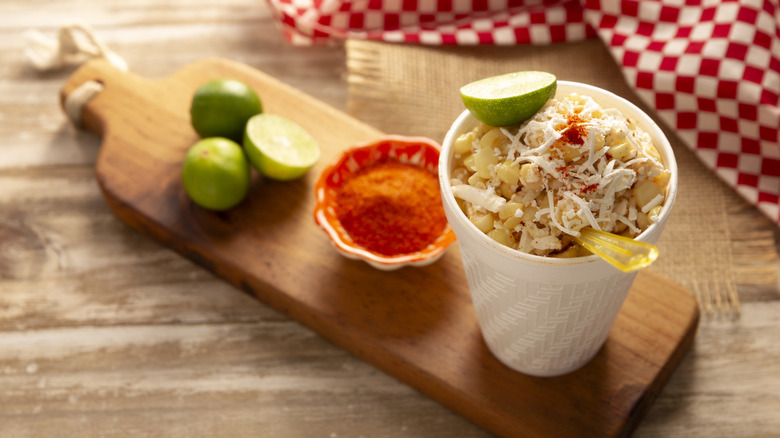
If you aren't familiar with these dishes, well, you are in for a treat. The word "elote" technically refers to any corn on the cob, but it is often used as shorthand for Mexican street corn. This is a common dish sold by vendors in which corn on the cob is coated in a creamy sauce and topped with cheese, lime juice, and spices. Esquites is basically elote in salad form, with the corn and toppings served in a cup rather than on the cob. It may already be clear how these ingredient lists make ideal chili-enhancers, but we'll go into a bit of detail about exactly how and why each of them are a good fit.
For starters, we have corn. This is the base of both elote and esquites, and adding it to a pot of chili isn't really all that new or exciting. But many of the best elote recipes involve grilling the corn to get a bit of char on the kernels, and that is a new take. Rather than dumping a can of corn into your chili pot, grilling the corn and piling kernels on top gives a little pop of sweetness as well as an intriguing touch of smoke.
Crema is an obvious fit for chili as well. Many elote recipes use mayonnaise-based sauces, but for chili it is probably better to stick with crema. Mexican crema is a creamy sauce similar to a mild, thin crème fraiche. It is sometimes tangy, but always rich. The pourable texture makes it great as a garnish, much easier to swirl around your bowl than a dollop of sour cream. Additionally, if your chili comes out a bit too spicy, crema is a great way to turn down the heat.
Elote is all about choosing the right toppings
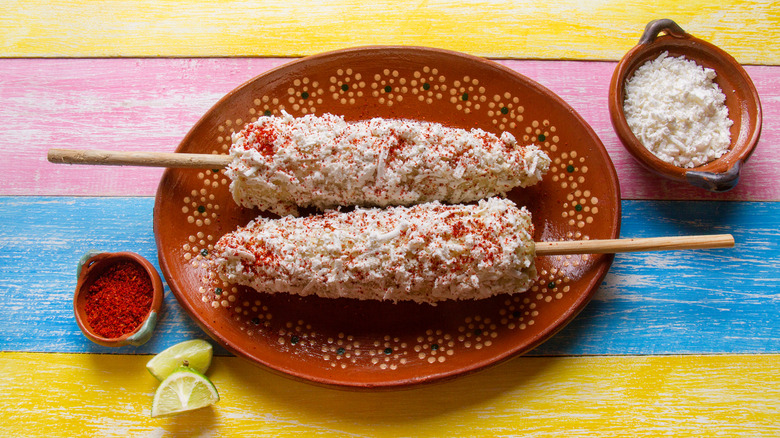
In addition to corn and creamy sauce, a heavy sprinkle of one of a variety of Mexican cheeses is an important part of any elote recipe, and another ingredient that belongs on your chili as well. Cotija cheese is probably the most common choice here, a nice crumbling cheese that can be reduced to a fine powder. Cotija does come in a variety of different ages, however. Young cotija is softer, with a mild salty flavor. Aged cotija, on the other hand, is harder, and takes on a texture better suited to grating as well as a more complex flavor that is often compared to parmesan cheese. Both, however, are delicious over chili. Or you can opt for some crumbled queso fresco, a cheese that is similar in flavor to a young cotija, but slightly more moist and with a creamier texture.
With just those three additions you have yourself a whole new chili experience, but there's no reason that you shouldn't bring the whole elote experience to the table. Finely chopped cilantro gives the dish a layer of freshness, an extra sprinkle of ground chile adds earthy heat, and a squeeze of lime will brighten things nicely.
Considering how wonderful and diverse the flavors in the toppings are, you might not want to use this technique with a particularly complex chili recipe, lest you end up with too many flavors competing for the spotlight. For a standard West Texas chili recipe, however, or a pot of white chicken chili from the slow cooker, the elote treatment might be just what you need to turn a good meal into something spectacular.