

Apples Vs Bananas: How They Stack Up Nutritionally
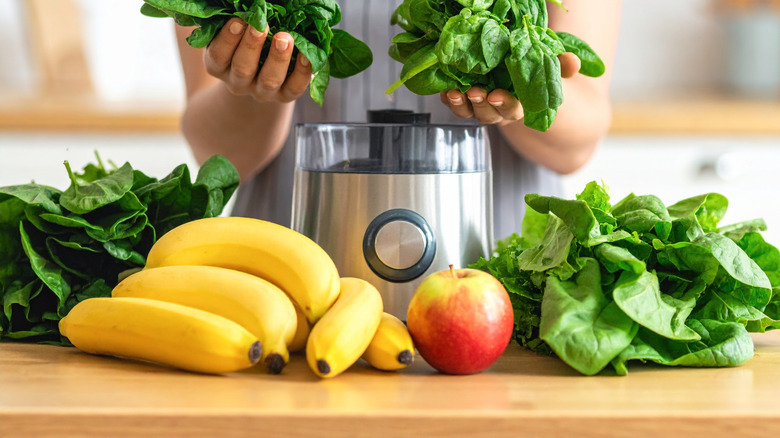
It's famously hard to compare apples and oranges, but no one is talking about apples and bananas. Well, except for Raffi. Apples and bananas are two of the most common grab-and-go fruits in American diets, and both are affordable, portable, and widely available year-round. They each contain fiber, carbohydrates, and essential micronutrients and vitamins. Neither one is a nutritional villain, but their compositions vary in ways that can make a difference depending on what your body needs, and having nutrient literacy can be empowering.
A medium banana (about 115 grams) contains roughly 113 calories, 23 grams of carbohydrates, and three grams of fiber, while a medium apple (about 140 grams) contains around 90 calories and 21 grams of carbohydrates and three grams of fiber. The numbers are pretty close, with bananas skewing a tiny bit higher in carbohydrates, largely from starches that convert to sugar as the fruit ripens.
Because both fruits contain naturally occurring sugars, they raise blood glucose levels to some degree. Bananas tend to have a moderate glycemic index, which increases with ripeness, whereas apples usually rank a bit lower. How drastically the fruits, or any food, spike your blood sugar really depends on your body composition, what else you've eaten that day, and even how tired you are. Pairing fruit with protein or fat — typical fruit pairings like peanut butter, cheese, or yogurt are perfect choices — can slow digestion and moderate glucose response. For most healthy people, though, the sugar in whole fruit is not something to fear, worry about, or even track. Fiber and water content significantly moderate the metabolic impact compared to any type of refined sugar.
How carbs, sugar, and ripeness work

Apples and bananas look similar on paper, but there is some interesting nuance when you look at how their carbohydrates are structured. Apples derive nearly all of their carbohydrates from naturally occurring sugars, primarily fructose, and smaller amounts of glucose and sucrose. Bananas contain a meaningful amount of starch that gradually converts to sugar as the fruit matures. That starch content is what gives bananas a more substantial, sustaining feel, because the starch, which is a complex carbohydrate, takes longer to convert to glucose-then-energy in the body, whereas apples may give a faster, "sugar rush" that drops off more quickly, because the body accesses and uses up the apple's sugars more readily, whereas the banana's starch is processed more slowly and steadily.
Ripeness is also a big factor. In slightly green or just-ripe bananas, more starch is intact, but as the fruit ripens, enzymes convert the starch into simpler sugars. By the time a banana is fully overripe, starch content has dropped dramatically, from 3.66 to about 0.41 grams per 100 grams, while glucose and fructose rise proportionally. This makes the fruit taste sweeter, obviously, but it also alters how quickly the fruit is digested, in turn affecting the velocity of blood sugar spikes. Greener bananas contain more resistant starch, which is more like fiber, gut-wise, whereas super ripe bananas are metabolically closer to straight sugar.
Water content is also an element that should be taken into account. Apples contain about 117 grams of water per 140-gram serving, rivaling watermelons when it comes to hydration, and making them more dilute and slower to eat. Ripe bananas are denser, bite for bite, containing about 86 grams of water per 115-gram serving. This is why a banana feels like a meal, and apples are more of a snack.
Mineral, temporal, and geographic context
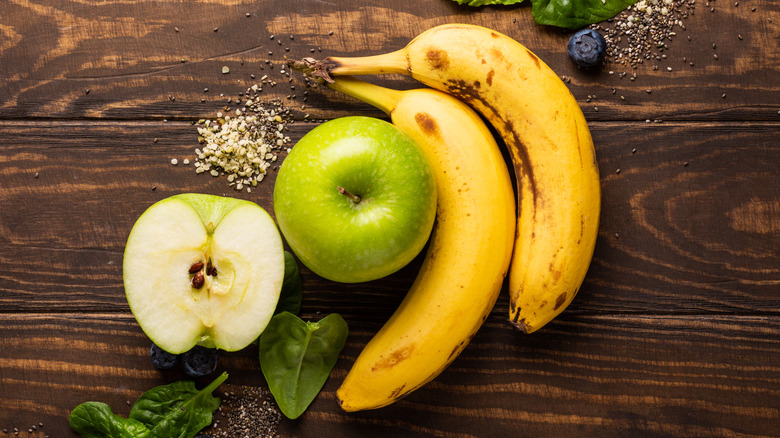
While apples and bananas are close in calories and carbohydrates, their mineral profiles diverge. A banana delivers roughly 326 milligrams of potassium, compared to about 146 milligrams in an apple. Bananas also contain significantly more magnesium, around 28 milligrams compared to the 6.5 milligrams in an apple. These differences impact muscle contraction and electrolyte balance. This is why bananas are associated with athletic recovery; their high mineral content supports fluid balance and nerve signaling. Apples contribute micronutrients, too, but they're less concentrated in those particular categories.
Geography and ecology are also worth looking at, because how and where food is grown both influence the nutrient content. The bananas most Americans eat are almost exclusively the Cavendish variety, grown in tropical regions in the Global South, harvested green, and ripened in transit, which is how we get fresh bananas even in the most frigid areas of the country all year long. Apples, on the other hand, are grown widely across temperate climates, especially in states like Washington and New York, and exist in thousands of cultivars. A Fuji, a Gala or a Honeycrisp will all have different nutrient profiles compared to a Macintosh, a Red Delicious or a Granny Smith. Apples are picked ripe during the late summer-into fall harvest time, and then sit in controlled-atmosphere storage for months, getting mealy and converting their starches to sugars, along with other nutrient and vitamin levels, over time.
In the end, the comparison between apples and bananas comes down to context. A banana might be the best choice in the morning or before a long run, and an apple might be perfect for hydration (the major unknown benefit of eating apples) and energy at the summit of a hike. Nutritional literacy is useful, but fruit is not a metabolic threat to be managed. Both are whole foods, rich in water, fiber, micro, and macro nutrients. Either one is a good choice.