

Why 19th-Century Bourbon Tasted So Different Than The Liquor We Know Today
Bourbon is arguably America's most iconic whiskey — it's what Hank Williams Jr. sang about, what Mark Twain grew up with on the banks of the Mississippi, and what John Wick sips in the rare moments of peace between the mayhem. The hold that bourbon has on the popular imagination is tied to our specific understanding of what it is and isn't. Under the United States Code of Federal Regulations, the mash from which bourbon is distilled must be at least 51% corn, distilled at no higher than 160 proof, and aged in new, charred oak barrels. And yet, what was known as bourbon in the 19th century was, in both taste and the regulation of its production, far different from what we know today.
According to Gerald Carson's book "The Social History of Bourbon", the former governor of Kentucky Augustus Owsley Stanley claimed that the first Kentucky whiskey was made from rye, but following a disastrous rye crop one spring, "the Kentucky distillers mixed corn meal with their rye mash as a desperate expedient, and so discovered the proportions of what became famous later as bourbon." Whether or not this legend is true, Carson writes: "For a long time, and just how long no one knows, whiskey was just whiskey in Kentucky ... Packaged in uncharred barrels and with no identification as to its source, the liquor was colorless, with a sharp odor, and biting taste." Early so-called bourbon therefore had more in common with the unaged, untaxed, and illicit liquor we today know as moonshine due to its potent, less refined profile.
If you want to taste 19th century bourbon, try modern moonshine
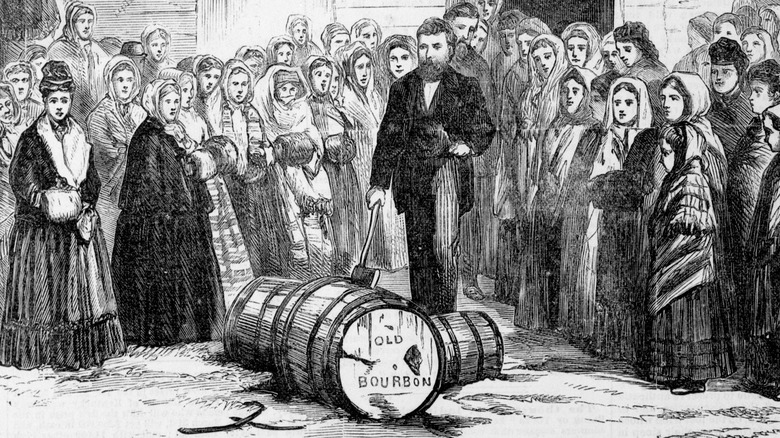
Although 1870 saw the release of Old Forester, advertised as "America's First Bottled Bourbon", the Gilded Age which followed the Civil War saw the whiskey industry plagued with corruption — most notably the "Whiskey Ring" of tax-dodging distillers — with much of what called itself bourbon as being little different than legal moonshine called under a different name. However, greater regulation would steadily narrow which whiskeys could be sold as bourbon and how it should be produced; today, those requirements are U.S. federal law.
Those curious to know what 19th century bourbon would have tasted like should probably ignore its modern descendants, and instead sample the burgeoning subset of legal white dog liquors sold at the store that market themselves as moonshine, which has its own devotees. Nevertheless, there may be one exception. In 2021, the Massachusetts auction house Skinner, Inc. announced it would be accepting bids on what they believed to be the world's oldest bottle of bourbon known to exist – a bourbon that, according to its type-written label, "was probably made prior to 1865", and which carbon-dating suggests was produced at some point between 1763 and 1803. The bottle went for $137,000, with the bidder remaining anonymous. Given what we do know about 19th century bourbon's dubious quality, the mysterious bidder might be better off leaving the historic bottle unopened.