

Why You Might Want To Avoid The Sam's Club Member's Mark Decaf Coffee Pods, According To Customers
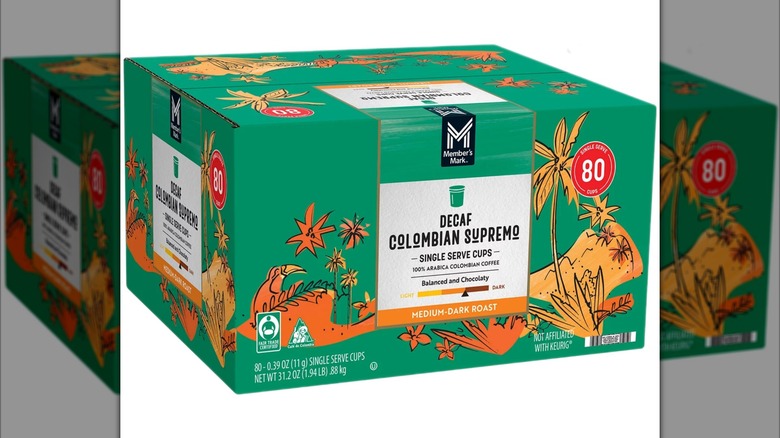
While famous brands like Starbucks command plenty of loyalty, Sam's Club shoppers know that its store brand Member's Mark offers equally great coffee products for less dough. However, for every Sam's Club dupe that reviewers say outshine the originals, there are other items that customers pan, like the Member's Mark decaf coffee pods. The red flag is the possible presence of methylene chloride, a chemical that has long been under fire for its potential health consequences.
Soaking coffee beans in a methyl chloride solution is a long-standing way to decaffeinate coffee. The Member's Mark Colombian Supremo Decaf Coffee Pods make no mention of the chemical on the package; however, in 2024, a Reddit user claimed to have called Sam's Club about the product and received confirmation that the coffee is decaffeinated using methyl chloride. At least one other source also alleges that these pods contain the controversial solvent.
Though methyl chloride is approved by the U.S. Food and Drug Administration, the chemical has been labeled as a carcinogen by the National Institutes of Health and Environmental Protection Agency. According to the EPA, various studies have found that inhaling methyl chloride increases the risk of lung and liver cancer in animals, leading the organization to label it as a "probable human carcinogen." This chemical is also widely used in paint strippers and degreasers. While an ingredient isn't necessarily bad because it has non-food uses, it's understandable why Sam's Club members are put off by the Member's Mark decaf pods.
How dangerous is the methyl chloride in Member's Mark decaf coffee pods?
While its alleged use of methyl chloride is concerning, Sam's Club isn't exactly putting customers in extreme danger. The FDA only permits methyl chloride in food and drink in the amount of 10 parts per million (ppm), or 0.001%. Typically, as little as 2 to 3 ppm is left in coffee beans after they've been rinsed and roasted. In major cases where methyl chloride caused health defects in humans, the affected persons directly inhaled amounts in the range of 1,000 to 4,000 parts per million — degrees higher than what's left in decaf coffee (via Centers for Disease Control).
Studies on methyl chloride's cancer-causing effects are also limited to animal subjects. The CDC states that "We do not know if methylene chloride can cause cancer in humans," though the potential risk merits classification as a possible carcinogen. According to a report on ScienceDirect, drinking high amounts of decaffeinated coffee has not been associated with an increased total risk of cancer.
That said, if you love the Member's Mark decaf coffee pods and are now feeling disappointed, you might want to voice your thoughts. Sam's Club recently made a major change to Member's Mark products by eliminating 40 ingredients that were "unwanted" by customers. Methyl chloride did not end up on the list, but it could if enough shoppers complain about these coffee pods. Until then, they'll remain an item to avoid buying at Sam's Club in the eyes of many customers.