

This Is How Dutch Bros Sizes Compare To Starbucks (There's Quite A Difference)
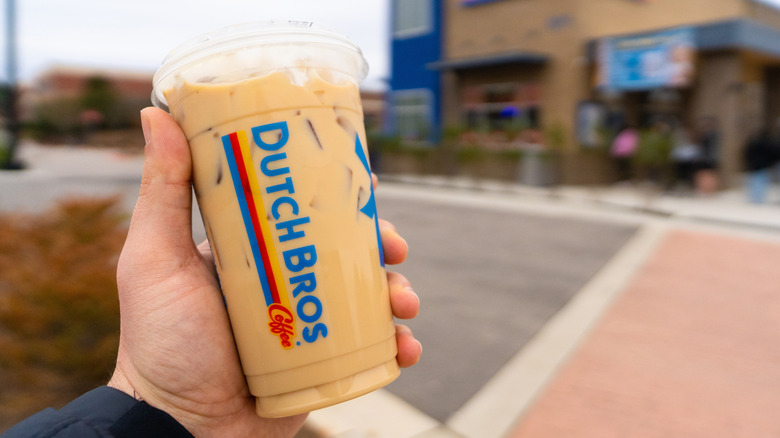
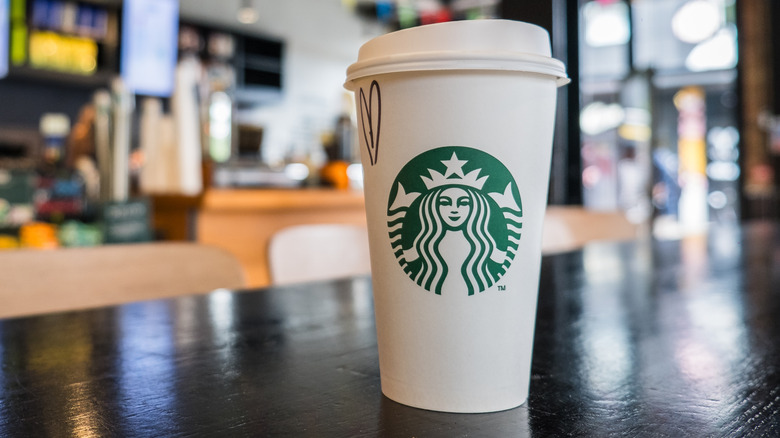
There are many factors a dedicated bean fiend might consider when choosing what coffee chain to frequent, but if you're suffering a caffeine deficiency on your way to work, and are facing a choice between two popular chains, you might wonder how the near-ubiquitous Starbucks compares to its growing competitor Dutch Bros in terms of cup size and price. Which is going to give you the bigger drink, and which is the best value for money?
Let's break it down: In ascending order of size, Starbucks has the demi (three ounces), the short (eight ounces), the tall (12 ounces), the grande (16 ounces), the venti (20 ounces for hot drinks, but 24 ounces for iced drinks), and their largest size, the trenta, weighing in at 30 ounces and only available for iced coffee and iced tea drinks.
Dutch Bros, on the other hand, offers as its smallest option the Kid's Size, which holds nine ounces, and exclusively serves caffeine-free and low-sugar drinks. Then there is the Small (12 ounces for hot drinks, 16 ounces for blended), the Medium (16 ounces for hot, 24 ounces for blended), Large (24 ounces for hot, 32 ounces for blended), and finally its Extra-Large, which holds 32 ounces of a hot drink or an undeniably hefty 44 ounces for an iced Dutch Bros alternative. For those in search of the maximal beverage, Dutch Bros consistently comes out on top.
Bigger is better if you want value for money
Comparing the prices of the two chains is a little trickier, as what you can expect to pay at Starbucks or Dutch Bros will depend on what state and region you are in. Additionally, the coffee industry has faced extraordinary pressure over the past year, partially as a result of U.S. tariffs imposed on Brazil and other major coffee-producing countries, as well as harvest issues, the effects of which may still cause prices to rise.
If you are wondering which cup size at Starbucks or Dutch Bros makes the most financial sense however, customers could simply choose what works best for their budget. While small sizes are the least expensive, buying a bigger cup means better value per ounce, particularly if a smaller one means you'll be back for another before lunch. Similarly, a grande or venti at Starbucks can be better value in terms of coffee-per-ounce than a tall.
Of course, size isn't everything, and there are other considerations that determine where you get your morning brew, be it the urge to support local businesses, a shared joke with your favorite barista, or just taste preferences. Yet with Americans increasingly willing to experiment and switch between the chains where they get their coffee, it's worth being as informed as possible about what you will be getting.