

The Best Way To Heat Water For Drinking (Yes, There's A Right Way)
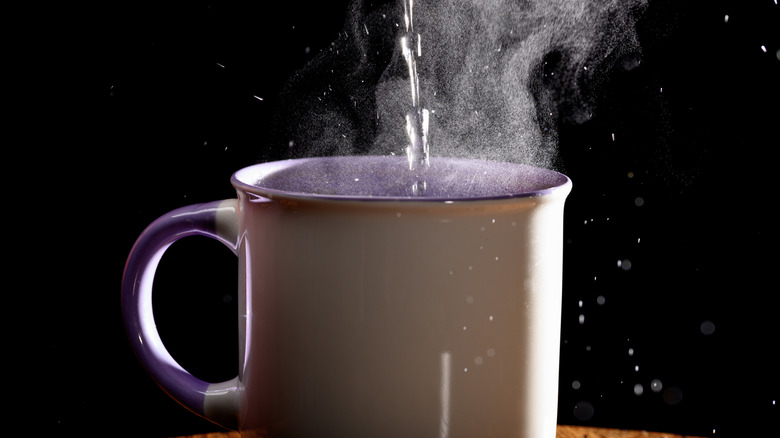
If you're heating a large quantity of water for cooking purposes, your options are fairly limited to pots and pans. On the other hand, if you're only heating a small amount of water for tea, coffee, or just plain hot water, your options expand to all sorts of techniques. It might sound redundant, but there actually is a right way of heating water for drinking, and the answer is a teatime favorite: the kettle.
A kettle heats water entirely different than, say, the microwave, because it uses convection heating, which in turn provides a more even temperature throughout the beverage. When a kettle is placed on the stove, the heating elements first heat the water molecules at the bottom, which become less dense and float to the top, dropping cooler water molecules to the bottom until they too heat and rise to the surface. This provides more evenly heated water.
On the other hand, a microwave is almost the opposite, wherein the water molecules are bombarded with electromagnetic waves until they vibrate. This changes the temperature of the liquid, but it doesn't circulate the water the way that convection heating does. This means that the water molecules at the top of the beverage will be hotter than those at the bottom, which is the biggest difference between boiling water and microwaving it.
Skip the microwave, break out the kettle
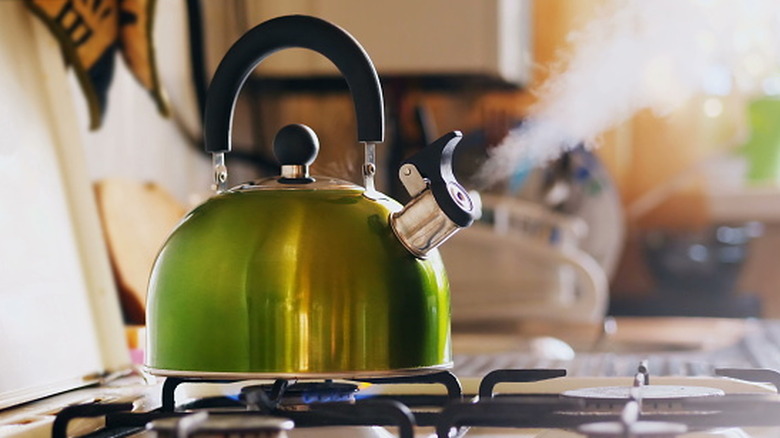
While using a kettle is a better way to heat water than the microwave, it's also better than simply boiling water for tea or coffee in a regular pot. The kettle's biggest advantage for heating water is that it's an enclosed space, meaning no vapors are lost during the heating process, so no energy is wasted. Due to that open top, pots also take longer to bring to a boil, and they can be exceptionally hard to pour once the water is finally hot enough.
You could technically use a lid on a pot to help you boil water faster, among these other unexpected tips for boiling water, but the efficiency of using a pot on an induction stove versus an electric stove can still make a noticeable difference. When it comes to kettles, you've got the option of using a traditional stovetop one or the newer electric kettles.
Modern kettles use a heating element to convert electricity into heat, meaning you can boil water faster with an electric kettle, and it's the more sustainable choice energy-wise, too. Conduction and convection still happen with an electric kettle, so you're still getting that uniform temperature throughout the water. Plus, they typically come with an internal thermostat that clicks off when your water reaches the correct temperature, making it a safer option than traditional stovetop kettles.