

This Colorful 2016 Food And Drink Trend Was Pretty Unhinged, Looking Back
We may receive a commission on purchases made from links.
Why do grown-ups attend Comic-Cons dressed in artfully-mastered, head-to-toe cosplay? Why does the animated Sanrio menagerie have such an impassioned adult fanbase? Why do I feel like I'm going to cry when I sit down on the swing set at my local playground twice a year and push off? The answer, simply put, is that "kid stuff" isn't just for kids. As C. S. Lewis noted, "A children's story that can only be enjoyed by children is not a good children's story in the slightest." Still, with a heart full of reverence for the power of intentional whimsy, the "unicorn trend" that took the food and beverage world by storm in 2016 got a little out of control (to say the least).
When the viral food trend first emerged, the colors were based on natural ingredients with nutritional value. Adeline Waugh, a Miami-based wellness blogger and food stylist, unwittingly springboarded the "unicorn food" trend after posting photos of foods that were dyed with beetroot powder. After her commenters likened the magenta fare to "unicorn food," Waugh adopted the title, incorporating the "unicorn" buzzword into subsequent photo captions. But, as Waugh told The New York Times in 2017, the trend quickly spiraled out of her hands: "All of a sudden all these people were making it and tagging it, and now the unicorn thing has gotten just insane." Soon, natural ingredients like green chlorophyll and freeze-dried blueberry powder were replaced by artificial food dyes in pastel rainbow tones and edible sugar sparkles.
Unicorn food evolved from playful whimsy into a technicolor Icarus
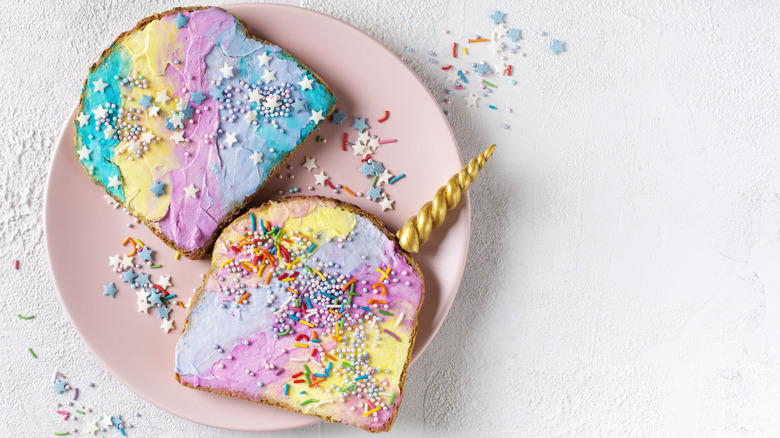
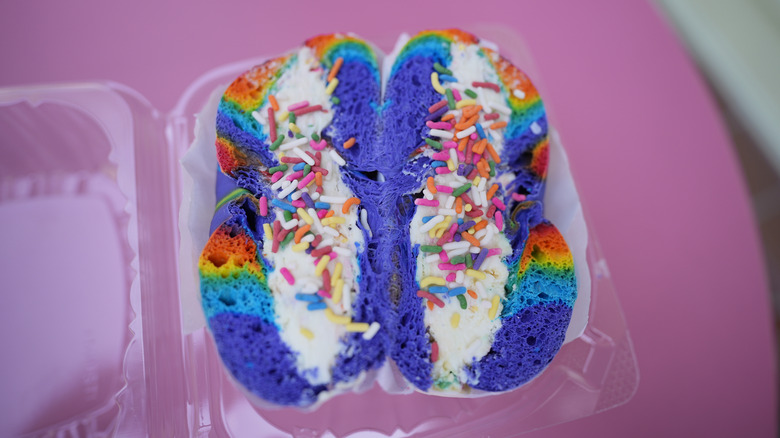
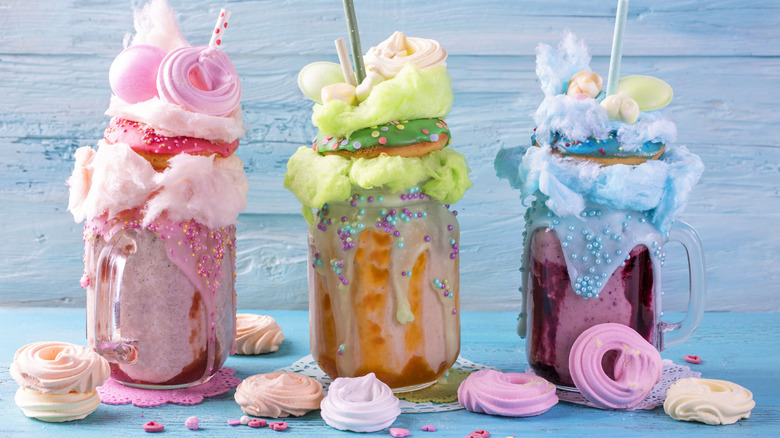
From a culinary perspective, the trend could be argued as an exercise in intrepid, creative, highly-detailed plating. Although, something about biting into a rainbow-dyed grilled cheese sandwich doesn't feel like dining at The French Laundry — it just feels ... kind of wrong, honestly. Unicorn-themed foodstuffs dominated social media and trendy cafe menus alike, featuring cupcakes and even slices of toast garnished with fondant unicorn horns. Purple and pink craft coffees were dotted with pastel mini marshmallows, and rainbow unicorn bagels were spread with multicolored cream cheese and sprinkles. Starbucks picked it up in 2017, releasing a Unicorn Frappuccino that ran for five days only. On Pinterest searches for "unicorn food" saw a whopping, year-over-year increase of almost 400% from August 2016 to July 2017, as reported by USA Today. The trend even leeched into the non-food world, inspiring rainbow eyeshadow looks on the Chanel runway in 2017 and a $396 Midnight Unicorn silk pajama set by Collection Drake's J. Crew that promptly sold out.
Even during the trend's heyday, Tasting Table was reporting that unicorn foods might have gone too far. Fast-forward nearly a decade, and with the benefit of hindsight, it's easier now to see how the novelty food and drink trend became too big for its own good. However, this vibrant, magic-tinged cultural tsunami was notably never designed with longevity in mind. Ultimately, the unicorn food craze found a responsive fanbase in light of the time's less-than-whimsical, sociopolitical zeitgeist.
Adult foodies are searching for a glimpse over the rainbow
In 2017, Jane Buckingham (founder of trend forecasting company Trendera) told USA Today, "Things are hard, and I think whenever things are hard we look for hope, and what is more hopeful and fantasy than a unicorn? In addition, you've got generations — Millennials and Gen Z — who are nostalgic, who are reaching for the past to give them a little bit of stability and purity." The modern adult was (and arguably remains) in need of some fantastical optimism, the same safe, escapist "eternal girlhood" dogma reflected in much of contemporary pop music (and, in the 2010s, Katy Perry's "Teenage Dream" album). Generationally, the pastel trend harkens back to the fond brand motifs of Millennial audiences' childhoods like "My Little Pony" and "Rainbow Brite." Meanwhile, the rise of social media in the 2010s made these aesthetically-pleasing, Instagrammable foods prime, eye-catching candidates for online engagement.
If unicorn-themed foodstuffs were a doom antidote in 2017, then what trends can foodies expect to see in 2026? Nowadays, any enduring unicorn-dom falls arguably more into the muted wheelhouse of the late Middle Ages tapestry, "The Unicorn in Captivity." However, the trend is faintly echoing via the reemergence of Lisa Frank hair clips and maximalist satin bedding that's marketed toward adults. Holiday season 2025 saw McDonald's release a novelty Grinch Happy Meal for grown-ups. Maybe magical days could be on their way once more (but, we'll hold off on the "unicorn snot" body glitter this time around ... thanks).