

How A Syrian Restaurant Became A Boston Fixture During The Great Depression
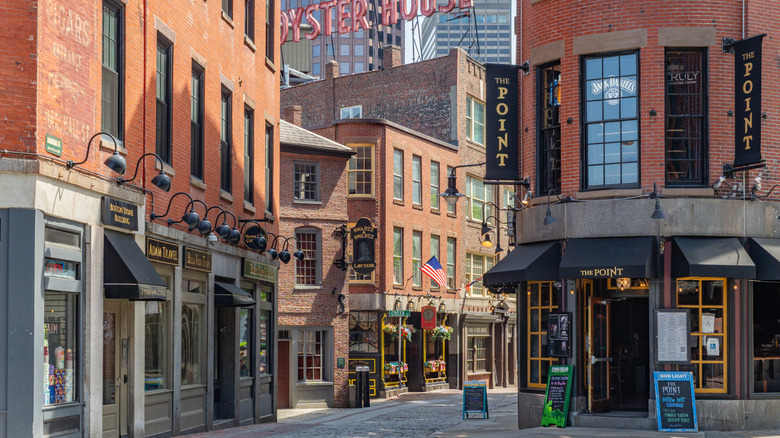
Walk through Boston's neighborhoods today and you'll find Thai, Korean, Italian, Indian — the city's food scene has come a long way. But in the 1930s, if you wanted something beyond American fare, your options were sparse. That's what makes Deeb G. Salem's decision to open The Nile all the more remarkable. Right in the heart of the Depression, this Syrian immigrant and his wife Rose decided to open a restaurant on Hudson Street, transforming it into one of New England's most talked-about dining destinations.
Restaurants got many Americans through the Great Depression. While many businesses were forced to close their doors during this time, restaurants actually thrived, offering inexpensive, delicious meals to families forced to ration bread. But it wasn't exactly a time when people were open to trying new or "exotic" foods.
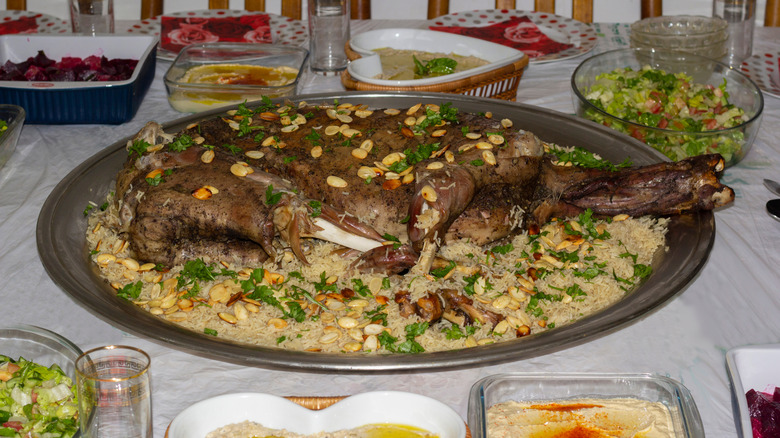
The Nile started in a single room with a mostly Syrian customer base, but Deeb Salem wasn't flying blind. He'd worked through enough New York restaurant kitchens to know how to run an operation. Back in Boston in their newly-built restaurant, he kept the pastry work for himself while Rose took on the role of the restaurant's head chef and John Salem — their son — manned the grill. By the 1950s, people outside the Syrian community were showing up. The restaurant's signatures were lamb, including lamb mishwi (shish kabobs) and kharouf mahshi — a hearty dish consisting of a whole lamb leg stuffed with "hashweh", a combo of spice-laced rice, meat, and nuts. Diners would wrap up their meal with baklava — crisp phyllo layered with pistachios and honey — handcrafted by Deeb. The humble restaurant and its food were so good that, soon, celebrities passing through Boston would make the stop to have a bite.
The legacy and the turnpike's toll
As more non-Syrians were drawn to The Nile, the restaurant also adapted. From a pure-Syrian menu, the Salems added American dishes to their repertoire; and in addition to desserts, they also set up a bar to serve cocktails and beers. Nevertheless, the heart of what they served — the lamb, the pastries, the authentic seasoning — never changed. Newspaper ads played up the Middle Eastern mystique of the restaurant with pyramids and palm trees beside flamboyant taglines like "The Most Famous Syrian Restaurant This Side of the Pyramids" drew diners in flocks to 52 Hudson Street.
Then came the Turnpike. The early 1960s highway expansion destroyed Hudson Street, and The Nile had nowhere to go but out. They reopened on Broadway, no longer a hole-in-the-wall dining spot, but a full-fledged restaurant — multiple adjoined dining rooms, Babylonian murals, a lounge decked out with flying carpets. It looked promising ... but it wasn't quite home to the regulars.
Deeb Salem died in 1966, and as the restaurant lost its anchor, money tightened. By 1969, it was done. But The Nile had already left its footprint on the city. The Salems proved that Syrian cooking — relatively niche in a city whose food landscape is dominated mostly by European cuisines like Greek and Italian (Global Eats) — could draw crowds, and that a single restaurant run by people determined to do it right could reshape how an entire city understood food. That proof didn't vanish even when the restaurant closed its doors.