

The Traditional Garnish Restaurants Use To Trick You Into Thinking Their Fish Is Super Fresh
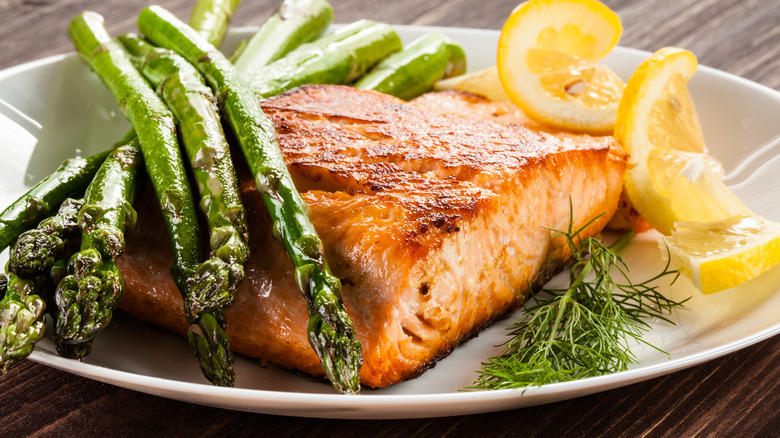
As popular as seafood is, it can also be a risky proposition. People make jokes about eating gas station sushi, or trusting a cafeteria tuna sandwich. We all know that seafood presents a risk if it is not handled and prepared correctly. According to the Journal of Food Protection, there were 2,400 seafood recalls in the United States between 2002 and 2022. Research presented in the journal Foodborne Pathogens and Disease shows that about 260,000 Americans fall ill from fish every year. A lot of this happens in restaurants. While you hope no one is knowingly serving spoiled fish, some restaurants may try to mask spoilage simply by using lemon.
Tasting Table talked to Chef Franklin Becker of Point Seven restaurant about ways some restaurants trick you into thinking their fish is fresh. Chef Becker told us about lemon and how it's kind of a complex ingredient. He uses it in his own restaurants to add acidity and accent the flavor, but pointed out, "there is a chemical reaction that occurs with citric acid that can mask any undesired odors."
That stereotypical fishy odor is chiefly caused by a compound called trimethylamine. It's a natural result of fish muscle tissue breaking down. The older the fish, the more it will smell. But the citric acid in lemon juice neutralizes the alkaline trimethylamine, reducing the smell. An unscrupulous chef could use this to mask fish that has just begun to spoil.
Acting fishy with the fish
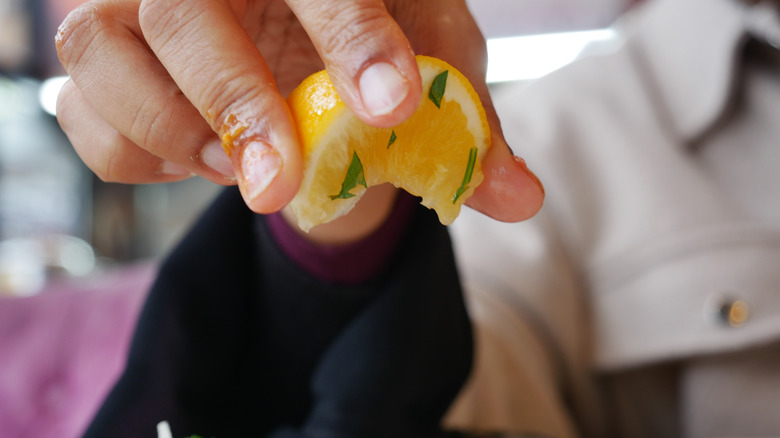
If lemon is being used to mask spoilage in fish, there are other warning signs to watch for. They may be more subtle, but if you feel something is off, trust your gut. "If there are putrid or sour smelling notes or ammonia notes, the fish is past its prime," Becker says. "If the fish is soft or mushy and does not bounce back at you, it is past its prime." In addition to ammonia smells or overly fishy odors and flavors, be on the lookout for other signs of spoilage such as discolored grey or brownish flesh that may be dry and crumbly.
As Becker acknowledged, lemon does have a place with fish and that's what makes this a difficult red flag to call out. Lemon complements even the freshest fish. The acid denatures proteins beyond what cooking with heat does, which is how a preparation like a ceviche works. Essentially, you cook with the acid because of how it alters the protein, and that is something desirable. In addition, lemon provides a bright, acidic contrast to briny or oily fish. It just rounds out the flavor, so it's not a red flag on its own.
Finally, while some bacteria in fish can be killed by cooking, not all foodborne illness is caused by bacteria. Scombroid poisoning happens when fish is poorly stored and builds up histamine. The symptoms of this type of poisoning are like a severe allergic reaction. This is why it's important to avoid spoiled fish whenever possible.