

The Chinese Techniques That Make Bacon 10X Better
We may receive a commission on purchases made from links.
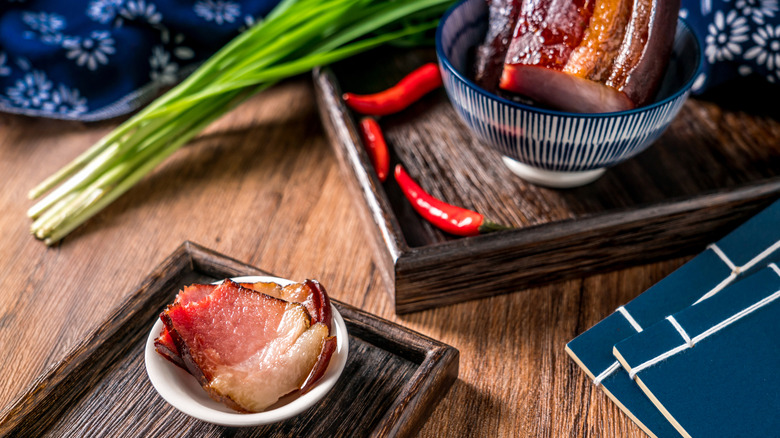
Bacon rarely takes center stage on a plate — it is either sitting next to scrambled eggs and toast or tucked away in a sandwich along with lettuce and tomato — but it is always the show-stopper. It is a side dish that has main-character energy. Think about it. You put bacon in ice-cream and it is the bacon that sings. You use candied bacon as a cocktail garnish, and suddenly that is all anyone's talking about. But, while all bacon is great, some bacon is just greater than others. If you disagree, try some Chinese-style bacon called Lap Yuk or La Rou. It should be available at any Asian supermarket near you (or even on Amazon). The Chinese techniques, from flavoring to curing, make this version of bacon 10 times better, and it can be used in a wide variety of Asian dishes.
Bacon, essentially, is pork that has been salt-cured. Curing is a preservation process that involves drawing out the moisture from the meat to inhibit microbial growth and extend their shelf life. There are different types of bacon around the world, separated either by which cut of pork is used, the technique involved in curing, and how it is integrated into various dishes. American bacon and its Chinese cousins are both made using the same affordable pork cut: the belly. However, they are literally worlds apart when it comes to flavor and texture. American-style bacon celebrates the porky-ness of the meat and is crispy when cooked. Meanwhile, Chinese-style bacon is more aggressively seasoned and has a soft, chewy texture. This is because of the wide difference in the techniques and ingredients used in the curing process.
Curing techniques and ingredients
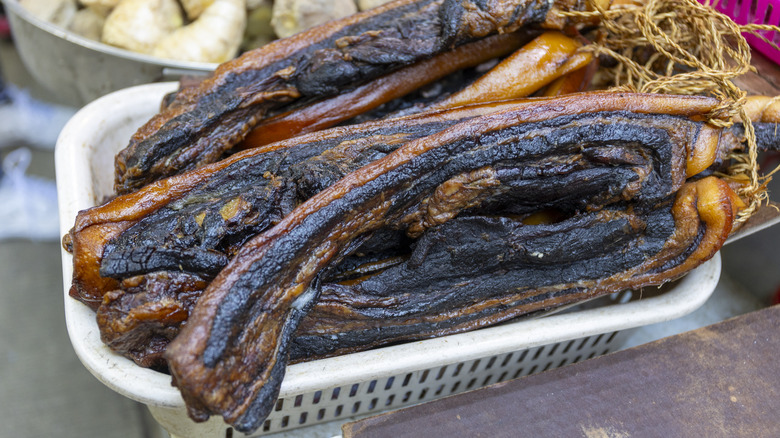
The fact that Chinese bacon is so much better should come as no surprise — after all, they pretty much invented bacon. The origins of cured meat can be traced back to South China in 1500 B.C., when pork was dried and smoked in the winters to preserve for the rest of the year. In contrast, what we know as American-style bacon was only patented in 1924. That is quite the head start. The first difference in how American-style and Chinese-style bacon differ is in the treatment of the meat. While in America, the rind from the pork belly is sliced off before the curing process, the Chinese versions prefer to leave the rind on. This gives the bacon an extra dimension — an enhanced meatiness and chewiness.
The second is the curing process itself. Most commercial bacon we eat is wet-cured, which means it is either soaked in or injected with brine before being smoked. This process is more efficient. In China, the belly is dry cured. A salt-based seasoning mix is rubbed into the belly, before it is dried and smoked. Where wet curing results in a gentle, even flavor, dry-cured meats have a more intense flavor. Also, where American-style bacon is cured in controlled, refrigerated environments, in China the pork belly is hung out in backyards and balconies to dry in the winter sunshine.
Finally, the seasoning. Unlike American-style bacon, Chinese bacon covers a whole range of intense flavors — Chinese liquor, sea salt, sugar, soy sauce, star anise, Sichuan peppers all go into the spice rubs that coat the pork belly. There are many regional versions, too. Apparently, Cantonese folks like their bacon sweet, while in Zhejiang and Shanghai, the emphasis shifts toward soy sauce for a deeper, saltier profile. In Sichuan and Hunan, there is often an additional final step: smoking the bacon over fragrant woods.
How to use Chinese cured pork
Unlike American-style bacon, you cannot just fry and plate up the Chinese version (called Larou in Mandarin and Lap Yuk in Chinese). Once cured and smoked, these strips of cured pork belly can feel quite tough. There are multiple ways to cook this. The first is to steam it. This involves two steps. First, soak thin slices of pork belly in cold water and then blanch for five minutes. This softens the meat and removes the excess salt. Then it is ready for the second step — the actual steaming. Fry some aromatics in a little oil, before placing the blanched pork and steaming it. Adding a layer of potatoes under the meat will soak up the excess fat and make your steamed pork belly less greasy.
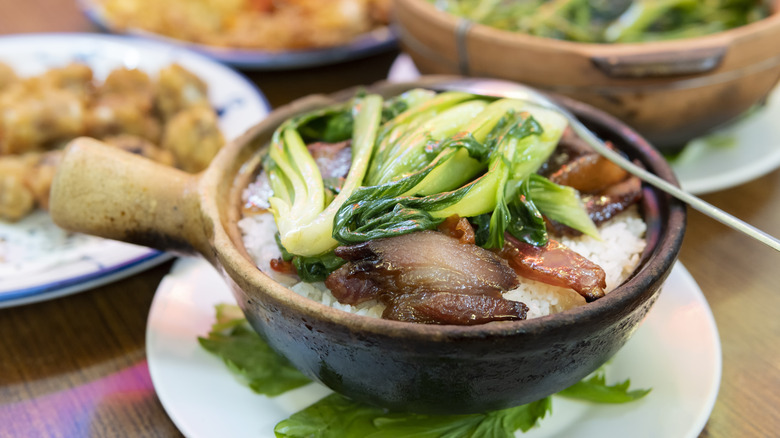
The second way to use your Chinese-style bacon is in a clay pot rice — a dish that made it to our list of 14 Cantonese winter foods to keep you cozy. Alternately, you can just keep things ultra-simple. According to Redditors, just adding it to the pot while boiling rice adds a deep, meaty dimension to it. You could also make a Chinese bacon and cabbage stir fry. Steam and slice the cured pork belly, and then stir-fry it with chopped garlic, dried red chilies, and cabbage to make a dish that's as simple as it is delicious.