

What Store-Bought Rotisserie Chicken's Appearance Says About Its Quality
Store-bought rotisserie chickens have become an essential grocery item for many people, but not all of them are as fresh as you'd like. Easily eaten as a weeknight dinner, or used as a pre-cooked ingredient in dozens of delicious rotisserie chicken recipes, it's one of the best grocery store finds for people who need satisfying food on their plate fast. But with supermarkets pumping out hundreds of these birds every day, and leaving them to sit under heating lamps, quality can be inconsistent at best, even at the grocery stores with the best rotisserie chickens. We reached out to experts like Chef John Politte, the founder and host of It's Only Food, to ask about visual signs that your rotisserie chicken might be subpar.
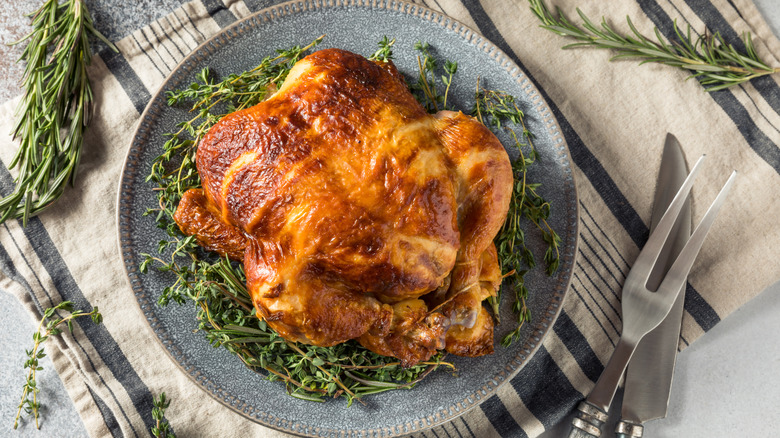
Politte gave us a great guide to positive signs to look for (and red flags to avoid) based on the appearance of your rotisserie chicken. On the plus side he says, "The skin should be an even golden-brown. This means the chicken was roasted well and will likely taste good." Politte also notes that coloring should be uniform around the whole chicken with no real pale or burnt areas. Beyond that, he tells us, "Look for skin that looks crisp and firm, not loose or rubbery." Politte also warns against buying rotisserie chickens that look too greasy, saying, "A little shine is fine, but the skin shouldn't be very oily."
Look for evenly browned rotisserie chicken with crisp skin and minimal grease
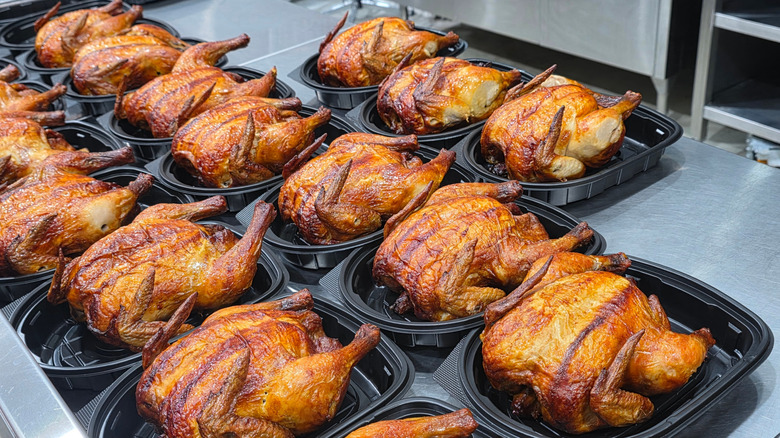
As a key warning sign, Politte explains, "Sometimes, added sugar or glaze makes the skin look too shiny or sticky to cover up poor quality." Once again, skin color is the biggest giveaway. He says, "Chicken that isn't cooked enough can look pale or gray," whereas burnt dark areas are a sign of an overcooked, dry chicken. Since rotisserie chickens can sit out for a long time, Politte also notes, "If the skin looks wet or wrinkled, the chicken may not be fresh." Finally, you want to avoid chickens with lots of excess oil or grease pooling in the bottom of the packaging.
One big thing Politte also looks for is cracked skin, which is a sign the poultry was cooked too aggressively and had too much of its fat rendered out. He says, "While many people enjoy crispy chicken skin, excessive cracking can sometimes indicate that the chicken has been sitting in a heated display case for a prolonged period, leading to further moisture loss."
For some extra advice, we also talked to Caroline Chambers, a cookbook author who recently partnered with Amazon to create a back-to-school meal plan costing under $50. Beyond visual clues Chambers says, "You can always ask your store when the chickens come out fresh, and buy it then!" She also has some good advice for just what to do with that fresh, high-quality rotisserie chicken.
A high-quality rotisserie chicken should be used quickly to prepare easy meals
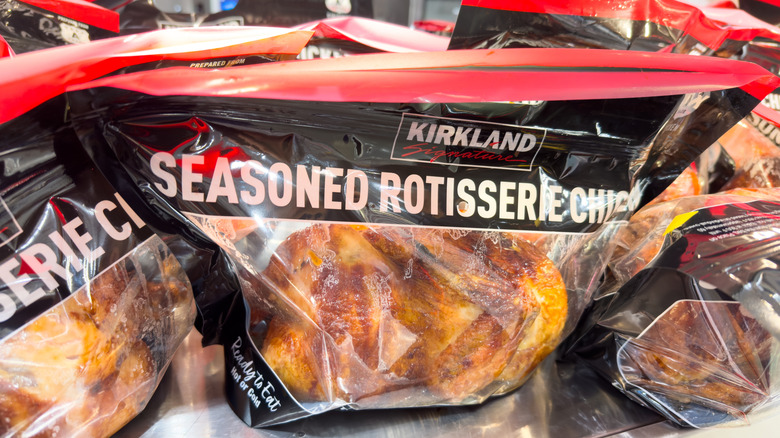
Once you've picked out a good rotisserie chicken, Chambers' first suggestion is shredding it right away, if you plan to use it in other recipes. She says, "The key is to shred it off the bones while it's still hot! It's much harder to do when it's cold." Once your chicken has been shredded, Chambers explains that it will keep in an airtight container in the fridge for four days, ready to be repurposed and added to dishes.
There are many recipes that rotisserie chicken can be added to. As Chambers explains, "It's a lean protein that adapts well to almost any flavor profile. Mexican, Italian, Thai, you name it." Beyond a chicken enchilada stew that Chambers features in her back-to-school meal plan, she also says rotisserie chicken makes a great protein for taco night, especially when dressed up with cheese, sour cream, and salsa. She notes that the chicken is even a great addition to any pre-made salad, and personally recommends introducing it into a grain salad. For an easy recipe, Chambers says, "Cook some grains and toss with some arugula, rotisserie chicken, shredded carrots, feta, golden raisins, and a balsamic vinaigrette." She also likes to add the shredded protein to curries, which can be made quickly with coconut milk and curry paste or powder (like our Thai chicken curry recipe). Of course, if the chicken is good, there's nothing stopping you from eating it straight up with some great rotisserie chicken sides.