

If Your Frying Pans Tend To Warp, The Culprit Might Be Your Stove — Here's How

Have you ever had one of those frying pans that you've used forever? When you put it on the stove top, maybe you have to adjust it to get it to sit as flat as possible. Otherwise, it'll wobble back and forth a little bit. The bottom has dark spots across its surface, and the metal is slightly warped and uneven after years of use. You may think this is just a symptom of your cookware getting older, a natural side effect of regular use, but the problem might be how you are using it. It's often the result of using burners that are too small.
If you put your largest frying pan on your smallest burner, the heat is going to be concentrated in that limited area. That means the metal is going to heat up faster and hotter in one spot, while the rest of the pan remains cooler. Remember that the atoms in materials like metal expand when heated and contract when cooled. Because it's not heating evenly, this can cause the metal to warp. The problem can be worse if it's a thinner or lower-quality pan, as well. A 2016 article in the journal Applied Thermal Engineering showed that variables like pan materials, thickness, and size had a strong effect on how efficiently they conduct heat.
Constant, uneven heating will cause stress in the metal of your cookware. Even if it shows no sign at first, over time, this stress will distort the metal and make your pan uneven, which then exacerbates the problem. To avoid that as much as possible, watch out for these cookware red flags.
Warp speed ahead
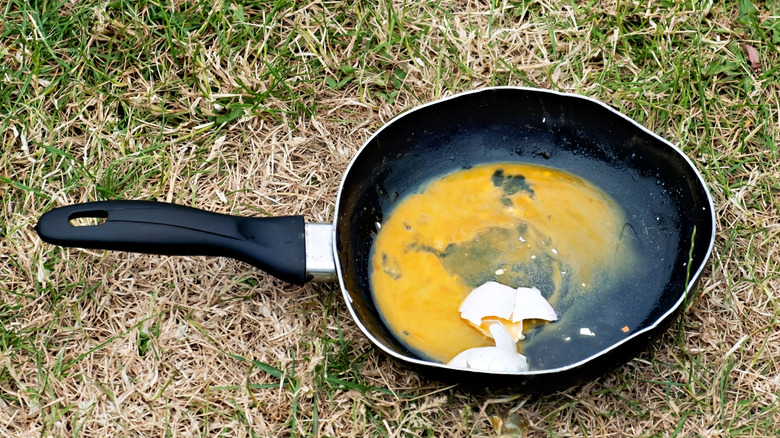
You can try to prevent warping by making sure your pan isn't larger than the element you're heating it over by more than an inch. Make sure both the cooktop and the bottom of your pan are clean before they come together. Grease, water, or other materials can cause uneven heating between the element and the pan.
Using high-quality cookware is also a way to ensure longevity. The cheaper a pan is, the more likely it is to be made with low-quality or thinner materials that can't hold up as well to long-term use. Even cast iron can show signs of wear and tear, though. Make sure you're not subjecting your pans to temperature extremes, too. That means don't take your pan directly from the burner and put it in a sink of cold water, which is the quickest way to ruin it.
If you're already dealing with a warped pan, all is not necessarily lost. If it is something you do not want to replace, there are a few fixes that may take a little elbow grease. If you have minor warping, you can try some home blacksmithing. Heat the pan over low heat, then transfer it to a towel on a flat, heat-safe surface. With another towel in the pan, use a hammer to try to bang the surface flat again. You have to be confident in your skills to try this method, and it probably won't work on a severely warped pan. For that, swap the towel with a wooden block to act as a buffer as you try to hammer the misshapen surface flat. If that fails, you just might need a new pan.